Jan. 27, 2011: Doubles Trouble…Disguised and Confused

Julie M:  Okay, I’ve got a question.  Why are fraudulent and duplicate identities such a popular theme in Indian film? American films don’t do it so often–well, maybe they do in stupid farces I don’t watch–so what’s so attractive about the theme to Indian audiences? Maybe a secret wish to pretend to be someone that has a different kind of life? To experience a kind of reincarnation without forgetting previous lives?

Jenny K:  They certainly do use the theme more than we do, but it is a classic back to Shakespearean plays and beyond. Of the ones we’ve done already, there’s Rab Ne Bana Di Jodi, which I watched again last night on Netflix (liked it better this time), Don 1&2, the second half of DDLJ, etc. Lots of others we haven’t talked about, like Shah Rukh in Duplicate. SRK doesn’t seem to want to be himself very often, does he? Or some say, he’s always being himself. Oh well, it worked for Spencer Tracy and Katherine Hepburn…


Julie M:  Is there an Indian actor of major status who has NOT done a double role like this?


Jenny K:  A double role or a disguised role? But I think for the men it’s a no to either question. I think there are a few of the women who have done one or the other, and a few that have done neither. Women, I guess are supposed to be dumb enough to be fooled but not men…

Julie M:  Well, I guess you can count Rani’s second identity as the prostitute in Laaga Chunari Mein Daag, but it’s not like she was trying to deceive anyone, just protecting her own honor, somewhat.

Jenny K:  It’s just not as often that you see the women do this kind of thing. Rani and Abhishek both did lots of identity shifting in Bunty Aur Babli, but that isn’t quite the same thing.

Julie M:  No, it’s not…the whole plot of BaB is the crime spree:  the alternate identities just helped them pull it off.  Although, the reason they did the crime spree in the first place is because they wanted to distance themselves from their failures as their actual selves…so it does make a weird kind of sense.

Jenny K:  Kajol has had at least one twin role that I remember, in Dushman.  Never seen Aish do either, to my recollection. Preity and Ajay pretend to be rich players in Yeh Raaste Hain Pyaar Ke, that also ends up with Ajay playing a twin role. Then there is Khal Nayak where Madhuri takes on a false identity.

Julie M:  Duh, Khal Nayak. I just saw that.

Jenny K:  I’m sure there’s more…Wait. Haven’t watched it yet, but Rani pretends to be a man in Dil Bole Hadippa! so she can play cricket, but then falls for Shahid. Got it in my queue at Netflix. She must have been the tiniest Sikh guy to ever wear the beard.

Julie M:  Maybe women-pretending-to-be-men, a la DBH!, in order to achieve something that is denied to women by the culture is a different issue? DBH! is very Shakespearean as well. Like Twelfth Night, recently made into the delightful-ish 2006 teen comedy She’s the Man, where a girl pretends to be her twin brother so she can play soccer and falls for a guy on her team.

Jenny K:  That’s really loosely Twelfth Night, isn’t it? Viola pretended to be a boy to save her own life…a woman alone in the world back then was in desperate straights…she wasn’t doing it to achieve something she couldn’t have as a woman. She thought her brother was dead, too, not that that is a particular issue, but it adds to the pathos. In the US we tend to do more body-switching or regressing films to “show how the other half lives,”  films like 17 Again (which I loved)/Back to the Future/Freaky Friday and that more recent one with Ryan Reynolds and Paul Rudd that seemed too crass to watch, so I didn’t. We seem to like it better when the characters have little or no control over the switching. I wonder why that is?

Julie M:  The Change-up, and it’s Jason Bateman, not Paul Rudd.

Jenny K:  Six of Juan, half a dozen of his brother… 🙂

Julie M:  Nah, Bateman is a much better actor…and technically B to the F is time travel with the characters playing themselves in the past/future, but I see what you mean. To me, body-switching plots in American movies tend to be for the purpose of learning how to empathize. (except for the action movie Face/Off—where it’s for evil—but that’s not body-switching, just face-switching) Maybe it’s a Christian thing–walk a mile in another person’s shoes etc., but what do I know from that, I’m Jewish–and I think that is culturally more attractive to Americans particularly when it’s a switch between generations. Adults always say they want to go back to high school, knowing what they know now, right?

Whereas dual- or alternate-identity plots in Indian film seem to be for the purpose of trying to cram two different lives into one normal lifespan, and may be more attractive in Indian culture.  But here’s a rare Indian body-switching AND gender-switching plot—Mr. Ya Miss—sounds a lot like the awful Rob Schneider film The Hot Chick.

But all this is very different from dual-role movies, where one character is the visual double of another, generally an opposite-personality type, both played by the same actor, and that is the basis of the plotline.  Sometimes one dies and the other replaces him (Kaho Na Pyaar Hai).  Sometimes they turn out to be actual twins but separated, so that one is unaware of the other’s existence (in which case, the purpose seems to be to heighten the story’s melodrama). That, I think, plays with the popular notion/fantasy that everyone has a doppelganger somewhere, and what would happen if they came into the same life-space at the same time.  I found a fun slideshow of recent and famous dual roles.

It’s also a way to get hot or new starlets some extra screen time, particularly when one of the characters is evil or likes to wear revealing clothes (or both):  I refer you to Bipasha Basu in Dhoom 2 and Deepika Padukone (ick) in Om Shanti Om and Chandni Chowk to China (ick) as two examples. So, women seem to get these kinds of roles although they don’t typically play characters with alternate identities.

(warning:  my inner nerd comes out here)  I thought this was pretty cool about why superheroes have been popular as alter egos á la Ra.One, and also sheds light on why dual identities are popular:

“Reincarnation is par for the course. It can be a cosmic pathway for attaining an alternate identity, sense of self, or supreme liberation… Women, who can often be powerless in the real world, can channel the divine female energy to break social convention and triumph over evil.”

Jenny K:  I still stand by my statement that the girls do the double roles much less frequently than the guys do.  My theory may have something to do with watching Pat and Kathy go crazy at every version of SRK that they can possibly watch, the more the better.  Cases in point:  Ra.One and Don 2, every different identity and/or disguise, and even every different makeover elicits hours of post-show dissection. The girls, not so much.

Julie M:  Aha!  Then this probably explains it:

“Audiences have always loved to see their favourite hero in two viable characters where one is shy and the other is daring at an exciting price of single ticket.”

And if the hero is hot…well, who can blame them?!

Speaking of alternate identities, I recently had fun with the comedy Chachi 420 (Aunty Fraud, 1998) despite its being a direct rip-off of Mrs. Doubtfire (1993). The basic plotline of the two movies is identical: a man, faced with losing the right to see his kid(s) as he and his wife divorce bitterly, disguises himself as a woman so he can get a job as their nanny and stay in their lives. Both characters face complications trying to maintain their dual identities. The differences in details and ending, though, are emblematic of the vast differences between Indian and American culture, and where the comedy comes from is likewise wildly variant.  I think may help shed light on why alternate-identity films are so popular.

To start with, the basis of the separation of the men from their children is very different. Jai (Kamal Haasan—who also directed the film), the dad in Chachi 420, has very limited visitation with his young daughter because the divorce was granted on the basis of fairly minor “cruelty” to his wife Janki (Tabu).  Not much chance for comedy there. In the American version, a culture where joint custody is pretty much the default in divorce judgments except in extreme circumstances, dad Daniel (Robin Williams) was refused joint custody and given only weekly visitation with his 3 children because he was an unemployed voice actor and generally an irresponsible person.  Voice actor=funny.  Irresponsible=funny.

The relationship of the father to the ex-wife is different, as well.  Jai still loves Janki dearly and hopes for reconciliation (another motive for trying to get closer to the family), but Daniel understands that his relationship with his wife (Sally Field) is at an end–for him, it’s all about the kids.

Both films have comedic love sub-plots. Daniel’s wife has a boyfriend that Daniel works to crowd out of the picture, as he doesn’t think he’s good for the kids (and he’s a bit jealous as well)–how he undermines the boyfriend is very funny but is not the main source of the film’s comedy, which derives from Robin Williams dealing with being in a dress, learning to cook and clean, and having to switch identities in seconds to keep from being found out.

But in Chachi 420, Janki’s widower father falls in love with Chachi, as does Jai’s landlord, and a good portion of the Indian film’s comedy is in Chachi trying to evade their advances. That, and seeing how Chachi beats people up: there is an extended fight scene in a marketplace that is pretty funny, done in South Indian filmi fashion with Chachi standing in for the character normally played by Rajnikanth, but it goes on way too long. Sorry, I can’t find a clip of that scene, but trust me, it’s hilarious.

Jenny K:  So they combined Mrs. Doubtfire with Tootsie, it seems, with the older suitors thing, and doubled it, just to make sure we got the joke!

Julie M:  The reveal scenes where the dual identities are discovered are also very different. In Mrs. Doubtfire, the reveal takes place in public, in a restaurant, where Daniel has to go back and forth between two tables in his different personas and ultimately slips up–and is absolutely hilarious. In Chachi 420, it’s much more serious.  Jai (as Chachi) saves his wife from drowning herself in a river once she realizes how she drove Jai away and that she still loves him; he reveals his true self to her (and her alone) to keep her from continuing suicide attempts.  They reconcile and reunite the family, inventing a tragic death for Chachi.  Mrs. Doubtfire‘s Daniel and his wife never reconcile, but he does end up with a new job hosting a kids’ TV program in the persona of Mrs. Doubtfire, which proves he is responsible enough for a joint custody arrangement.

Jenny K:  You can usually see where the “homage” directors are drawing from the originals, and that’s part of the fun.  I’m, in most cases, pretty good at it…but the suicide on the bridge thing has got me stumped.  Where did that come from?

Julie M:  Oh, that was totally out of the blue. She sees Jai (who has been promoted from choreographer’s assistant to head choreographer on his current film) on TV giving an interview. Jai goes into detail about how he has two children, his 5-year-old daughter and his ex-wife who acts just as childish, and this triggers an extensive flashback as to how they met–very cute, she hit him with her car on a film set–fell in love, eloped and had their daughter.

She realizes how great Jai really is, and she runs to his house to find him, only to find a bunch of Chachi’s clothes and Jai’s dance assistant. (the assistant thinks Chachi is Jai’s housekeeper) Janki leaps to the conclusion that Jai is seeing both the assistant and Chachi, and this prompts her to throw herself off a bridge instead of, hm, I don’t know, leaving him a NOTE??!!!

Jenny K:  You and I obviously don’t feel things deeply enough.  I’ll try to do better.

Julie M:  It’s also a testament to Kamal Haasan’s acting talent that he makes a really good woman. Robin Williams does not–and that’s the funny part of Mrs. Doubtfire.  Here’s the first public appearance of Jai as Chachi.

Jenny K:  I see what you mean…he does look nice…only his forearms give him away. I don’t think I would have recognized him. He is a wonderful actor, though I think I’ve pretty much only seen him in his dramas and not seen his comic side before.

Julie M:   What I thought was funny is that as Chachi, he tucks the front of his sari back between his legs like he is wearing a dhoti, and nobody seems to notice. And throughout the film his fake boobs get bigger and bigger–he is positively svelte in that first reveal scene compared to later in the movie.

It’s also telling that Kamal, in the Jai persona, is a complete straight-man, while as Chachi he’s doing the comedy. It’s like he doesn’t want to pollute peoples’ visions of him as a dramatic actor.

January 18, 2012: Lies, Cries and Family Ties

Now that the festive time of year is good and over, it’s about time to turn away from the entertaining desserts of rom-coms and high adventure (bungeed villains flinging themselves off high-rises, indeed!) and settle in for a very hearty meal of Indian issue films. We found, from three different decades, three serious films and many amazing performances.  Bon Appétit!


Julie M:  Today’s feature was Rudaali (The Mourner, 1993). It was a fairly artsy film, directed by Kalpana Lajmi (niece of Guru Dutt) who also directed Chingaari, which I think you had recommended to me at one point.

Dimple Kapadia stars as Shanichari, a poor, low-caste village woman in Rajasthan with an extremely hard life. As the film opens, she is a youngish widow who is temporarily hosting Bikhni (Rakhee Gulzar), a professional mourner (or rudaali) called in to await the death of the local wealthy landowner or zamindar (Amjad Khan, most memorable as “Gabbar Singh” from Sholay, in one of his last film roles). She tells Bikhni her story: her mother abandoned her in infancy, her father died when she was young, she was married to a man who drank most of his wages and she has a retarded son. In flashbacks covering about 20 years she tells of the attraction between her and the zamindar‘s son, which turned into a job as maid to his mother and an illicit affair.  This haunting song, which is sung as Shanichari is remembering the affair, is probably what anyone knows about the film: 

When the zamindar first gets sick she is turned out of the house, and things go from bad to worse. Her mother-in-law dies, then her husband takes ill with the plague and dies, her home (a gift from her lover) is taken to pay the debt on his funeral rites and she and her son become indentured to the zamindari family for 15 years’ hard labor. Still she remains dry-eyed and resigned to her plight, even when her son (Raghuvir Yadav) impregnates a local whore (Sushmita Mukherjee) and marries her, then she aborts the baby. Her son runs away, and still she remains stoic. She asks Bikhni, who used to be an actress, how she can cry real tears for people she has never met when she can’t even cry for all the things she could cry about, namely, that everyone she’s ever loved has left her.


Jenny K:  That Raghuvir Yadav is a surprising one…he’s in practically everything, especially when they need an affecting performance from a smallish but pivotal role.  Does that in Salaam Bombay, too.  In that one he surprised me by being rather young and handsome…never had seen him that way before.  Just goes to show that we all have our day.


Julie M: I recognized him right off, but I didn’t get that he was supposed to be slow until later in the film when they talk about it.  I thought he was just ornery.  Anyway, while talking about all this stuff Shanichari and Bikhni grow close.  Here’s the song where Bikhni comforts Shanichari after hearing her story, and Shanichari learns what it is like to be taken care of.

Afterwards Bikhni is called away on a mourning job. Unfortunately, she catches plague while she is away and dies, sending Shanichari one last message: Bikhni is, in reality, Shanichari’s long-lost mother. This news releases Shanichari; she is finally able to mourn everything that has happened to her, and she takes Bikhni’s place as the rudaali, becoming famous for the sincerity of her tears and intensity of her wailing.


Jenny K:  Well, if she couldn’t mourn sincerely after getting a bombshell dropped on her like that, she would have to have been made of stone!  Poor thing.


Julie M: Dimple Kapadia is, in a word, AMAZING in this film. She convincingly plays a young woman, a slightly older widow, and a supremely beaten-down, old-before-her-time crone. It’s quite an emotional (but not melodramatic) film, and she proves herself up to the task. This film is not to be missed.


Jenny K:  I haven’t seen Rudaali, yet, but it sounds great…not a light amusement, of course, but interesting. And Dimple will always be one of my favorites. She always puts all of herself into a role, like the one we discussed in Being Cyrus, she is just totally committed to her character, whether or not it’s a flattering one.


Julie M:  She was definitely the best thing about Hum Kaun Hai, for sure!  Can’t wait until I get hold of a copy of Bobby so I can catch her at the beginning of her career.

[a few days later]

Julie M:  I watched Fiza (2000) this afternoon. Compared to Rudaali it is not at all arty, but it is serious and highly melodramatic, which normally I get impatient with, but my jaw continually dropped at Karisma Kapoor’s fabulous performance. Whenever she was not onscreen my attention wandered… except, of course, in this “preparing for the action” scene, which I know was put in to please the ladies. Nice foreshadowing of Hrithik’s Dhoom 2 role–dead serious and focused.

Jenny K:   I was sort of sorry when Karisma took a kind of backseat to her baby sis, Kareena.  Not that both don’t do good work, but I think that Karisma tends to be overshadowed sometime by Bebo’s gift for finding the limelight.  She isn’t always involved with lightweight fare as in Andaz Apna Apna [shudder] or Dil to Pagal Hai.

Karisma’s the best thing in Shakti, playing a distraught mother taking an active hand in saving her son from the influence of his psychopathic grandfather (Nana Patekar in full scene-chewing glory) and is quite wonderful in Zubeidaa, as a film actress in the ‘50s on her way to the top, who marries a prince and yet doesn’t live happily ever after.  Rekha and Manoj Bajpai are with her in that one; strong performances all around. Maybe a bit too weepy for you, not sure, but you will like the score, all Rahman!  

Julie M:  Well, never fear, she’s back!  In Fiza I really liked Karisma’s “girl power” dance number, taunting her boyfriend for not liking her the way she is.

But I’m getting ahead of myself.

Brief plot summary: It is 1993.  Fiza (Karisma) and Aman (Hrithik) are Muslim teenagers living with their widowed Ammi (Jaya Bachchan) in Mumbai–they are a a very cute and close family. One evening Hindu-Muslim riots break out; Aman rushes out to see what’s going on and is not seen again. Six years later he is still missing. Fiza is sad but has grown accustomed to his loss; however, the distraught Ammi still visits the police station weekly hoping for news. While out on a job interview Fiza spots Aman in the city and hope is again rekindled: she pawns the family jewelry for bribe money, causes a ruckus in the press and with politicians, disrupts her relationship with her boyfriend, and eventually tracks him down on the India/Pakistan border, where he has become a jihadist. The story of what turned him in that direction and what happens next (and next and next) is the stuff of high drama and even higher melodrama. Yes, people die.


Jenny K: You sound so happy about that…so bloodthirsty!


Julie M:   Well, I thought I ought to warn people.  It’s quite unnerving, actually, and I think something like this would not have been possible in mainstream film until Dil Se’s paving the way a couple of years previous.


Jenny K:  It’s funny that they named it Fiza if it’s all about war and terrorism.  I looked about online, and it translates to variations on “a pure wind filled with love and romance” to “God’s Blessing”.  In either case, it seems a strange title.


Julie M:  Maybe it’s supposed to be ironic, since he’s a terrorist?  Hm.  Unfortunately the filmmakers kept breaking the mood by putting in item numbers like this one with Sushmita Sen, and this equally random, but depending on your orientation a much more interesting one, with Hrithik. 

I understand why they’re there–otherwise it would be an overly intense film–but they do not advance the plot or provide useful characterizations, and I found it difficult to get the mood back to the main action afterwards.  It could be for this reason that the film tanked a bit in the box office.  My favorites were the ones that added rather than distracted, like this one with music by A.R. Rahman.


Jenny K:  Weird…A Rahman song in the middle of an Anu Malik soundtrack.  Wonder what went on there.  Not at all usual, as they are more often competitors…story there, I daresay.


Julie M:  Well, it was a qawwali (Sufi devotional song), and seemed to call for a specialist, and they couldn’t get Nusrat Fateh Ali Khan?  All in all, it’s a great message film–“we are all Indian no matter our religion”, a message that even the jihadist Aman is fighting for–and fabulous performances by all three lead actors make this a win.   Even though it was only his 2nd film released (first one that he actually signed to, which is an interesting fact), Fiza showed Hrithik as much more than the chocolate hero he was in KNPH. Well, at least the second half of Fiza did.  The first half showed him to be too sweet, and I am not a fan of him in sweet parts.  All my thumbs and big toes are up for this one, which I think may make my Top Ten up near Dil Se.


Jenny K:  I may have to watch it again when it comes back in the returns…I don’t remember being quite that impressed by it. Not that I disliked it, or anything, but it was just so-so for me.

[the next week]

Julie M:  I really loved Salaam Bombay (1988). Mira Nair is a genius. Much like I did with Deepa Mehta’s Water, I loved how the film was unafraid to portray the gritty and unpleasant reality that Bollywood likes to cover up–the street kids, the prostitutes, the drugs, the poverty and the dirt. You mentioned Nana Patekar’s performance–while I liked it, I thought that Raghuvir Yadav was the stronger actor in this film as the drugged-out older best friend of the street boy Krishna. No wonder this is ranked among one of the best films ever made, and why it didn’t win the Best Foreign Language Picture Oscar in 1989 is a mystery.  (oh, yeah, because it was some Scandinavian film, urk)


Jenny K:  I know!  No accounting for taste.  It was more impressive, still, when you realize that SB was Mira Nair’s first full feature film.  I watched it again last night, first time since I started all this Bolly-madness, and it is even more deeply affecting, now.   She certainly knows how to spot good talent.  As to Nana, I liked his performance, but in this film I’m remarking more on his presence…just electric.   I’m glad you pointed out Irrfan Khan as the scribe or I might not have noticed.


Julie M:  Although this film is relatively plotless, the episodic narrative concerns Krishna, a young boy who ran away from his village home after a misunderstanding and makes his way to Bombay, where he lives on the street, selling tea, plucking chickens and even turning to crime as he tries to earn enough money to return home and make up for what everyone thought he did wrong. It’s just heartbreaking.  The adults in his new life include Baba (Patekar), a drug kingpin and a pimp; Rekha (Anita Kanwar), Baba’s prostitute-girlfriend and mother of young Manju who has a crush on Krishna; and Chillum (Yadav), whom we understand to be a grown-up street kid who is also an addict and a runner for Baba.


Jenny K:  This was only Raghuvir’s second film.  Can you believe it?  So talented even at that inexperienced stage.  He’s done so many things since then.  Did you know that last year he even played Hitler?  Yep. 

Julie M:  Here’s the beginning of the film, where the runaway Krishna has joined a traveling circus and is abandoned by them, occasioning his relocation to Bombay.  

Jenny K:  The kid who played Krishna, Safiq Syed, was wonderful, too.  Won an award for best child actor that year, but only managed one other film in his career, one called Patang, about four years later with Shabana and Om Puri.  The plot sounded similar from a description I found…small group of thieves that worked the trains for food and loot, mostly children, led by a Fagin-esque Om, who was in love with Shabana’s character, yet another prostitute with a heart of gold…her son, Shafiq, bears the burden of Om’s interest.  I can’t find it available anywhere.  Well, Safiq’s now repairing and driving autorickshaws for a living.  The fickle hand of fate.


Julie M:  My understanding is that he wasn’t really an actor, he was just a street kid that Nair found.  She also filmed the brothel scenes in a real brothel, and the madam in the film was the actual madam of that brothel.  How she got such amazing performances out of non-actor people…it was more like a cross between a fiction-film and a documentary.  If you want to catch it, most of  Salaam Bombay seems to be on YouTube, subtitled in English, but in a lesser resolution. Here’s part 1 (of 12).

I would rate this a MUST WATCH, not just for fans of Indian film but for fans of any kind of film, in any language.

January 8, 2012: Starting the New Year With a Bang

We just can’t escape action films, even though it was the HOLIDAYS, for gosh sake… and everywhere we turn,  people are shooting at us or each other (some in IMAX and 3D)!   So, rather than fight ’em, we decided we might as well join Messers Cruise, Craig and Downey and give in.  But Bollywood has it’s own take on hair-raising, guy-friendly escapism and we watched a bunch of them over our break, including Don 2.  Here’s our take on three, or toke, given the title of the first one!


Julie M:  Dum Maaro Dum (Puff, Take a Puff, 2011) is a violence-infused action/thriller about the attempts of one man to single-handedly clean up the contemporary drugs-and-gangsters scene in Goa. This trailer pretty much shows the visuals and style of the film.

The title/item song is a remake of this number from 1971’s Hare Ram Hare Krishna.

 
Jenny K:  It was funny…when I watched your trailer, I thought of the Hare Ram, Hare Krishna movie, but I didn’t recall at that time that that was the name of the song. It was one of Dev Anand’s first films as a director, and Zeenat Aman’s first big hit.  I believe it caused a big to-do with all the drug takin’and the implied free lovin’.

 
Julie M:  Abhishek Bachchan plays the one-man, ACP Vishnu Kamath, an ex-corrupt-cop with a new mission to set things right because his family (Vidya Balan, in a cameo appearance, plays his wife) was killed in a car crash with a drugged-out driver.

Vishnu chases various figures including a small-time player named Ricky (Gulshan Devaia), a reluctant “businessman” named Lorry (Prateik Babbar), an elusive capo-dei-tutti-capi named Michael Barbossa (hey, wasn’t he a pirate?) and, with perhaps the funniest criminal name in Indian film, Lorsa “The Biscuit” Biscuita (played by Aditya Pancholi).  There are the requisite scantily-clad females as well: Bipasha Basu plays Zoe, Biscuit’s second-in-command and girlfriend, there is a pass-around chickie named Rozana (Mariah Pucu Gantois Gomes), and Deepika Padukone steps in to gyrate as the item girl in the title song, which takes place at a rave about two thirds of the way through the film.  


Jenny K: I still think Zeenat Aman was much sexier than Deepika, even given how overtly sensual DP’s choreography was. Just my old-fashioned opinion.


Julie M:  Similar to Yuva, the main action starts with Lorry getting busted for carrying drugs at the Goa airport and then splits off into flashbacks showing how each of the characters got to that point, then picks back up and moves forward through to the end. It would have been interesting as a technique, except Yuva did it first, and DMD added some very headache-inducing half-time and double-time sequences as well as half-screen double-images (yikes) to heighten the sense that it was in the characters’ memories.  Supposed to be hip and cool, but seemed overly self-conscious to me.

There is one character common to all the stories: the singer Joki, yummily played by Rana Daggubati, check him out in this song.   He’s kind of like a visual narrator since he is the only one who seems to appear in all the various story threads, and he gets to have a hot love scene with Bipasha (thereby standing in for all the males in the audience…).

Things really get going after the drug bust, as Kamath and his team work into the organization and go after Barbossa. Lots of people die, some spectacularly, some gruesomely. And while the end is a perfect revenge fantasy, you get the feeling that it is only a temporary lull in the permanent party-and-kill scene.  No wonder this film aroused the ire of the Goa tourism people.  [youtube-http://movies.ndtv.com/movie_Story.aspx?id=ENTEN20110173562&keyword=&subcatg=]

Abhi does OK in his role, a little wooden though, and as the film started I thought to myself, “Gee, I hope he doesn’t rap in this movie.” Alas, he does, talking about how good it is to be a corrupt cop (ugh). This video intersperses scenes from the movie with scenes of the song, because nobody should see the rap video in its entirety.


Jenny K: His dad still does it better, of course, example from Aladin.  Sorry, Abhi…


Julie M:  Overall, Dum Maaro Dum is a stylishly made, but ultimately not very interesting, gangster movie that caters to the under-30 set (although if that’s true, why Abhi was chosen as the star completely defeats me). I thought it was merely OK.

[a day or two later]

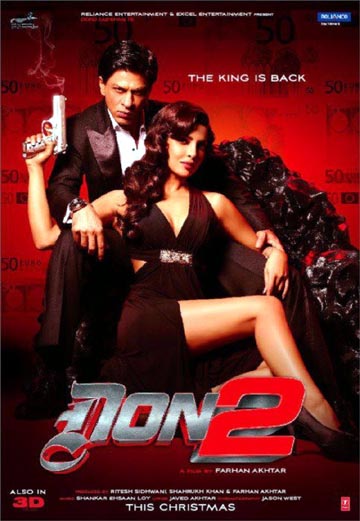
Jenny K:  Well, I finally got to see Don 2 today…and I’m not sure that you should see it. You always complain when there is too much dishoom, and this film is dishoom to the max.

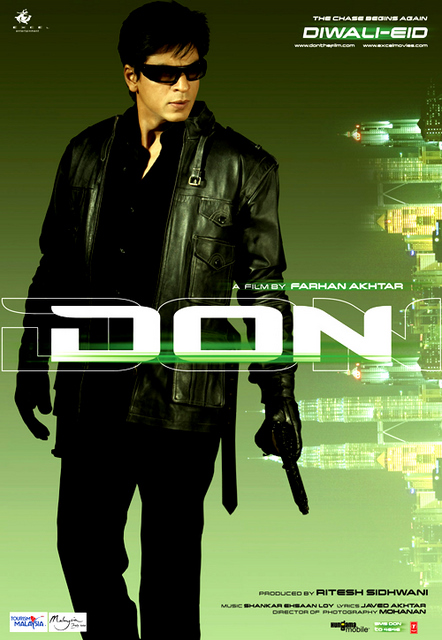
This is the sequel to Farhan Akhtar’s popular remake Don (2006) [Amitabh starred in the original] in which Shah Rukh Khan essays the double roles of the South Asian Kingpin of Crime, the titular Don, and his simple but sincere doppleganger Vijay. In this follow-up film, I am really missing Vijay, because there’s no simple or sincere focus in the entire movie, and I, for one, had no one to root for.


Julie M:  True, I sincerely dislike pointless and gratuitous dishoom…although our holiday entertainment has been a complete re-watch of the four Die Hard movies, which I love. Maybe it’s just Bruce Willis.  But I liked the Vijay character, particularly in the original 1978 Don, and if this film has gone another direction then I question the wisdom of even going.  And my common complaint about most Indian action films is that so few of the stars can dish out a punch without my wanting to laugh hysterically at its awkwardness.


Jenny K:  I will agree with Kathy, my co-viewer that day, that the fight choreography looks much more convincingly done, even making it seem plausible when the often physically smaller SRK gets the drop on his larger combatants, however, it is pretty much relentless. I’m hoping Shah Rukh has finally exorcised his Jackie Chan fantasy, and can get it out of his system.

The thumbnail synopsis has Don being singled out by the European drug tsars for a hit, because he’s so dangerous to their business…so Don develops a very convoluted plan to turn himself in to protect himself from their reach and secure himself with immunity for his past crimes by providing the authorities with names, dates, etc. in their quest for these other drug dealers. Seems he’s “tired of his life of crime”…oddly, the powers that be (returning in their roles as the police investigators, Om Puri and Priyanka Chopra) don’t really buy it and toss him in prison.

Ah, but that’s all part of the plan…Don always has a plan…far-fetched or not…and always assayed with consummate style.  SRK is at the top of his game in style, slickness, suavity and any other S-ettes you can think of, but I find I’m hard pressed to be engrossed in a caper film of almost three hours long, when the “hero” is so enormously ethically challenged. He’s ruthless, he’s a player with girls and lives, a major egomaniac, and he has the largest custom fitted designer wardrobe ever sported by a recently released jailbird.


Julie M:  Since I’m still recovering from a cold, and it’s snowing like crazy, and I’m back to work tomorrow, and this seems like a typical Hollywood-style action crap-fest, I will skip an attempt to see Don 2 in the theater today. If it’s still around over the weekend I’ll consider it, but if I don’t get there, I’ll just wait until it’s out on DVD. I’ll get my SRK fix another way.


Jenny K:  Definitely not a “crap-fest” but… He’s The King, as everyone in and out of the film constantly tells us.   And HE’s BACK!  And THE CHASE CONTINUES…and continues…and continues…as I dozed…once…in the seemingly endless set up to the caper in the bank. Which wasn’t too bad, given the sheer lack of sleep I’ve had for the past two weeks of holiday run-up. Needless to say, Kathy disagrees with me on almost every point of this assessment. She loved it. Eh, it may just not be my type of film.

However, the most fun I had with Don 2 was watching this promo reworking one of the songs from the earlier film to get us into the theater for the new “adventure”. Shah Rukh looks amazing in it, and looks like he’s having a great time…and is a bit tongue-in-cheek in his swaggering here, which is something the movie as a whole could have used more of, as does Robert Downey, Jr. in almost any of his genre films.


Julie M:  WOW.  So ishtylish. If the whole movie were like that I’d go, but since you say it isn’t, I’ll wait for the DVD and I can fast-forward through the dishoomiest parts.   SRK looks kinda gaunt underneath the perfectly-fitted leather jacket, though. If he looks that skeletal in the entire film, ugh. Get that man some parathas, stat.


Jenny K:  If you fast forward through all the dishoom in Don 2, you ‘ll have about 22 minutes left…hehehe… and as to his look, almost all the outfits were stylin’. Lots of leather. And no odd tie/shirt combos like in the last Don film. Priyanka and Boman looked very well groomed, too.

All my style issues were with Shah Rukh’s hair. In about two thirds of the movie, I think he looked pretty good, even with occasional “leftover Ra.One hair moments”, Kathy’s phrase. The long hair phase was about twenty minutes or so, and was too girly for him, especially pulled back at the top  (even with the shotgun)…however, I liked the facial hair that went with it, and thought he should have kept it for a transitional phase, but he didn’t.  At the end, he rides off on a motorcycle with his Ra.One  “South Indian” curly locks blowing in the breeze.  Very fetching.  End of SRK Hairscaping. Glad you liked the video clip…I had to watch it more than once, myself.


Julie M:  And did you notice that in all the Don 2 publicity shots, Farhan’s muscles have gotten way out of control?


Jenny K:  Haven’t seen any of them…show me what you meant. Would be a shame if he wasted that sexy boy-next door thing he has going.


Julie M:  Oh, gosh. Here’s one.   And another.  And here’s a possibility as to why the new physique.


Jenny K:  Hmmm.  Here’s the older article about Mehra’s casting ideas on this film.  Farhan’s pushing it a bit playing 22, and he’s much better looking than Milkha Singh, but, if they’ve decided to not go with an unknown…Farhan is better than most, but I think I might go with that kid from Udaan first, Rajat Barmecha. He’d be almost the right age now and had quite a lot of potential in that film.


Julie M:  Whoops, so much for an unknown. Oh, well, something else to watch Farhan in.  By the way, you need to send me Rock On! and Karthik Calling Karthik.  Because I just did my first official Indian film re-watch, of ZNMD, and I need more Farhan, and I know you can hook me up.


Jenny K:  Now, I don’t buy everything he’s in…almost, but not everything.  I can send you Rock On! but I don’t think I bought KCK.  It was good, but spoiled itself a bit with an added-on, unnecessary happy ending, IMO.

[a couple of days on]

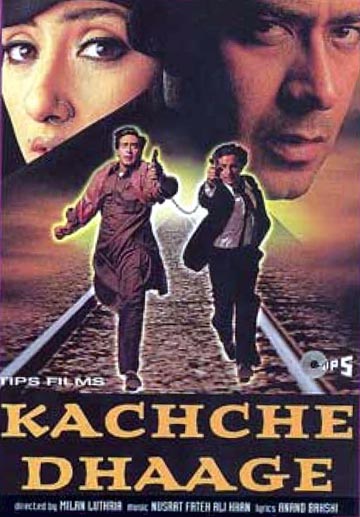
Julie M:  While lying around today trying not to be sick, I watched Kachche Dhaage (Raw Threads, 1999). I thought it was a decent action movie with a gratuitous couple of love stories, without which it could have been a great action movie. Check out this “making of” feature, which does not spoil the film but serves as a good trailer.

 
Aftab (Ajay Devgan) is a minor criminal in a Rajasthan village, engaging for his living in a bit of cross-border smuggling of goods, occasionally including arms, from India to Pakistan. He is trying to marry Rukhsana (Manisha Koirala), whose parents won’t agree because he is illegitimate. Dhananjay (Saif Ali Khan) is a citified yuppie, a broker of financial deals with a contemporary lifestyle and a knockout wife, Ragini (Namrata Shirodkar). The two find out that they are half-brothers over their father’s deathbed and instantly hate each other, exacerbated by the fact that one is Moslem and the other is Hindu.

When a circumstance forces Aftab to call on Dhananjay for a favor, it sets off a series of events involving the both of them escaping from arrest while chained together, corrupt border enforcement officers, a clueless attorney, a runaway train and lots and lots of shooting of various weapons. While on the run together the two of them learn to rely on each other for their lives, and by the end they have forged a true brotherly bond as they collaborate to bring the bad guys to justice.

I am a big fan of good action films and buddy comedies. This is a buddy action film that hinges on the audience believing in the growing relationship between the two heroes, which only truly comes into play in the last quarter of the film. Ajay is suitably glowering as the resentful Aftab and Saif is a proper angrezi [English/Westernized] figure, which means his effete mannerisms are laughable and his wardrobe completely inappropriate. The roles were not particularly challenging for them, and they pulled them off competently.

The love stories are completely irrelevant to the film and to my mind could have been ignored without affecting the storyline. Some other device could have been introduced to reinforce Aftab’s illegitimate status, and another kind of deus ex machina introduced to effect their escape from the runaway train–it didn’t have to be Ragini driving up in a jeep. But it does lead to this amazing stunt sequence, done entirely by Ajay.


Jenny K:  Of course Ajay’s stunt scene would be good. His father is a stunt man and Ajay got his start by doing crazy far-out stunts.  Someone has collected some clips of his best “entrances” on Youtube.


Julie M:  The love songs were merely OK, nothing special. The big dance numbers were 100% gratuitous, although fun, particularly this item number, which occurs at the point where the two escapees have lodged for the night at a small village. Despite its flaws the movie is a lot of fun and a good one to see on DVD.


Jenny K:  I haven’t seen it in a while, but most of your remarks had me going “yeah, I thought so, too”. I did like their eventual chemistry together, and watching it grow. It sort of felt to me a bit like a lesser version of Robert DeNiro and Charles Grodin’s chemistry as they trekked across country, handcuffed together in Midnight Run (1988).


Julie M:  I had forgotten about Midnight Run: I’ll have to watch it again. It was probably deliberate on the filmmakers’ part, the allusion to the earlier film, with the typical Indian twist that they are not just opposite character types, but also half-brothers.  Here are some cute clips. 

[Editor’s Note: Lots of use of the “F” word…very New Yawk.  Be warned.]


Jenny K:  I don’t think it’s close enough to be a copy, what with the bail jumper/bondsman pairing that it is. It’s at best an homage thing…I just thought the feeling was similar. MR still has the best helicopter stunt ever done, in my opinion, when DeNiro’s character shoots the rotor out of the pursuing copter’s tail and so it spirals out of control and into the hillside, exploding. First believable use of handgun vs. big flying object I’ve ever seen in the movies. Stuck with me ever since…gives all those action directors (from both countries) something to shoot for, literally!

December 27, 2011: Déjà Vu All Over Again

We are back (somewhat) from our holiday break, and we’ve been puzzling lately on one of our favorite filmi topics:  Hindi remakes of American films.  So far we’ve brought you quite a few, like Kaante and Jo Jeeta Wohi Sikander.  Tune in to our latest discussion of three more…


Julia M:  My weekend library haul this time includes Shaurya (Valor, 2008) with Rahul Bose.  I am determined to try and like him!  If you’ve not seen it, you can catch Shaurya free on YouTube with English subtitles:


Jenny K:  I keep trying to think of a film of Rahul’s that has the other, more manic side of his personality, but the two that I am thinking of are so bad that I can’t recommend them. I’ll keep trying.

[a few days later]

Julie M:  Shaurya was clearly inspired by A Few Good Men. More than, since it’s the same plot with a couple of twists. But it’s not as interesting as the original, not even close. Rahul Bose displays an actual personality, though, and some animation, so it’s worth watching. And Jaaved Jaffrey is pretty good as the prosecutor/Rahul’s best friend (love his deep sexy voice).

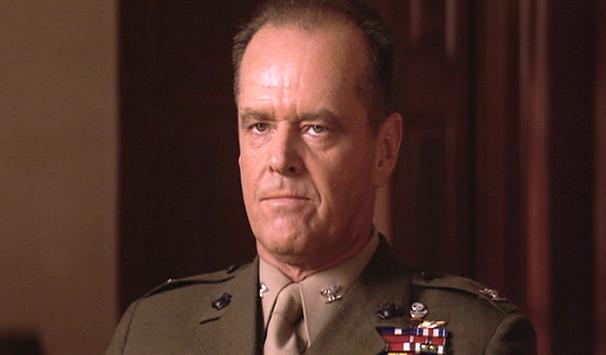
Jenny K:  Does anyone say “Such…you can’t handle Such” [ Such “truth” hai]?  Now, who is it who plays the Jack Nicholson anyway?


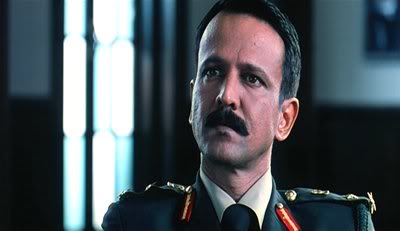
Julie M:  Yes indeed–KK Menon plays the Jack Nicholson character’s analogue in Shaurya and he does say that. It’s not translated very well, and he doesn’t yell it like Nicholson did, but it’s said. I was looking for it and was very proud that my rudimentary Hindi skills overcame the inexact subtitles in that instance–enough so that I recognized the quote.  Here’s that scene (start at about 6:00 in for the full effect).

And KK was really good as Brig. Gen. Pratap. It’s more of an extended cameo appearance rather than a role, just two or three scenes, but he totally nailed it without Jack’s histrionics.  Here’s the scene where he’s first introduced.  No subtitles, but he’s doing some golf practice at the border and knocks one into enemy territory, then makes an underling go and retrieve it.  Totally creepy. 

[about a week later]

Jenny K:  Okay, I’ve now watched Shaurya and then A Few Good Men again after, and am ready to voice a more informed opinion. The director of the former definitely used the Aaron Sorkin/Rob Reiner film as a template, no doubt about it. The basic plot of the maverick outsider lawyer in the military played by Rahul in Shaurya is, of course Tom Cruise in the earlier film, and KK Menon takes on the Nicholson role. Once again the bad guy is a superior officer with aims at a high office and a feeling of absolute godlike correctness in anything he chooses to do. They meet in a semi-friendly fashion at the Brigadier’s base, over a meal and discuss the case. There are in both films an innocent victim murdered and an innocent murderer, depending on your side in the argument. There’s lots of researching done by Rahul’s helpful co-workers, and a nifty if unlikely courtroom triumph for the underdog at the end, where Rahul, like Tom Cruise, is up against his best friend as prosecutor. Even the courtrooms look vaguely the same…old fashioned military decorum with lovely big windows. But there is definitely more than a few differences that make the Indian film its own take on the shared themes.

The first thing that I find different is that Rahul’s co-investigators are outsiders, journalists, and would in no way be allowed or even encouraged to help with a military case. Rahul’s job was to keep all of this out of the press, and he even got in trouble for it…yet here’s Minissha, practically in the next scene being let in on all the dirt…yet she doesn’t feel the need to print it. All her earlier ambition chucked out the window, it seems. Highly unbelievable on all fronts. I guess things couldn’t be stretched so far as to allow a mere woman to be an equal legal partner as Demi Moore was in AFGM.


Julie M:  And yet, Nargis was a lawyer, on her own, 60 years ago in Awaara…no problem there…nouvelle prudery?


Jenny K:  And then, there is the change in motive for the case. Instead of pondering the nature of power and how a bad job can make a military hero a villain by what he’s asked to do (Jack’s Colonel truly believes he’s doing right by his men and the country by defying the orders of his higher ups about Code Red prohibition), the Hindi film has to make all the bad guys explainable in their motives and much more sympathetic. With ethnic bigotry as the focus of the piece, the defendant was perfectly justified shooting his superior, who was about to kill a local child. He was also right to take his punishment, as he saw it. Further justification is needed when you learn that the Brigadier isn’t an out and out rotter…his wife, child and, don’t say it, his mother have all been killed by a native boy who he took into his home and trusted. Well, no more Mr. Nice Guy! He’s going to wipe out the whole race, so this kind of thing can’t happen to anyone else. Makes Nicholson look downright simple in his monomania..”I’m right and everyone else can just fall in line or get out!”

All in all, though Shaurya had some nice moments and some nice performances from Rahul, Jaaved and KK, I’m always going to choose the Reiner film, because it’s an almost perfect film. Stands up and salutes as well today as it did when it came out in ’92. Hoo-Rah!


Julie M:  You expressed almost perfectly my sentiments about Shaurya vs AFGM, right down to the ridiculousness of Minissha’s character Kaavya being able to be as much help as she was (although truly, how much investigating did she actually do?).  I too felt that the racial/ethnic/religious angle was uniquely Indian–maybe because they don’t at bottom believe their public fiction, like we do, that race (or caste, in their case) no longer matters, they can get away with it in a film whereas we can’t here, not in big-budget Hollywood films anyway. My big surprise at this film was that Rahul was so much less low-key than he usually is–almost manic–and his character is given a simplistic, yet highly effective reason for all the high-danger sporting activity. Since Indian films don’t get into the dark side of psychology very much, I found it refreshing.

[several weeks later]

Julie M:  Hum Kaun Hai (Who Are We? 2004) is an almost identical remake of The Others (2001), except without the atmosphere and with very weird, wholly Indian “explanation” scenes tacked in that inexplicably reunite Amitabh Bachchan (as the main character’s missing husband) and Dharmendra (as a totally new character not in the original).

First, the similarities. Basically, everything is the same. Dimple Kapadia takes on the role that Nicole Kidman portrayed in the original film, and does an excellent portrayal of a deeply religious (Catholic) woman trying to deal with a beloved husband missing in the war while faced with circumstances which seem to indicate that her house is haunted, or that her servants for some reason are making her think it is. Two cute kids (Hansika Motwani aka Baby Hansika, Master Aman) with a disease that renders them unable to be in bright light; three servants who appear out of nowhere to take care of them; the need to lock doors and keep curtains drawn to keep the kids from inadvertently stumbling into daylight; a mom plagued with migraines. Photos of dead people in a creepy album. All the same from start to finish. In fact, if you squint you could swear that Fionnula Flanagan, who played the matronly servant in the original, had reappeared in the remake and was speaking Hindi.

Now, the differences. First, the quality of the film stock was very bad—or maybe it was just the print that the DVD was taken from—it had color problems, jarring jump-cuts and bad sound. Looked very low-budget. (OK, had to get that off my chest) Where the original took place on a dim, misty remote island where the viewer could really believe that the house was haunted (and there was some meaning to the fog as well), HKH takes place in a sunny, park-like estate with the merest wisps of fog floating in and out, and it looked at times as if the fog was digitally added. The dimness of the original is replaced throughout by bright light, even in the “candlelit” scenes, which was jarring. The original took place in the 1940s, whereas the remake takes place in the present day (there are mentions of television, for example), removing the otherworldly quality that made the original so creepy. Dimple Kapadia seems very strong and capable, in dramatic contrast to Nicole Kidman’s ethereal fragility, which actually made her descent into screaming panic so much more scary (you kind of expect Kidman to fall apart, based on her looks). HKH had multiple flashbacks to the married couple’s love for each other, setting up the totally weird ending where we get an explanation of the husband’s strange reappearance that is totally different from the original film’s. (won’t go into details because it’s a major spoiler) And a final scene that is just really, really stupid.

In general the 2nd half was much, much better than the first half, which unfolded at a breakneck pace and with as much drama as reading the newspaper. And I was just as freaked out with what was the second-to-last scene in the original (but ended up as perhaps the third- or fourth-to-last scene in the remake). But then they had to ruin it with the last two scenes.

If you’ve not seen The Others, you will like Hum Kaun Hai just fine as it represents a genre rarely seen in Indian film (a creepy psychological story with ghosts—but maybe this is a growing trend, because 2007’s Bhool Bhulaiyaa entered into that genre as well). But if you have seen and loved the original, you’ll spend a lot of time rolling your eyes at Hum Kaun Hai.


Jenny K:  You make Hum Kaun Hai sound like a fun watch. I had seen The Others, but just when it originally came out, and I don’t have many clear memories about it, so I may be safe. And I love Dimple.


Julie M:  Well, I’ll make it easy for you to see it.  The film is available free on YouTube. I saw it on DVD where the running time was just over 120 minutes; online the running time is about 106 minutes, so there may be some missing scenes.  But I checked—the “added” scenes are all there, in all their ridiculous glory.

[a week or so later]

Julie M:  As a follow-up to many discussions, I’m finally watching Pyaar To Hona Hi Tha (Love Had to Happen, 1998), even though I know it’s a remake of French Kiss (1995), but since I haven’t seen FK I figure I’m safe.  I’ll watch FK after, in order to give this one a fair chance. After a disastrously farcical first half, it’s settling down into a decent movie.  Here’s Part 1: 

It’s nice to see Ajay help the girl he loves connect with the boy SHE loves, just like in Hum Dil De Chuke Sanam (although this is an earlier film). And he and Kajol have nice chemistry in this. Not as much as in U, Me Aur Hum, but they are cute. She more than he, although he got much cuter once he shaved off his mustache.

Oh, and BTW, what is UP with Indian movies and the first half/second half dichotomy?


Jenny K:  You know, until this past year, I’d have said that it was always a first half strong/second half fizzle out tendency. This year, not so much. And I always felt that Ajay and Kajol’s chemistry in this was much stronger than in U Me Aur Hum. In that one, he was such a conceited guy in the first half, and then he was so concerned in her care and worried, that chemistry didn’t enter into it, at least in the traditional way. Interesting that you got it completely differently.


Julie M:  Here’s my take. (it only applies to masala or romances) If the first half is really stupid, the second half is strong. If the first half is great, the second half falls flat. Examples that come to mind right away are K3G and KHNH. Great first half, overly melodramatic 2nd half.


Jenny K:  But we must note that that’s coming from the point of view of a die hard non-sentimentalist.  I will grant you that K3G goes a bit too far in it’s emotional histrionics in the second half, but there are enough good moments in it (especially that dance number with Hrithik and Co. in those GORGEOUS sherwanis!) that I still enjoy it.  And KHNH is supposed to be an emotional love smorgasbord…so you must be prepared to eat a full gut-wrenching load, or you just skip it altogether.  I love it.

Oooh…that reminds me.  I just watched Affair to Remember, that transatlantic smorgasbord with Cary Grant and Deborah Kerr.  Wish I had put in the Indian match-up of this one, Mann with Aamir and Manisha.  It takes all the emotional fluffery and pads it out to double its length with much anguish and gnashing of teeth and even more silly songs than the original, which were very silly in the first place “Tomorrowland” being the most unlikely choice for a nightclub song that one could think of.  It’s free on Youtube as well, with subtitles.  Aamir is young and peppy, and Manisha smiles more than once or twice, Rani does a cute item number early on, but I can’t even go into the grandmother’s shawl scene at the end because the translation of that one into an “Indian version” had me rolling on the floor with it’s unintentional hilarity.  You just have to see it.


Julie M:  But back to the films at hand.  The setup is standard rom-com fare: the male half of an engaged couple leaves for a business trip to a different country and falls for another woman, prompting the female half to follow and try to win him back. En route she meets a native of the country she’s going to, and circumstances force them to be together unexpectedly. They get to know each other, become friends, and he helps her with a plan to win back her fiance by pretending they are lovers. Pretense turns to reality, and at the end the fiance is overthrown in favor of the new romance.

The plots of the two movies were, with the exception of a couple of added scenes in the Indian version and a slight adaptation to make it more desi (changing the setting from Toronto/Paris to Paris/India; and some details, because I somehow don’t think India is big on vineyards) exactly the same, with key scenes absolutely shot-for-shot identical–down to the female character’s wardrobe. The Indian version adds terminal clumsiness to the female character who is already afraid to fly, occasioning much (to my mind, unnecessary) slapstick in the first half of PTHHT; but that’s balanced by the FK subplot where the female character is American trying to get Canadian citizenship, which is jeopardized by the trip. In FK there is a language barrier, which is very funny, and is absent in PTHHT. And of course, the Indian version adds musical numbers, only one of which was at all memorable.

I think Ajay made a better Luc/Shekhar than Kevin Kline, and, much as I love Kajol, I think Meg Ryan made a better Kate/Sanjana. I could believe Ajay as both a thief and an ordinary village boy with dreams of land, but Kevin always had the thief about him–the vineyard scenes fell a little flat. Meg Ryan…well, she pretty much invented, for the late-80s and 90s, the cute-and-bewildered rom-com heroine with questionable taste in men, and even Kajol can’t compete.


Jenny K:  I’d agree that Meg slightly edges Kajol out, as she is the prototype and does that type of role (cranky/cute) almost better than anyone. I’m sorry she’s sworn off. I have always described Kajol to people as a sort of Meg Ryan type…even physically, with those big eyes and killer smile…and the coloring differences just give you great variety. I do agree with you that the clumsiness thing was rather unnecessary.


Julie M:  Frequently the reasons for remaking a Hollywood movie for Bollywood audiences are unclear, and the remake falls flat. FK was a great choice for an Indian remake: it has all the elements of comedy, romance and drama built right in, and obvious points at which a song would underscore the plot or action. Comparing these two versions is also instructive, for newbies, in the differences in pacing between American and Indian movies. American films move right along, with no wasted plotlines or introduction, whereas Indian films take more time on the setup and draw out the denouement, sometimes excruciatingly long, to wring out every drop of drama and sentiment.


Jenny K:  I actually liked the longer format for PTHHT, and think it works well for the story. The ninety minute format for French Kiss always left me wondering why, in that short a time, Kate fell for Luc…Kevin Kline or no Kevin Kline, who has always been a favorite of mine. So, with the longer time spent at Ajay’s home, etc, that all makes more sense to me.


Julie M:  Me too, having seen FK second.  But if I had only seen FK, then I’d put it down to “movie convention.”  Of COURSE she’ll fall in love with him once he demonstrates his knowledge of wine, because THAT’s what’s important in a relationship.  Oh, and that he knows his diamonds.  But in PTHHT I must tip a hat to this song,  which shows to best advantage the chemistry between Ajay and Kajol in this film  (sorry for the bad quality and no subtitles).

Overall, I’d say that if one hadn’t seen FK then PTHHT would be 100% satisfying, adorable, and stand-alone excellent—ranking among the best of Indian romance films. But for American audiences, FK is going to win out, if you like that kind of thing (I’ve seen way too many and am jaded on the genre).

PTHHT is available in one link, free on YouTube, with subtitles.

Dec. 13, 2011: Sham & Dev: The ‘60s — Mod to Mysticism

Julie M:  In memory of the great Dev Anand, who passed away recently, we should talk about one of his films that we both liked, Guide (1965).

Jenny K:  I’d be happy to—I like it without reservation. I’d also like to talk about the latest in our foray into Shammi Kapoor’s video vault, An Evening in Paris (1967), as he’s so recently left us, and both Dev and Shammi were such a focus in that era of Hindi cinema.

Let’s start with Paris, shall we, so as to go from the ridiculous to the sublime, for a change.

Julie M:  Saw Evening in Paris (Shammi Kapoor, 1967) this afternoon, free on YouTube. A cute rom-com romp in the first half and kind of a thriller in the 2nd half when Shammi has to rescue Sharmila Tagore from the bad guys who have kidnapped her. Lots of fun and 60s music. Also, lots of ridiculous plot lines to mock.

Jenny K:  Ooof…don’t want to read this yet…I have it in the pile on my dvd player. Perhaps I can see it and then comment… eyes closed, eyes closed.  Don’t get too far ahead of me…

Julie M: Brief plot: Deepa (Sharmila) is spoiled, rich, lonely and bored. Her dad wants her to get married, but all the Indian boys are only interested in her money, so she goes to Paris to try and pretend she’s poor and hook someone who’s interested in her as a person. Enter Sam (Shammi), whom she instantly hates, but then he very sweetly and comically pursues her all over the world and hate turns to love. As it happens, Shankar (Pran) is an evil retainer of her father’s who is in money trouble and schemes to marry Deepa for her riches; this turns into a kidnap/ransom plot by the mob to whom he owes the money.

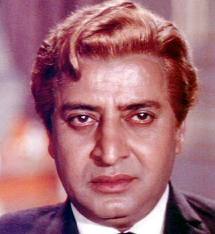
Jenny K: Oh yeah, Pran is a professional villain.  299 films on IMDb, and all of them various layers of slimy, from nasty to pure evil.  His orange wig is very oddly hypnotic, though, “poisonously permanent waved” might be an apt descriptor of Pran in this film.

Julie, I think I’m losing my touch…I tried again to finish Paris last night and fell asleep again. I think it’s the plot. Why does Shammi seek Deepa out? Just because his friend wanted her? Doesn’t seem enough impetus. Chase-chase-chase, nahi-nahi-nahi, sing-sing-sing, maybe-maybe-maybe, chase-chase-chase again…blah-blah-blah. I’m rapidly losing interest in Paris, even with the kidnapping.

Julie M:  I think he went to meet her first to see if he could help his friend, and then his eyes went BOINGGGG and he fell in love with her himself, and basically stole her away.

The mob boss has a moll, a cabaret singer named Suzy who is Deepa’s double (yes, the obligatory dual role for Sharmila), so Shankar plots a switch to hide the fact that Deepa is kidnapped. It goes on from there.

May I entice you with this campy number?

Jenny K:  Why, may I ask, does Suzy make her entrance on a Webber kettle grill rack?  Is being presented as a tasty morsel or is she just being roasted??? Or are we?

Julie M:  There’s also lots of beautiful Paris, Switzerland, Niagara Falls and Beirut (Beirut? yes, the Paris of the Middle East in 1967) scenery.

Jenny K:  I am finding all this “oh, by the way, meet me tomorrow evening on another continent” stuff rather, shall we say, implausable, and highly “yeah, right!” if you know what I mean.  Too distracting outside a fantasy item number, IMO (example, “Suraj Hua Madham” from K3G, not exactly necessary, highly unlikely, but deliciously “right” because it was a fantasy scene).

Julie M:  Here’s another number, where Sharmila looks like Kareena Kapoor? (hey, maybe that’s why Saif likes Bebo!)

Did you get to the part yet where the fact that he stole her from his friend bites him in the butt?

Jenny K: I did finally finish Paris this morning, (Paris in the Morning…sounds like a song title) but I must have missed the part where he got bit in the butt?? Lot of odd stuff going on in the film but I didn’t pick up on that.

Julie M:  She finds out that he stole her from his friend, and she pouted at him for a while (this was just after she admitted that she loved him), but it disappeared quickly in the kidnapping plot.

Jenny K:  Ah, yes, but all complications to romance cannot last longer than the next love song…or subsequent kidnapping by thugs from your backstory.  It’s in the masala handbook.

And though I have just finished complaining about the needless side trips from France, I did like all the nice camera work on actual location on Luna Island? at the top of the Falls, even if the handy security railing made it a bit less imminently dangerous.

So, I guess, my final verdict is okay but not as charming as some of Shammi’s other vehicles, say, Professor which we reviewed earlier, or Kashmir Ki Kali, also with Sharmila…they were both better in that one.


Julie M:  I agree.  The cute first half is just not cute enough, and the action-y second half not exciting enough.  Maybe if her clothes were better it would have distracted me.


[A week or so later]

Jenny K:  And now, for the more serious part of our double feature…Guide with Dev Anand and Waheeda Rehman.

Julie M:  I never read the novel that it’s taken from, The Guide by R. K. Narayan (but it’s on my list now!) as it struck me as something I might not like, but Dev Sahib’s version got me interested.  It’s a long, complex story about sacrifice and fulfilling one’s destiny. A number of commentators rank it as Dev Anand’s lifetime masterpiece–he produced and starred in it, and it was an early example of an Indo-American co-production, shot in both English and Hindi, with the Hindi version directed by his younger brother Vijay (who also directed another favorite of ours, Teesri Manzil).

Jenny K:  I haven’t watched very many of Dev Anand’s films, but this one struck me as very atmospheric, almost something out of time, especially as Dev’s character progresses toward the climax.

Julie M: Dev plays Raju, a tour guide in the historic city of Udaipur, who initially protects a histrionic client (Waheeda Rehman) from her distant and borderline abusive husband, then falls in love with her himself, encourages her to divorce her husband (!) and helps her achieve her goal of international dance stardom despite the rather unsavory reputation of her art. They move in together (!!) but just when he ought to be happiest his life starts to fall apart as he self-sabotages spectacularly (!!!). Ultimately he finds redemption in a peculiarly Indian way, and proves himself to be a “guide” in several senses of the word.

Anand gets to do everything in this film. He’s a handsome romancer, a dutiful son, a savvy business manager, and a spiritual leader (albeit reluctantly). The camera loves his good looks, and I fell in love with his easy patter and jokey demeanor (he never crosses the line into sliminess). I’m sure there’s a lot more to the philosophical angle of things that one who was raised in Hindu tradition would understand, but most of that whooshed right over my head.  And Waheeda Rehman, a frequent co-star, was simply brilliant in what I consider a fairly negative role.

Jenny K: I found this film after having seen Waheeda in a couple of Guru Dutt films, Pyaasa and Kagaaz Ke Phool, specifically.  She was so luminous in them, that I had to find out if it was just working with Guru Dutt or if  it was a quality she had in all of her movies.  Needless to say, I found she had it in almost every film, and still has it, today, evident in Delhi 6 and Rang de BasantiKagaaz Ke Phool is an interesting one to compare Guide to, as it’s also set in a showbiz arena with managers and stars, etc, though that one is more about actors and directors than this foray into the dance world.  Guide is almost a better showcase for her, as she’s the fulcrum the whole film winds around.

Julie M: Oh, yeah, that WAS her in Delhi-6 as the grandmother.  I loved that character. Interestingly, the soundtrack for Guide ranks #11 on this list of the 100 Best Movie Soundtracks  (although I don’t know how reliable it is…Dil Se… only ranked #46, and it is my absolute favorite; your favorite, Lagaan, was #34)  I wasn’t really enamored with the music.  Unfortunately the videos of the Guide songs available online are such bad quality I’m not sure it’s worth posting them…but “Aaj Phir Jeene Ki Tammana Hai” was my favorite.

Jenny K:  Nah…that list doesn’t have any of my favorite three albums on it, Taal and Meenaxi by Rahman and Omkara by Vishal Bhardwaj.  It is rather skewed toward “classic” Bollywood.  To each era, their own, I guess.

My favorite number in Guide was always the snake dance…I had seen the parodies like the one the sister does in Bride and Prejudice, but hadn’t seen the real thing, as it were, until this one. She just totally wowed me. 

Julie M:  I liked the snake dance too…her face while she was doing it was amazing to watch.  I should have said that Raju was a CHATTY tour guide. I mean, he never stopped talking!!

I was curious to see if the English version was as good so I went hunting.  Difficult to listen to, but here’s a clip of the beginning where he’s doing his guide patter.    It’s not a shot-for-shot duplicate, which is odd.  Pearl S. Buck wrote the dialogues.  I wish the sound was better so I could compare better.

Jenny K: It’s odd…sounds a bit like his patter is written in verse…but not.  Made me think of Shakespeare for some reason.  Waheeda’s so lovely, even when she’s severe like in this scene.  Always reminded me a bit of Jean Simmons.  Here’s a clip of Jean around the same time in Spartacus, to show what I mean. That whole era of film in the ‘60s could be so iconic.

When the film started, I didn’t want to like Raju, with all the advice and help he was giving Rosie to dissolve all her traditonal ties to her old life and husband.  Becoming Nalini was important to her self image, but was it important to her true self?  Maybe that’s why Raju finally chucked it all in for a new path, maybe he saw that he had been leading them both away from deeper truths.  Devsaab managed in this film to show all the layers of bravado, doubt and self sacrifice that made it a really nuanced performance.  Perhaps the best I’ve ever seen him do. Wish this had subtitles, but it was not to be.  Don’t watch if you don’t want spoilers.

Julie M:  I found this clip of an interview with Dev Sahib where he talks about his long history in film:  No wonder they call him “evergreen.”  I also couldn’t resist watching this clip of Aamir Khan’s remarks   about him  (it’s about half in Hindi, half in English).

I hope nobody succumbs to the temptation to remake this classic film, as they did with Devdas. It’s perfect just as it is.  And Dev Anand…what a star.

December 1, 2011: A Suitable Boy suits me fine

I just spent the last month reading Vikram Seth’s A Suitable Boy, 1400+ pages long, ten years in its writing and finally published in 1993.  I selected it because a) although not an award-winner it’s an English language classic  b) I love epic novels and c) it’s about India.  As a piece of literature it is unparalleled for both its scope and characterizations, and for Bollywood addicts it will seem both familiar and highly explanatory.  A novel like this can provide insights into culturally-driven motivations that no film, even the most melodramatic ones, could handle.  I simply adored it.

The time period is 1951-52 and the setting is (primarily) the fictional state of Purva Pradesh, in the the fictional city of Brahmpur, a large university town along the Ganges that seems to be a couple of days’ train ride to both Lucknow and the “big city” of Calcutta.  The story centers on three extended and interrelated upper-middle-class families–the Mehras, the Kapoors and the Chatterjis–and their friends, the family of the Nawab of Baitar (the Khans).  Every character in every family, as well as several of their friends, acquaintances and bosses, gets a narrative arc.  Some of the tales are poignant, such as feckless and citified Maan Kapoor’s sojourn in a rural village where he learns some key life lessons, and a tragedy that befalls a young character during a religious festival.  Some are joyful–I loved the story of Savita Mehra Kapoor’s pregnancy and birth experience.  And, frankly, some of the narratives, particularly those discussing finance, verge on boring.   Seth even inserts himself, as a character writing a very long and meandering novel.

Although the thread tying the novel together is Mrs. Rupa Mehra’s search for a suitable boy for her youngest child, Lata, to marry, it

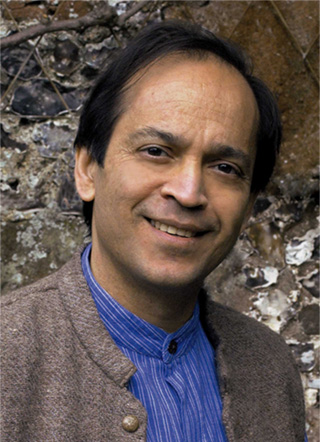
Author Vikram Seth

actually ranges very widely from city to rural village, from politics to academia to industry, to religion and cultural customs, to fashion and movies and literature and food and gardening and law enforcement and astrology and…you get the picture.  In fact, I can’t think of anything that isn’t addressed in some form in the novel.  Love, or rather, marriage, is the book’s central theme, with Lata accumulating no less than three suitors and proposals and trenchantly observing several other marriages for clues as to which choice will be best for the life which she intends to lead.  (interestingly–the choice of no-choice does not occur to her despite several unmarried-woman role models)  Who will she choose?  Will it be Amit Chatterji, the published writer ten years her senior but with whom she has so much in common?  Or will her mother’s preference prevail–the up-and-coming shoe executive Haresh Khanna who has not a few personality flaws?  Or will Lata follow her heart and marry Kabir Durrani, a fellow college student who is the one boy her family has deemed completely off-limits to her because of his religion?

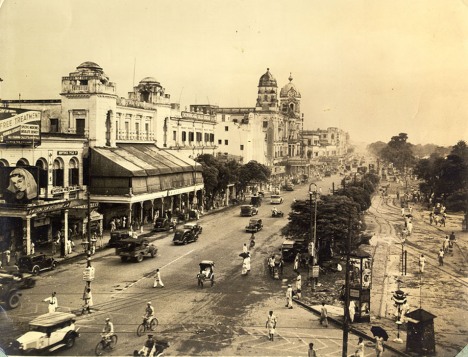
Calcutta, c. 1950

Even though translating this novel to the silver screen would be absolutely impossible, I could see it done on television as a mini-series.  In fact, it was released as an episodic, five-hour  BBC radio play in 2002 with some actors Bollywood fans might recognize:  Boman Irani, Roshan Seth, Rahul Bose and Ayesha Dharkar.

But as a novel it’s as entertaining and diverting as Bollywood’s best.  Described by most readers as “Jane Austen meets Tolstoy,” A Suitable Boy will likely excite devotees of the Yash Raj imprimateur, stuffed as it is with cultural mores, wicked characterizations (Meenakshi Chatterji Mehra is hilarious in her social-climbing vacuousness, a perfect match for her husband Arun Mehra’s Anglified snob), oh-no-she-didn’t gossip, affairs, secret identities and several instances of unrequited love (some of them hideously tragic) before the inevitable happy ending.  There are even song interludes–or rather, poetry interludes that serve the same purpose as filmi songs.  One can have a great deal of fun casting the novel as a film from among current stars, and in fact I would encourage it to make the book come even more alive.  There is even a bit of film fandom:  the characters are obsessed with the current film release, the Nargis/Dilip Kumar starrer Deedar, which has been showing to packed audiences for months and its songs are on everyone’s lips.  This movie is described in the novel as being so emotional that it makes grown men sob uncontrollably, and has “…an unusually tragic ending, but one which did not make one wish to tear the screen apart or set fire to the theater.”  In fact, it is so popular that the ticket-buying queue retaliates on an annoying woman by blurting out the ending, spoiling it for her.   In short–it’s the perfect movie. (watch it online free here, unfortunately without subtitles)

And for those who completely fall in love with A Suitable Boy and want more, rest assured that Seth is working on a sequel called A Suitable Girl, set in modern-day India and nominally concerned with 80-year-old Lata’s search for a match for her grandson.  Even though it’s set to publish in 2013, look for it in…oh…2020 or so.  (I’m so mean)

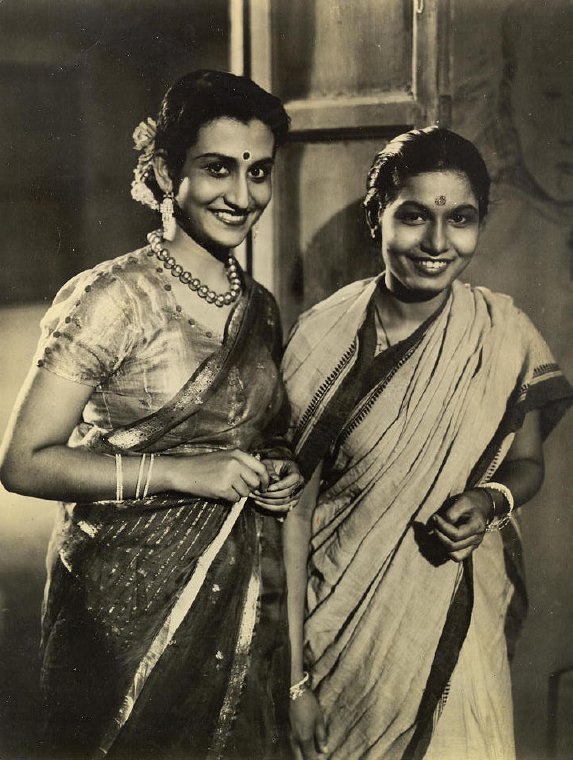
Calcutta beauties, c. 1950

November 28, 2011: Thankful for Guilty Pleasures!

Here we are, still in Thanksgiving Week, and what are we doing?  We’re dodging Black Friday and Cyber Monday by watching our favorite Guilty Pleasures Bollywood films.  Come join us! 


Julie M:  Got Jaan-e-Mann (Darling, 2006) from the library.  Preity, Salman and Akshay…how can it miss?


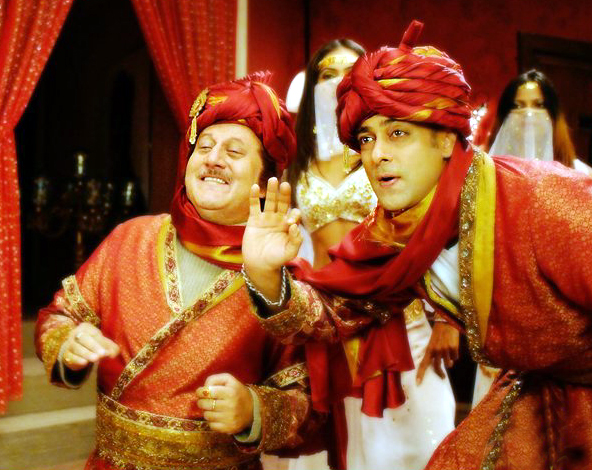
Jenny K:  Tell me if it’s worth seeing. It was being filmed in NYC almost simultaneously with Kabhi Alvida Naa Kehna and there were lots of reports on Bollywhat.com’s forum on the sightings around the city. Lots of fun reading about it, but I remember seeing references to Salman in drag as Marilyn in the Seven Year Itch white dress looking not very fetching, and I recall references to Anupam Kher playing a Toulouse-Lautrec-ish style dwarf, completely on his knees for the shoot. I just gave up at that point and didn’t go to see it.  Here’s a link to a Rediff article on what Anupam went through doing it.


Julie M:  Despite my general aversion to Salman, I really enjoyed Jaan-e-Mann. On a number of levels it is a typical love story, but there were staging devices that made it interesting and the first half was unrelentingly funny.

In the opening we are introduced to Agastya (Akshay Kumar), an astronaut in a space vehicle with a blonde astro-companion, telling her a flashback story of his friend Suhan (Salman Khan). Suhan is an out-of-work actor with a favorite uncle, who happens to be a dwarf (occasioning a run of puns that I’m sure in Hindi are hilarious but I just didn’t get in translation). He gets a letter from his ex-wife Piya (Preity Zinta) stating that since he has not paid alimony for the past many-X months, she will accept a one-time settlement of 50 lakhs and he has no further obligation to her. We learn through a flashback number (it’s a flashback within a flashback, if you are keeping track) that Piya left him after he was forced by his agent to separate from her as a positive career move (heroes can’t be married, doncha know). This is actually a very cool and surreal number and I love how it’s done.  As the flashbacks nest the dance numbers get crazier and crazier.

Suhan and his uncle decide that since he doesn’t have the money, the best way to get out of paying the sum is to find someone to marry her. Enter Agastya, Piya’s formerly nerdy college acquaintance, who is looking to hook back up with her, and not recognizing Suhan as her ex-husband. Brainstorm: put Agastya with Piya and have him marry her!  Here’s the number where Suhan and his uncle convince Agastya that his destiny lies with Piya (warning—this is a moderately offensive, all-dwarf dance number):

The guy in the purple suit is Salman as Agastya’s nerdy self in college. Love the cardboard cutout representing Piya (in college-age getup), and then the dwarf dressing up as Piya.


Jenny K:  It still looks a bit scary, especially in the dwarf number, but I’ll take your word for it. All those nods to KHNH and DCH (NY bridge shots, tilted just that way and the surprise red rose in the park) are sort of cute but also odd. And from the clips you have here it looks as if Preity is doing an extended cameo and never actually speaks! Funny!


Julie M:  Actually Preity does speak, quite a bit, but it’s true, you do go through the first, oh, hour or more without actually seeing Preity’s character in live action, only in flashback montages, and so when the real person shows up you have to get re-introduced to her through her own actions instead of filtered through everyone else’s years-old perceptions of her. And she’s very different in “person” from how the other two have portrayed her in the montages. I told you that there were some narrative devices that elevate this film above the typical crazy-comedy-romance genre.


Jenny K:  With all the numbers condensing through montages, is the movie shorter than normal Bollywood, or do they just pack three times as much in it?


Julie M:  It’s a full three hours—but you don’t notice.  It’s kind of strange how the montages tell the back stories very quickly and concisely, since Bollywood movies usually linger lovingly on back stories, but it leaves more time for the main action which consists of the developing friendship between Suhan and Agastya (Salman kind of channels SRK’s typical Raj-Rahul character in this), Suhan’s letting go of his longtime anger against Piya and the Piya/Agastya romance which has some very fun scenes. But all of these are typical rom-com-melodrama fare.


Jenny K:  With Salman it’s a Prem-Raj/Suraj type.  Only one Rahul that I can remember…but I get what you mean. 

 
Julie M: The rest of the film is controlled chaos as Suhan and his uncle make over the nerdy Agastya in Suhan’s trendy image and then drag him to New York to throw him in Piya’s path. Complication: Agastya is painfully shy and Suhan must stay within 100 meters of him with a transmitter to feed him lines without Piya recognizing him, occasioning many ridiculous but funny costumes. In the process Suhan learns the real reason(s) Piya left him and has to make a decision: continue with the ruse and let Piya be happy with Agastya, or try to get back together with her himself?


Jenny K:  And you found all of that funny?  The chaos sounds like it was not in the least controlled…but maybe that’s just me.  Put Salman and Akshay together and my hulchul-meter just goes spinning out of control.


Julie M: Overall the first half was crazy-hilarious, with the second half toned down and more romantic without the melodrama.  The ending comes fast and funny.

This setup had the potential to be really awful, and there are indeed some cringeworthy moments. There is even the obligatory senseless dual role, this time for Anupam Kher as the dwarf uncle in Mumbai and a look-alike but non-dwarf cafe manager in New York. But Akshay makes such a fetching nerd with his tiny glasses, and his smile is so adorable, and he and Salman make such a good buddy team, that I forgave the flaws. It’s much more fun to see them working together than at odds like in Mujse Shaadi Karogi. And Preity and Salman have excellent chemistry even though it’s seen only in flashbacks until the last 30 minutes. Sallu was actually rather engaging and almost like a real person.  He only opened up one small can of dishoom in the whole film, showing admirable restraint there if not for going shirtless, which he did early and often, and in one scene he 97% convinced me that he has some actual acting talent.

One of the best scenes was the introduction of the Suhan character via a dream sequence where he’s accepting a Filmfare Best Lead Actor award…in the 70s! Cool B/W footage of older stars with Salman inserted into the clip.

So…Jaan-e-Mann could have been awful but wasn’t. I might have hated it if I was in a really foul mood, but this is the kind of film that is so goofily good-natured that all its flaws can be forgiven.  It’s easily skip-able story-wise and actor-wise (no new ground for any of the leads) but it really is cool how they tried to do something different with the montages reflecting the layered flashbacks. And for that it’s worth seeing.


Jenny K:  The director, Shirish Kunder, is Farah Khan’s husband. He was her editor first and they fell in love working on Main Hoon Na, I think. He seems to have absorbed all her love of color and raucous energy and translated it in his own way. She choreographed for him, of course. Good to keep it all in the family!

 [a few weeks later]

Julie M:  So I was taking it easy this afternoon, and thought I’d watch a funny film from your box, so I selected Marigold (2007), anticipating a gleeful Hollywood/Bollywood fusion and Salman Khan acting entirely in English.

At first glance it was full of possibilities for an American-made film meant to introduce American audiences to the joys of Bollywood films without the offputting length and subtitles. Here’s the trailer.

American C-grade actress Marigold Lexton (played by real-life C-grade actress Ali Larter) with a bad attitude finds herself stuck in India and gets a part in a Bollywood film, where Prem Rajput (Salman Khan) is the choreographer, and love ensues. Complications arise in the form of Prem’s disapproving royal family and longtime-arranged fiancee, and Marigold’s boyfriend who arrives on the scene, but all ends well and the characters grow as people. Add sweet love songs, big dance numbers, music by Shankar-Ehsaan-Loy, lyrics by Javed Akhtar, and location shooting in Goa, and it couldn’t miss, right?

WRONG. I found the film a series of misses, although in some areas they were near misses. Salman Khan, locked into amused-smile “romantic” mode, was curiously low-key, displaying very little of the good-natured manic charm that makes him such a huge star in India. Ali Larter (and she was cast exactly why?) lacked the necessary comic timing to successfully pull off the b*tchy-cum-lovestruck Marigold. The story did not adequately build the case for Prem’s and Marigold’s attraction to each other, and the complications were not intense enough to make the audience feel that they could possibly be insurmountable and hence the stuff of dramatic tension.

I did like this number, which was the last scene in the film and very typical of an Indian-made Bollywood spectacle:

Maybe I’ve been watching REAL Bollywood, but the whole thing seemed rushed and some key scenes seemed to be missing–particularly, scenes where choreographer Prem takes the decidedly non-graceful Marigold in hand and teaches her how to dance, which would have given them a very nice and logical foundation for romance.


Jenny K:  Is this the same woman who was defending Bride and Prejudice so staunchly?  Well, I’ll agree that it was more effective than Marigold, but I wonder how you’d review B&P now?


Julie M:  I much preferred Bride and Prejudice as a film all in English, with a major Bollywood star, as one to introduce the genre to Western audiences and actually convince them that it’s worth a second look. All in all, if this was supposed to be a “crossover” film it didn’t do either Hollywood or Bollywood any favors.

This number, where Marigold supposedly proves her mettle as an actress and dancer, fell flat with me; it’s as if the entire dance troupe was infected with Ali Larter’s chronic stiffness despite the energetic choreography.

And the movie took itself too seriously: to my mind, romantic comedies (in any language) succeed because the characters know it’s a story and have fun with it. Finally, Salman only displays one bad shirt choice, which I have to admit despite my snarkiness I always look forward to in his films.


Jenny K:  I loved the white jacket with the fringe on the arms!  Very cool.  Who would have thought I’d have been approving his sartorial choices?!?


Julie M:  The sets and costumes were stunning, and I did enjoy a couple of the dance numbers, above, which were clearly given a lot of thought. In this beachside number, Marigold is introduced to the concept of dance numbers as integral to Bollywood filmmaking, and it’s a pretty awesome song too. 

Jenny K:  I felt much like you the first time I saw it. Ali was much too b*tchy to be at all endearing, and Salman being fully clothed and always charming didn’t seem to be at all believable to me. However, I sent it on because I watched it again recently on Netflix (It had been a two year gap, I think, since I saw it first) and I had really mellowed on it. Thought it did much better on second viewing, and I saw many more funny bits in Ali’s performance and much more sweetness in SK’s.

 [about a week later]

 Jenny K:  Went to see Rockstar with Pat and a friend of hers on the day it opened, after I got off work. Mid-week, how decadent! 

My main comment is: best Rahman Score since Meenaxi….some of the songs were just wonderful! Odd, though. I went through some of the clips of the videos on YouTube, and it must be that the numbers are very integrated into the plot, because the song that moved me the most is very generic looking here.

Admittedly, this is edited to pull out, I think, five minutes of build-up, and so that may have a lot to do with it. This one is the lead couple of Ranbir and Nargis reunited in Prague during an international music festival. In context it’s permeated with a bittersweet quality of remembrance of their time together two years past, of the fun they had before she was married. Their chemistry really built up in the longer version.

Basically, I liked it. Without too many specifics, I’ll say it was a nice performance by Ranbir, if you ignore the first, say, quarter of the film. They needed to just take ten minutes and say, “Jordan is a nice boy but is too bland and has no real drive and focus for his musical inspiration, and so he fixated on a random beauty to try to give him one.” See, there I saved us a good forty-five minutes of tedious exposition in one sentence.

The film only got rolling when things got darker, and this qawwali number marks where the slow first quarter finally picks up.  I’m always a sucker for a good qawwali…nice boy Jordan (Ranbir) is finally getting the more troubled life he wants to make his music more gritty…he tells his dad he won’t ever work in the family business and they kick him to the curb, and he winds up sleeping in the Haji Ali Dargah, a mosque, where he begins to find enlightenment and deepen his music with worship. Nice segment.

Drama, angst, sturm und drang continue as the film progresses…Ranbir’s hair gets even longer, and his facial hair more scruffy, and he gets much more physically attractive…though the look they gave him in this last big number went too far…Ranbir as Yanni in his Sgt. Pepper Phase…shudder. Angst is one thing but fashion masochism is something else again.

Julie M:  You know, that look isn’t so bad.  Maybe it’s just that it’s Ranbir, but I think it’s kind of cute.


Jenny K:  You are a hopeless case,  Jules. 

Newcomer Nargis Fakhri does alright, if a bit of an emotional, turn-on-a-dime shuttlecock in the first half, and she looks too much like Katrina Kaif. There’s a lovely cameo by Shammi Kapoor, in his last appearance. And the film looks wonderful with typically great cinematography by Anil Mehta (Lagaan, KHNH, Marigold). Don’t know if you’d consider it worth seeing on a big screen or not.


Julie M:  I’m so mad at the theater here, it’ll be a cold day in h*ll when I try to see a movie that isn’t action-based, because it’s impossible to tell when something is going to be subtitled.  But I’ll report back if I go. 

Meanwhile, your report got me into such a Ranbir mood that I actually PAID to see Bachna Ae Haseeno (Lucky Boy—not a literal translation—2008) through YouTube.  Here’s the trailer.

I had a lot of fun with it. Ranbir was absolutely winning as Raj Sharma, the handsome, successful cad (aka “killer”) who, 8 years apart, loves and then leaves two women (Minissha Lamba, Bipasha Basu) when they start to get serious about him, only to himself be dumped after he falls head-over-heels a few years later for a third (Deepika Padukone).


Jenny K:  Hah!  I thought you’d like BaH! Just the right mix of heartfelt and cheeky. And I remember the wonderful dancing, too. He’s right up there, though I am much more likely to have Imraan Khan as my menu-topper for guilty pleasure viewing, Ranbir does have his good points.


Julie M: I also liked this bhangra number, where Ranbir crashes a wedding so he can approach Minissha and apologize to her:

He realizes that he needs to redeem himself, and the journey he takes to apologize to his former lovers and atone for the impact his caddishness has taken on their lives is alternately funny and sweet.

The music was fun and Ranbir can dance, and dance well. Check out the number that appears over the opening credits: 

I thought the quick costume changes towards the end of the song were particularly interesting.  I was tickled to learn that it was a remake of/homage to this 1977 number, starring Ranbir’s dad Rishi Kapoor.  How much do you love the fluffy white suit and matching hat!!

Jenny K:  Fluffy!?!  Them there are industrial-grade full-on white paillettes!  Huge wonkin’ flat sequins that dangle and flip with each twitch of Rishi’s swivelin’ hips.  Gotta love it, as you say…though I’m not sure that paillettes should ever grace a man’s cap.  Sets a bad precedent.


Julie M:  The film had a “friendly appearance” by Kunal Kapoor, which I was not expecting, was a bonus (yum). And the first love story is inspired by DDLJ (not ripping it off–the Minissha character is a fan of the film, leading Raj to woo her using the film as a key to her heart), which made me giggle for the entire first half-hour of the film.  Here’s the entire song:

Granted, it was not a perfect film. It was overrun with anachronisms, which always bug me (example: the first story supposedly took place in 1996, but the cars and fashions were all wrong and there were modern cell phones; later, at a party, they dance to music from films that had not yet been released). The best friend character (“comedically” played by Hiten Paintal) was an *ss but Raj never seems to notice.

I remain bewildered as to why Deepika is given parts where she is expected to act, because clearly she is best suited for eye-candy roles (even Bipasha out-acted her, and that’s saying something, because I’m not a Bipasha fan either).  Ranbir spends too much time alternating between wearing obvious-branded Abercrombie clothing and wandering around inexplicably shirtless, although I’m not really complaining about the latter.

Finally, I liked this number, where, in order to obtain her forgiveness, Bipasha is making Ranbir dance (literally) attendance on her and he parodies the dancing styles of major Bollywood stars.

Ranbir’s acting in BAH redeemed him from the weird and confusing Saawariya and gives a hint as to how amazing he would be in Raajneeti. All in all, it was a nice Friday treat and a “guilty pleasure” to admit that I enjoyed greatly.


Jenny K:  I give thanks and hope the rest of the holiday season goes as well!  God Bless Us, Everyone!

Nov. 20, 2011: Wives, Widows and Wanton Women

Recently we’ve been watching a number of Indian films that center around women, ones that show them as fully rounded characters in situations that are far from the romance-movie norm. Please come along with us and join in on a fascinating subject for conversation.  It’s a long one, but well worth the time.


Julie M:  Tonight’s feature was Deepa Mehta’s Water (2006). What a film–so beautifully shot, yet so sad and made me angry at the same time. You know I love “issue” films, and this film raised enough issues to keep me musing for days.

Set in 1938, Chuyia (Sarala Kariyawasam) is a rural girl, age 8 and recently widowed–according to tradition her parents take her toVaranasi to live in a widows’ ashram. Chuyia must adapt to a life of faith, austerity and begging with her new “family” of much older women. She doesn’t fit in at all, but she does befriend Kalyani (Lisa Ray), a beautiful young widow who is shunned by the other widows because she is routinely sent out as a prostitute to make money for the ashram. Another widow, Shakuntala (Seema Biswas), takes Chuyia under her wing. Chuyia and Kalyani meet Narayan (John Abraham), a wealthy recent graduate and a Gandhi follower.  Narayan and Kalyani fall in love and plan to marry, but there is a major roadblock that leads to tragedy. Chuyia is next in line for “the life,” but Shakuntala intervenes and in a very nice parallel, Chuyia’s chances for a better future end up linked with the Gandhian political movement.


Jenny K:  I saw this movie more than once in the movie theater, and once I was lucky enough to see it with the director there to talk about it.  I got a much better feel as to what went on with the original filming, and how it was stopped due to protests over her controversial subject matter.  What perseverance! 

The elements of the plot reminded me a lot of Gloria Whelan’s book, Homeless Bird which won the National Book Award in 2000.  It details the life of a thirteen year old child bride as she is widowed and left in Varanasi to die, but who gets a second chance making her own way in the world.  Lovely book, don’t let the children’s book status warn you off.


Julie M:  I read that the original cast, before the film was shut down for five years because of the protests, was supposed to have Nandita Das as Kalyani, Akshay Kumar as Narayan and Shabana Azmi as Shakuntala: my mind reels at the thought of that combination!!  But this cast was awesome too.  John Abraham was excellent (and hot hot hot in a dhoti!), best I’ve seen him, and Sarala was fantastic as Chuyia. Seema…well, Seema is always wonderful, but her portrait of a woman caught between tradition and common sense is heart-rending.


Jenny K:  Oh, my gosh!  Seema blew me away.  I cried like a baby just from the expression on her face at the end of the film as she puts Chuyia on the train.  Actually, hers is the only performance that I cry at, every time.    Didn’t you like Raghuvir’s performance, too?  What a hoot!


Julie M:  It took half the movie before I recognized him as the eunuch/cross-dresser Gulabi, who assists the ashram by pimping out the widows.  Great performance but wrapping my head around what he (she?) was doing was hard.  The nature of the time period, the status of widows in Indian society (somehow I feel that not much has improved in the rural areas since 1938), the clash between the educated/literate and the not-so-educated, class and caste differences, and the attribution of misogyny to religion when it’s simply a product of ignorance…  But this film was so atmospheric, and the Rahman music so stunningly integrated, that it’s entirely possible to just enjoy it without thinking about its more serious side.  Truly one of the best films I’ve ever seen. Even though it was a bit slow in spots, and didn’t have Aamir, I think I liked it better than Earth.


Jenny K:  I can see how you’d say that, but I think that, for me, Earth still had the most impact, if only for the scene where Aamir meets his sister’s train.  Shudder…made me feel a bit more identification with Ice Candy Man’s situation.  In Water, except for Seema, I watched them, but didn’t really connect.  Perhaps Lisa Ray was just too cool for me.  She was, however, much better than she was in Bollywood/Hollywood, if that can actually be compared.  Deepa’s never been that good with comedies, if you ask me.


Julie M:  Well, just look at her.  I’ve never seen Deepa laugh, even in an interview.  She’s just so intense and focused.

 [a few days later]

Julie M:  Saw Chameli (2004) last night. Plot-wise it falls into the genre of “guy gets caught up with the denizens of the night where he is a fish out of water” film. I have not seen the type in English as anything other than a comedy, or something that purports to be a comedy, most recently Date Night which, although I love Tina Fey and Steve Carel individually, I could not bring myself to see. My favorite was 1985’s After Hours, less comic than most, probably due to the direction by Martin Scorsese.


Jenny K:  Maybe, I’ve just not seen enough of this genre in our films.  Can’t think of any I’d compare it to…certainly not Pretty Woman, which is the only “pro/john” kind of film that jumps to mind.  And non-sequitur, you should give Date Night a chance; it’s fun!

 
Julie M:  I will if you give Harold and Kumar Go To White Castle a chance—I thought it would be dumb but it’s hysterically funny. 


Jenny K:  Ooof…that might be too steep a cost, even for Kal Penn.


Julie M:  Anway. The plot revolves around Aman Kapoor (Rahul Bose), a successful Mumbai businessman whom we meet over the opening credits schmoozing at a cocktail party. Nice suit on him. We are also simultaneously introduced to Chameli (“Jasmine,” Kareena Kapoor), a prostitute, getting ready for a night of work. Aman leaves the party and finds himself stranded in the red-light district in a heavy downpour, which has literally flooded his car. It is, of course, Chameli’s corner where his car breaks down. Here’s the scene where they first encounter each other.

They talk for a while, get to know one another, and he becomes involved in her typical working night. We also learn that Aman has a tragedy in his past that rainy nights like this make him think about. Chameli’s matter-of-fact outlook on life (and apparently very salty language–occasioning the only bleeps that I can recall in a Hindi film) causes Aman to brood a bit less on his own troubles.


Jenny K:  Yeah, you don’t hear things bleeped much in Hindi cinema, do you?  Though I do remember that people said that the dialogues in Omkara was considered very vernacular and quite uncouth; it caused a good bit of scandal at the time it came out.

Julie M: She also displays a softer side, seen in the pretty number, above. Then events transpire that get Aman and Chameli into some trouble with the police, which he uses personal connections and not an insignificant amount of cash to get out of, and as dawn breaks Chameli goes back to her dump of an apartment and he goes back to his life. You see a quick but very nice scene that indicates her influence on him, then in the last scene (the next evening?) he shows up at Chameli’s corner, and there is a quick scene indicating his influence on her.

Rahul Bose displays his typical low-key, indie-film style to portray the brooding Aman, but the true star of the film is Kareena Kapoor. Having only seen her in ingenue roles that do not require nuanced performances, I thought she was marvelous as the hoarse-voiced, ribald Chameli, slouching up and down the street in her bright sari, dozens of bangles and overly made-up face.

She speaks of her business very casually and explicitly, sometimes to shock Aman but more often, it seems, to remind herself that she can have no other hopes and dreams than what her life actually is.  And she teases Aman by displaying herself and saying (paraphrased), “we’re not all Umrao Jaans and Chandramukhis.” But she tries her best to help others, and we find out that her connection to her pimp has a strong element of genuine friendship rather than purely his exploitation of her. So while she is not exactly the “hooker with the heart of gold” of more fantasy-like films, we definitely get a more complete picture of her as a woman than we do with portrayals of prostitutes in other films, like the character played by Preity Zinta in Chori Chori Chupke Chupke. And as a romance, much more satisfying than films like Pretty Woman, which was a fantasy all the way.


Jenny K:  I keep meaning to see Sushmita Sen’s film about the life of a village girl of questionable morals, Chingaari (2006) which got very mixed reviews.  I love her presence on screen and wish she’d get more lead roles.  No subtitles in this confrontation scene with the village priest (Mithun Chakraborty) but you get the gist…she reminds me so much of Shabana in this scene.


Julie M:  Chameli was kind of a cross-over film–not quite a realistic Aparna Sen-style film but definitely not mainstream Bollywood despite three song numbers and very high production quality. Having seen Tabu gloriously portray the life of a pay dancer in the gritty Chandni Bar, I was derisive of this overly glamorized number showing a Mumbai dance bar.

The writer/director, Sudhir Mishra, also directed one of my favorite films Haazaron Khwaishein Aisi, and bravo to him for getting more out of Kareena than I thought possible. I enjoyed Chameli, but only because it was an attempt to get a real female character into the Bollywood mainstream. Overall it was kind of slow and I am not enough of a Rahul Bose fan to see this much of him without being surrounded by extra characters to take the edge off his blandness.


Jenny K:  Hmmm…I thought she brought quite a lively quality to the film and I liked their chemistry.  Not as much as I liked his chemistry with Konkona in Mr and Mrs. Iyer, another Aparna Sen film that I will send in the next big shipment.  Now that I think of it, Rahul seems to gravitate to films where he doesn’t really interact physically with his lead actresses, here and in The Japanese Bride and M&M Iyer.  Curious.

 [about a week later]

Julie M:  Laaga Chunari Mein Daag (My Veil is Stained, 2007) is a fairly old-fashioned potboiler about honor, duty and sin–with the “modern” twist that the main characters are all female. “Modern” I say in quotes, because although it is set in contemporary Mumbai, it seems to have always been that women bear the brunt of whatever actions are deemed sinful at the time.  Here’s the trailer.

The plot involves a pair of happy sisters, Vibya (Rani Mukherji) and Shubya, called Chutki (Konkona Sen Sharma), who spend their time skipping around Varanasi (yes, the same Varanasi where the widows of Water live, except 70 years later) and raising heck..

They live with their parents (Jaya Bachchan and Anupam Kher) in a grand but decaying old mansion and we find out that they are quite poor.  Things go from bad to worse, and in order to save the family Vibya decides to take drastic actions that also lead her into a life of sin. She lies to her family (sin #1) that she has a job offer in Mumbai and leaves Varanasi, but finds nothing.  Desperate, she sleeps with a prospective employer (sin #2), who then flings money at her and denies her the job. She realizes that the only way she can make enough money to send home is to sell her body (sin #3), and she transforms herself into an alter ego, Natasha, a high-class, high-priced “escort.” This song indicates her state of mind as she practices walking in high heels and divorcing herself from her occupation as she thinks of home.

Of course she is deeply shamed and stressed, despite the fact that she becomes very wealthy and in demand.  Trying not to blow her cover while she falls in love with a nice man (Abhishek Bachchan), pays blackmail to her evil cousin (sin #4), and supports her executive-trainee sister (who has moved to Mumbai and also fallen in love with a nice man (Kunal Kapoor, mmm) stresses her out even more.

All seems lost when Chutki figures out her Natasha identity.  Then it is revealed that Abhi and Kunal are brothers.  I won’t spoil the ending, but suffice it to say that at the end the truth is revealed, and the fallout is not what Vibya expects. And there’s a cute final dance number (here, with German subtitles).

Great performance by Rani Mukherji as the torn Vibya, albeit a bit overblown.  The sisterly love between Rani and Konkona was very sweet and natural.  And Rani and Abhishek have great chemistry together:  nice to see them again after Bunty aur Babli.  Plot-wise, amid all her moaning and groaning about the “stain” she brings to the family, it seems that all is in Vibya’s head. Also, a plot point is that Vibya and Chutki are friends with a “courtesan” (Hema Malini, in a wonderful cameo role), an Umrao Jaan-like mother-figure whom they admire for her artistic skill despite the fact that she sleeps with men for money.

So why doesn’t anyone care that Vibya is selling her body?  Maybe ultimately it’s the difference between being a streetwalker like Chameli and being an escort like Natasha–i.e., the amount of cash changing hands. Or maybe it’s because did it all to support her family, which makes it okay.


Jenny K:  I saw this film in the theater when it came out, and though I liked all the performances, I didn’t have much of a fondness for it.  Maybe it was how easily Rani got to the top of her “profession”.  I think in real life, she’d have had a more depressing life path.


Julie M:  Overall, I thought that this film was much ado about nothing considering it is the 21st century already. All the drama seemed to be a relic of the past, and people were upset because they thought they were supposed to be.  A plot like this might have been impressive in the 1950s, but considering the family in all other ways seemed to be quite modern, the quandary Vibya was in rang hollow.

[a few days later]

Julie M:  Mrityudand (Death Sentence, 1997) is an interesting take on woman-power, Hindi-style. Not what you’d expect from a mainstream film.

Plot:  the (fictional) village of Bilaspur holds traditional values, particularly when it comes to their women, who are expected to remain chaste, keep their place and allow the men to run roughshod over them. Town-bred Ketki (a surprisingly unglamorous Madhuri Dixit), arrives as the bride of Vinay (Ayub Khan), a young businessman. She is quickly absorbed into his family, consisting of his father, brother and brother’s wife Chandravati (Shabana Azmi). Shortly after her arrival, Vinay’s brother leaves Chandravati, who is barren, to head up the local monastery. Tradition demands that Chandravati act like a widow; however, a deep depression combined with the intense pressure to conform to social norms makes her gravely ill. Then Vinay falls into business problems with the local bully, Tirpat Singh (Mohan Joshi)–he as well cracks under pressure and starts to drink and beat Ketki. Here’s a scene as he deteriorates. 


Jenny K: Madhuri’s wonderfully tough in this, and almost almost as surprising as she is in Lajja, but I never recommend that one unless you speak Hindi, because the subtitles are almost non-existent.


Julie M: Ketki leaves Vinay but after he apologizes and quits drinking she returns home and figures out a way to solve his business problems. Chandravati finds true love with an old family friend (Om Puri) and becomes pregnant, proving that her infertility was not her fault; however, a pregnant widow is in a difficult situation socially so she hides in the house. Meanwhile, their servant girl is having money problems with Tirpat Singh, and he forces her to sleep with him to pay off the debt. Ketki learns of the situation and convinces the girl to refuse Tirpat; when she does, Tirpat comes after her and beats her, but the village women under Ketki’s leadership save her, driving Tirpat away.

Ketki’s ideas turn Vinay’s business around and he starts to best Tirpat. Tirpat, upset with his loss of power, contrives to have Vinay’s motorcycle explode and the troublemaking Ketki is now a “defenseless” widow.  Then Tirpat rounds up Chandravati’s monk-husband and blackmails him into accusing his wife of adultery.  [Spoilers, highlight to read] The village men arrive to hound Ketki and Chandravati out of the village (and kill them en route); however, the women come to their defense and attack the men. In the ensuing melee Ketki grabs Vinay’s rifle, drives Tirpat out of the house and shoots him dead.[end]

Madhuri Dixit was stellar as the smart, fiery Ketki, and Shabana Azmi was softer than I’ve ever seen her as the depressed, then joyful Chandravati. Om Puri was great as Chandravati’s savior-turned-lover—this was the first time I saw him in a romantic role.


Jenny K:  He can do it, if he sets his mind to it…and he’s often cast as a protector of women. I recently saw him as the old factory manager, Chowkidar Abu Miya, in Mirch Masala (1987) where he barricades himself with all the female factory workers to keep Smita Patil safe from the evil, lecherous local boss, played with moustache twirling glee by Naseeruddin Shah.


Julie M:  What I liked was how under Ketki’s influence the attitude of the village women changed from the early “this is how men are, it’s the women’s role to shut up and take it” to one of self-empowerment, realizing the importance of sticking together and not letting men’s’ ideas of what is appropriate female behavior rule their lives. And, in an interesting cinematic turnabout, the female characters in the film display complexity and depth while the male characters are one-dimensional stereotypes. It was an excellent combination of a typical “entertainment” film (the love story between Vinay and Ketki is explored with the usual array of songs) and a realistic treatment of an important social issue.

Nov. 12, 2011: What to Make of the “Making Of” Books

A few weeks back, Julie gave us a wonderful post about some of her favorites in Indian literature.  I certainly have read my share of novels set in various parts of the desi diaspora, but I find, more often, I leave my fiction for the screen and my reading tends to follow my long held addiction:  Behind the Scenes books.  I am totally hooked…from my first one in college (I believe it was my old buddy Jean Cocteau’s film diary of shooting his classic, Beauty and the Beast…What an amalgamation of brilliance and neurosis…never the like to be seen again!), I am fascinated with how these films that I love are shot, and with all the myriad details of the people who shoot them.  Bollywood, would of course, be no different.

I’m going to begin this listing of my wanderings through the cinematic history of Hindi film making, chronologically, with a book that I mentioned a few weeks back, White Cargo by Felicity Kendal [Penguin, 1998, ISBN 0140271589].  For any lover of Indian film, especially of the Shashi Kapoor era, this is the perfect mix of nostalgia and poignancy.  It details the formative years of Ms. Kendal, one of Britain’s finest classical actresses, which she spent in theaters all over the Indian subcontinent, traveling with her family, who comprised the troupe Shakespeareana.

The story of her years with the troupe, and their adventures during their tour of the 1950s, unfold in a series of vignettes that fill her mind as she sits at her father’s bedside in the 1990s, hoping he will come out of his coma.  Ms. Kendal paints a vivid canvas of a caravan lifestyle as she and her mother, father and sister Jennifer wend their way from town to town giving their classical productions for all the local villages.  It’s a very exciting life for a young girl, eventually winding up with her starring in Shakespeare Wallah, a fictional chronicle of their life.  The whole family acts in it, including her then brother-in-law, Shashi Kapoor, himself Bollywood royalty.  A wonderful read.

As anyone who has read this blog knows, I began my mania for Bollywood films with Lagaan, an award winning film by Ashutosh Gowariker, starring Aamir Khan, one of India’s finest actors.  Set in the latter half of the British Raj’s occupation of India, it dramatizes the valiant struggle of a poor village to compete in a  cricket match in order to forego their paying the annual land tax to the crown; it captured my imagination with its colors and song, and I haven’t been the same since.

After I saw Lagaan, and found out that there were a few “Making Of” books about it, what did I do? Of course, I bought all of them that I could find.  The first was called The Spirit of Lagaan by Satyajit Bhatkal [Popular Prakashan, Pvt. Ltd., 2002, ISBN 8179910032].  This is a very fun and thorough documentation of the ins and outs of the creation of this classic film, offering us images and stories, many of which have stayed with me.  Like that of producer and star, Aamir Khan rising at 5 am with the rest of his cast and dozing in the bus that transported them to the set, in the dry-as-the-proverbial-bone Kutch desert.  Also, a story Mr. Bhatkal told on himself about the trials he had when asked to provide a fully caparisoned elephant for a day’s shooting.  No mean feat, it seems, even in India.  His story [also told in the film, Chale Chalo: Madness in the Desert] is completely enjoyable, except for the photos, which are few and very small, surprisingly so, given he was the film’s official chronicler.


Balham to Bollywood, Chris England’s tale of the Lagaan shooting [Sceptre, 2002, ISBN 0340819898] tells some of the same stories, but from the other side of the cricket pitch. 

Mr. England was cast as the British cantonment’s bowler (pitcher, for the baseball counterpart), because of a) his acting talent and b) his skills as a cricketer.  But the casting team had no idea the problems they’d have after finding the perfect looking actor/athlete and finding he could bat, but not bowl.  This book is a completely irreverent tour through the whole saga of film making from casting to cast party with all the sordid details of daily life on the set included.  Not for the faint of digestion, or the overly serious minded of readers, but I found it hilarious.

Devyani Saltzman writes her tale of cinema history in South Asia from a unique viewpoint.  As Deepa Mehta’s daughter, Shooting Water [Newmarket Press, 2006, ISBN 1557047111] she details their life during the filming of Water, her mother’s final chapter in the Elements trilogy (with Fire and Earth). 

As a photojournalist, she has the skills to explore the technical as well personal efforts that go into filming a controversial drama as it unfolds from Canada, through India and on to Sri Lanka, all the while letting us see the toll it takes on the mother-daughter relationship.  I found the memoir elements touching and the behind the scenes elements very informative.  The photos, while good, are few, again, and in black and white, even in the hardback version.  An odd situation, given her job as photographer on the shoot, but her prose is clear and fluid and I enjoyed taking the trip with her.

The last two books on my list, I haven’t finished…but for two very different reasons.  The Making of Kabhi Khushi Kabhie Gham [2001, ISBN 8175083387] is your typical blockbuster chronicle coffee table book.  Written by Niranjan Iyengar, ostensibly, and published by Dharma Productions and India Book House Pvt. Ltd.  It has all the lush photos you could desire in the documenting of a song and dance extravaganza.  You’d think I’d just eat it up, given all the whining I’ve been doing about bad photos in the earlier books.  But no.  Didn’t grab me.  At all.  Still haven’t been able to finish it. 

Maybe it’s that with Dharma publishing it, it is, in actuality, an extended, director-approved advertising filler piece…and hagiography.  Why, do I say this?  Perhaps that it’s filled with piles of purple prose all pointing to one purpose?…all but deifying the film’s director, Karan Johar.  I’ve never seen a book like this before that has as many images of a director (all carefully chosen, I’m sure, for the best angles and sufficient seriousness shown); almost more than of his stars.  I’m not exaggerating, or not by much.  I checked.  Photos of Amitabh, Hrithik, Jaya and Kajol; 37, 35, 32 and 32, respectively, while Karan had 25 photos of himself in there, quite a few of them as large and glossy as any matinee idol could desire.  But poor Kareena Kapoor…a measly 20 shots, and only Shahrukh, of course, steals the lion’s share of the photo “exposure” at 51 portraits.  Sheesh.  No wonder I’m left with a very narcissistic aftertaste from this very overpriced book.

The other book that I haven’t finished yet, is Take 25: Star Insights & Attitudes by Bhawana Somaaya [Sambhav Publishers, 2002, ISBN 8190135414].  A formidable film journalist with degrees in psychology and the law behind her, Ms. Somaaya is one of the few commentators on Indian film that I actually take seriously. 

Really…if you love the medium like I do, you just ache to read something about the films that has some meat to it (beg pardon, to the veg portion of my readers), and all we get to sate our curiosity is the fluff of Cineblitz and Filmfare fodder.  Personally, I don’t give a flying falooda (or would like to, a la Glee’s Slushee attacks) about where on her European vacation Rahkee got her faaabuulous handbag, but most filmi-journos seem to think I do.

But Ms. Somaaya has been writing intelligent interviews and actual think pieces on the actors of India and their films for over thirty-five years now (25 when this book was written, hence the title) in publications as varied as the Hindustan Times, The Hindu, The Pioneer and Newstime.  Right now she is Editor in Chief at Screen Weekly, a slight publication if measured by size and gloss, but head and shoulders above any of the others in serious content. 

This book, Take 25, though very hard to find now (even on her website  or her new blog ), is a compilation of some of her favorite articles published to date, all filled with wit, whimsy and insight, and is well worth reading.  And the reason I haven’t finished it is this: Five hundred and eighty four pages; and all interesting, especially for those of us who have been researching older Bollywood fare.  I must say, on a strictly superficial note…what was the publisher thinking to put it out in a 5 ¾” by 10 ½” format?? It’s the oddest sized book I’ve ever bought, bar none.  Doesn’t hurt the quality any, though.

So that’s my current take on the “Making Of’s” that are out there.  I have two or three more on my shelves, waiting.   Sholay: The Making of a Classic, and one on Dilwale Dulhania le Jayenge, both by Anupama Chopra, and Fantasies of a Bollywood Love Thief: Inside the World of Indian Moviemaking by Stephen Alter (don’t you love that title?) all with varying degrees of promise, so you might expect a follow-up post sometime in the future.  Feel free to recommend your favorite Bollywood non-fiction to me, as well.  Enjoy!

Nov. 3, 2011: Action Movies ~ Thugs, Jugs & Bad Rugs

Julie M:  Saw Don: The Chase Begins Again (2006) last night. I was pretty dubious about how good it would be considering Indian action films are hit-and-miss for me and I’d never seen SRK do extended action, but if I’m going to see Ra.One and Don 2, I thought I’d plow through it.

I’ll try to do a plot summary without spoilers, although this film was so huge that I’m sure everyone’s already seen it. Don (Shahrukh Khan) is a high-ranking lieutenant in the drug-and-theft syndicate run by a shadowy kingpin named Singhania, and Don is in charge of the entire Malaysian end of things. He is handsome, smart, ruthless and a pretty decent dresser if you discount his habit of wearing, as necklaces, printed ties that match his open-collar, printed shirts [proof in our earlier article.]. DCP DeSilva (Boman Irani) is a police officer bent on hunting him down and extracting information crucial to bringing Singhania’s organization down.

At one point in the recent past Don had forced mild-mannered (but exceedingly handsome and fit) computer tech Jasjit (Arjun Rampal, looking very fine indeed) to steal some diamonds, but Jasjit was caught by DeSilva and put in prison. He has just been released and is out to get revenge, not on Don, but on DeSilva who wouldn’t believe he was doing the crime under threat of the murder of his wife and kid. Another element is Roma (Priyanka Chopra), the sister of one of Don’s employees whom Don killed for trying to get out of the business. Roma anonymously infiltrates Don’s organization and makes herself useful as she waits for the chance to get her revenge on Don.  Don’s two molls (Roma and Anita) get their own random disco item number.

A sting operation ends up with Don falling, wounded, into DeSilva’s hands. DeSilva sets up a plan of his own to infiltrate Don’s group by substituting a Don look-alike (also Shahrukh Khan), the lighthearted Vijay, a festival singer, in this number.

The rest of the film is a high-powered and near-random collection of chase scenes, gunfights, explosions, confrontations and coincidences with one or two pretty important plot twists that, although not super-surprising, were shocking enough to upend assumptions of individual characters’ motives. The final scene very nicely sets up the upcoming sequel. There were a couple of good musical numbers. The attempted stylishness of the film is demonstrated in the title song, “Main Hoon Don.”

I admit that I was highly entertained by Don. I like action-thrillers that focus more on thriller than action, and Don’s plot twists came at just the right moments to keep me from concluding that the action was pointless and silly. There was a significant amount of film-making awkwardness–SRK cannot, CANNOT pull off fight scenes so don’t make him try anymore, OK?–and one or two “oh, come ON!” moments, such as Roma’s inexplicable martial-arts prowess, and SRK and another guy being suddenly sucked out of an airplane and somehow one of them has the presence of mind to grab a parachute, which they of course fight over in free fall. But it was high-energy, somewhat stylishly done and did not focus too much on the details of Don’s gangster business. SRK was pretty good in a negative role–I like him better doing these than the gushy romantic roles.


Jenny K:  Here’s my own, Oh, come on moment…you can’t say SRK’s fighting wasn’t believable in Dil Se… and you haven’t seen Asoka yet, have you?  The fighting with swords and various other pointy objects is quite effective.  Maybe it’s just the director that makes the difference?  Sorry, Farhan.  You know I love you.


Julie M:  My favorite number was this one from later in the film showing Vijay-as-Don, on the run and drunk/high on bhang, dancing an ode to paan (filled betel leaf):

Not so fortunately, Kareena Kapoor’s item number in the beginning was cringe-worthy.  Although the song was pretty good, she is far too muscular and the steps too jerky to effectively pull off a seduction:

Overall, a fun way to spend a Friday night and B didn’t mind it too much either.


Jenny K:  Kareena’s seduction number in the glittery dress, “Yeh Mera Dil,” is a tribute to Helen’s version of it in the earlier Don with Amitabh in the lead of that one. It’s almost a move for move copy…a camp classic, it’s said. And the other one that you liked, the paan number, is another BigB classic.  SRK’s designers paid tribute to it with the design of the shirt fabric he wore.   I will say, that as much as I love Amitabh, his dancing makes Shahrukh look like Fred Astaire in comparison.


Julie M:  I like the original version of “Kaike Paan” better.  And even in the earlier version of “Yeh Mera Dil,” it’s a throwback to about 1966. Still campy, still not seductive. No wonder it doesn’t work on Don 1978. But Don 2006 seems to succumb to it, at least until the end. Maybe that’s the difference between SRK and The BigB.

Here’s the other song remake from the 1978 version, Main Hoon Don.


Jenny K: Wow…I hadn’t realized how much they’ve changed this one, though keeping the same title and setting.  Only a few words in the chorus are similar, but SRK’s version is much more dangerous and James-Bondy.  Completely different music. And boy, does he make a better evil entrance!  Not sure I’m digging the lion mask on Amitabh.


Julie M:  And for those interested in plot differences: not many, mostly in the spoilers that I’ve left out.

The 2006 version is clearly both an homage and a reboot for the 21st century. Did the film need it? Probably not, but then again, neither did Footloose (1984 and 2011).


Jenny K:  Don’t get me started on Footloose 2011…talk about your slavish, pointless xeroxing.  No matter how much the artists involved said they loved the original, why bother if it’s that close a copy?


Julie M: My personal feeling is that remakes have to happen for a reason, not just to make the original more palatable to the younger generation (e.g., better clothes, music, technology and if necessary special effects) and earn more money for the studio holding the rights to it.

[a couple of weeks later]

Jenny K:   Went to see Ra.One on opening night and thought I should warn you, as you have definite opinions on kitsch in your films…


[Sorry about the video quality (you can up it to HD on the menu bar) and no subtitles, but this one seemed more indicative of the feel of the film.]

Pat and Kathy loved it. Pat had been really worried she’d hate it, as she likes superhero films no more than I do. Reena (our friend from Mumbai) seemed to like it too. I didn’t hate it, but was pretty bored for most of the first half anyway.  Problem for me was that I kept seeing all the influences that SRK’s people were drawing from.  Virtuosity, in particular, which I loved, was a big influence, as well as Tron and Terminator 2 (Good Arnold) with tiny bits of Matrix and Starman thrown in with the kitchen sink. And, of course, though the tech on it was much better than Virtuosity, I didn’t like it nearly as much.  That could just be the Russell Crowe factor…I am aware of my own prejudices.

SRK brought his own sense of humor and self-mocking to it, especially in the first half…but all the exposition had me sorta bored…the kid, Armaan Verma, kept reminding me of Elijah Wood back in his whippersnapper days.  Kareena was not very annoying.  Arjun Rampal continues his sexy villain trajectory…best one yet.  He’s mostly in the second half…which is much the better part in almost every way.  Beware, for you, of a rather alarming cameo at the very beginning of the second half.  I thought it was sort of funny.

I decided, after I left, that maybe I was being too hard on the filmmakers.  This is really only one of the first few tries at the Indian Super Hero genre, and what else are they supposed to do but draw from things that they liked from international examples?  It isn’t a direct copy of anything…and with the song and dance numbers (two, I think, plus a montage song and another dance over the credits) and after they get used to the CGI and the other bells and whistles, then, maybe they will start coming up with their own original themes and plots. I think I may go back with a few of my other friends who missed Wednesday’s show and give it another chance…if just for the experience (hopefully the last) of seeing SRK try to play South Indian.  And to watch the crazy Manga section at the beginning, over again.  Everyone liked this bit. But someone should feed the man intravenous milkshakes for a while…SOOOOO skinny!


Julie M:  And my friend Marcia and I went to see it on Saturday afternoon, 2:30 p.m. show.  I’m so mad at the theater—well, not the theater, but the promoter who organizes Indian films at the theater, but the theater bears some blame as well. After our Bodyguard debacle with no subtitles, I called the theater a couple of days before to make sure the showing was subtitled. The guy said yes. To make double-sure I emailed the promoter who arranges the films at this theater and never heard back. So of course, we get there and it’s not subtitled. The guy at the ticket desk said that they really don’t control which showings are subtitled. So, that’s TWO films non-subbed that I’ve seen there, and only one (ZNMD) that was. I’m going to email the promoter again and electronically yell at him/her. Or maybe I’ll just spread his name all over the Internet and shame him. He’s got one more chance.

Nevertheless, we stayed. The first part, where the son is dreaming in a video game, was fun because of the obvious allusions to Asoka (the look of the hero-character) and calling the damsel (Priyanka Chopra from Dostana) “Desi Girl.” And Sanjay Dutt as Khalnayak. Definite in-jokes that I had to explain to Marcia.


Jenny K: I could have done without that tight, fisheye lens on Sanjay.  Scariest thing in the movie, but a fun segment.  Shahrukh as the new Manga Superhero?  Now his hair was great in that scene, not like the crazy, curly one in his mundane life.


Julie M: The rest, to me, varied from merely interesting (the whole thing about video games transitioning to reality) to very funny (the scene with the piercings at the airport) to gratuitous (all the booty-shaking dancing goris) to random (fight scene at the airport) to just plain confusing (why did the game villain fixate so much on the kid?).


Jenny K:  That one was in the text…Ra.One hates losing to anyone, and as Prateik left the game in the lead, our villain needed to find “Lucifer” (his game name) to save face…as if he had one, in the first place!


Julie M:  I’m sure I missed some key explanations due to the lack of subtitles, but in general it was easy to follow. Nerdy dad designs killer video game villain Ra.One to impress son, then due to its particularly advanced technology the game invades the real world. Dad is killed by villain, who is actually looking for the son, but comes back as G.One, the avatar of the hero (which he had modeled on himself). G.One follows family around to protect them, and eventually has to battle the shape-shifting villain. Of course Mom half-falls in love with G.One, and son bonds to him. Add in item numbers (gratuitous, as mentioned earlier, but darn if that “Chamak Challo” song isn’t catchy!) and a cameo by Rajinikanth Sir (our theater went WILD when he showed up, more so than for SRK), and there isn’t a trick that was missed. I would call it a glorious hot mess, and a sequel seems likely.


Jenny K:  Ah, a South Indian audience in your area…probably why they usually don’t bother with subtitles there.  From my experience, South Indian promoters think there is no one non-desi that will want to see their films.

Here’s that catchy Akon song, and a link to an interesting video on the recording of it.  BTW, get rid of that line through the video by hitting the red rectangle on the menu bar below it.  Annoying.


Julie M: There were too many crotch and snot jokes for my ultimate comfort, and allusions to Terminator 2 and The Matrix were frequent. Like you, I also saw a bit of Starman in it. Marcia was slightly miffed because the main game designer’s name was Akashi, a good Japanese name, but the character was supposed to be Chinese. She thought it showed a cultural insensitivity on the part of South Asians for East Asians. SRK looked gaunt (guess he was supposed to be buff? He sure was in the opening sequence, but who knows how CGI’d that was), and in the final over-the-credits number he looked much older than he is.


Jenny K:  Tell Marcia that I didn’t get the impressions in the dialogue that Akashi was supposed to be Chinese…everytime someone joked with him, calling him Jackie Chan (because of all the martial arts) he’d get really p’ed off at them.  His mother would hit anyone who said it.  They seem to agree with Marcia.


Julie M: Plot–ordinary to us, but probably unusual and interesting in context. Genre–sort-of a superhero movie, kind-of science-fictiony but more like a traditional (to us) video-game movie of the type that attracts 14-y-o boys and that I don’t typically watch. Special effects…definitely high-level. My favorite effects were not the animations that defined the game characters, cool as they were, or the high-flying fight scenes, silly as THEY were, but the ones where the train station was destroyed. Awesome.


Jenny K:  That scene where the Chhatrapati Shivaji Terminus (calling it the VT was much easier) was demolished, was, I think the best CGI segment in the film.  Very state-of-the-art.  Here’s a short promo with BigB talking about CGI use in Indian Cinema today.

Sorry about the subtitle problems…But I am impressed with both of you sticking in there. Fabulous! I think you did get most of the jokes, too…though you’d really see even more parallels if you’d seen Virtuosity. The girls here were pleased with everything except SRK’s horrible curly wig as the game designer, and there being too many “butt dance numbers.”

I kept having problems with plot logic, like, why a game company would have so much equipment to create the real life game characters in the first place. Also, why would you invent a game that requires you to know various forms of technically complicated martial arts to actually play it? Isn’t the popularity of these games due to the fact that they make normally skilled boys major warrior he-men? Oh, well. When I got too frustrated, I could just stare at Arjun some more.


Julie M:  Arjun definitely did not disappoint. Without the hair, though, he was hardly recognizable. I likes my hunky men with long hair…but there was not enough Arjun to suit me.  I didn’t at all mind nerdy SRK–kind of a throwback to Rab Ne Bana Di Jodi–but the hair was hideous. I agree with the NYT review that Kareena looks better with a few extra pounds. And her eyes did not bug me like they usually do. I think she makes a good mom-character, although doing this bit once more might disqualify her from ingénues in the future.

Compared to this movie (which I remind you that I DID like), Bodyguard seemed almost…literary in its faithfulness to the masala format.


Jenny K:  Ah, Salman…patron saint of the old, multi-song genre!  Who’da thought I’d be thankful to him for something?

The adventure continues…

  • Categories

  • Blog Stats

    • 77,339 visits
  • December 2025
    S M T W T F S
     123456
    78910111213
    14151617181920
    21222324252627
    28293031  
  • Archives

  • Enter your email address to subscribe to this blog and receive notifications of new posts by email.

    Join 24 other subscribers