
 Jenny K: Continuing our progression through the wonderful variables of Hindi film, we now veer into the comedies. I had been twisting between curiosity and dread as to what Julie would think of Khalnayak, with Sanjay Dutt at the height of his long-hair glory, paired with Madhuri Dixit in one of her least predictable and most varied roles to date. No sweet domestic goddess here.
But to justify myself a bit…even with all the positive things I said about some of the performances, the dancing and the amazing music, I never whole-heartedly recommended it. The film is all over the place stylistically, and I didn’t think it was in Julie’s preferred genres in any case, yet, I’ve been wrong before in second-guessing her…Pardes for example?
Julie M: Per your suggestion I watched Khalnayak…love love love the “Choli Ke Peeche” number, both the original and the male gangster parody!
But overall Khalnayak struck me as a very old-fashioned film–even though it was released in 1993 it has a 1950s vibe. Through a series of circumstances a boy goes bad and turns into a gangster (Sanjay); a police commissioner (Jackie Shroff) becomes obsessed with catching him; the commissioner’s girlfriend (Madhuri), also a police officer, goes undercover to track the villain and bring him in; a mother’s heartbreak; a bit of Stockholm Syndrome to up the drama quotient; and the villain redeems himself in the end. Too melodramatic for me. I don’t know, maybe in black and white with other stars that aren’t Sanjay Dutt in bad hair it would have been better. And Anupam Kher plays the fool, which I never like to see. Overall: meh. Madhuri Dixit was the best thing about it.
Jenny K: Like I said in an earlier post, Sanjay’s sex appeal, especially with the long hair is an acquired taste. And the film, itself is a mixed bag. You are right; the main reason I remember Khalnayak fondly is Madhuri. I loved her dance numbers, and I loved her spunkiness while she was “in character” as the bad-girl-dancer-on the run.
 I’d love to show a clip of that scene in the restaurant where she was playing that song lyric game while trying to enthrall Sanjay’s goondah cohorts. (I can’t remember its name…Pat loves to play it. You sing a song that starts with the letter of the first letter of the last song sung, or something like that. Looks like fun if I spoke more Hindi.) But what I was saying was that I wouldn’t have even recognized Madhuri in that scene if I had seen it out of context. So different from her usual persona. And aside from the bad hair I liked Sanjay in it. The odd long stretches with him all but chest-butting Jackie in the prison were all but intolerable in an uncut form.
Julie M: Yeah–two LONG fight scenes with Jackie/Sanjay were too much. And I got tired of Sanjay looking out with one eye from greasy bangs. Eccch. Eventually I just watched it on double-speed and slowed down when Madhuri came on the scene.
[Two weeks later, romantic comedy…]
Julie M: Mujhse Dosti Karoge? (Will You Be My Friend?, 2002) was a tear-jerker of a romance film that doesn’t break any new ground. That doesn’t mean, however, that it isn’t a satisfying film for those who like the genre.
Here is part one of the “making of” featurette that introduces the characters.
Raj, Tina and Pooja are childhood friends (about 8 or 9 years old) when Raj moves to Englandwith his parents. Raj has a kiddie crush on Tina. They promise to write through the “new” medium of email (more on this later), but since Tina doesn’t have a computer, he addresses his letters to her in care of Pooja. Tina is immediately bored with the prospect of a long-distance friendship, so for the next 15 years Raj (Hrithik Roshan) and Pooja (Rani Mukherji), in Tina’s name, correspond and fall in love. When Raj comes back for a visit, he starts wooing Tina (Kareena Kapoor) in person while Pooja looks on in hurt disappointment. Although eventually Raj realizes that Pooja really wrote the letters, he has already started an important relationship with Tina. A tragedy and a couple of engagements bring the situation to a head.
Jenny K: Every time someone refers to this film, I’m not sure I have seen it before…then I look at the clips and say, “oh yeah, I did see it…I must have forgotten.” Sort of sums it all up for me, I’m afraid. More of the same-old same-old.

Julie M: The three big stars all do their jobs well (Kareena being her typical annoying self), and it’s clear that the Yash Raj producers wanted this to be an emotionally-equivalent follow-up to K3G (2001), which had included all of them. Hrithik doesn’t dance as much in this as one would want, but there are lingering shots on his handsome face and he definitely brings the moves. The action was definitely soap-opera-ish and the songs fairly forgettable, and even bringing Uday Chopra in for an extended cameo as Rohan, Pooja’s intended, doesn’t revive it. But, again, for fans of long, drawn-out, post-interval melodrama, it works.
Jenny K: Now, let me get this straight…you think of Uday’s appearance as a film-saver? Have you been spending time with Kathy behind my back??? Finding him endearing is really the exception to the rule, for me.
Julie M: Well, he is a filmi-child…but I don’t think as badly of him as you do. He was a cute comic sidekick in Dhoom and Dhoom 2, and he really can dance. He can’t help who his family is. Give the poor guy a break! (But still, not upset that he’s retiring.)
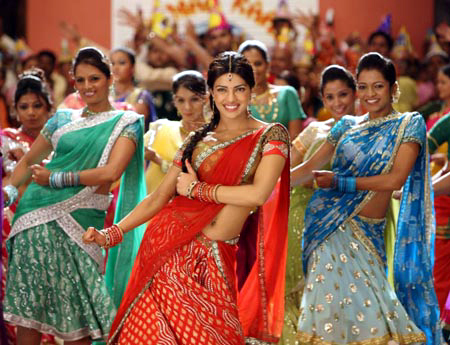
The high point is definitely the song medley performed at Pooja and Rohan’s engagement party, featuring classic film numbers that have lyric subtexts appropriate to the MDK plot and reproducing the original choreography (in so much as was possible).
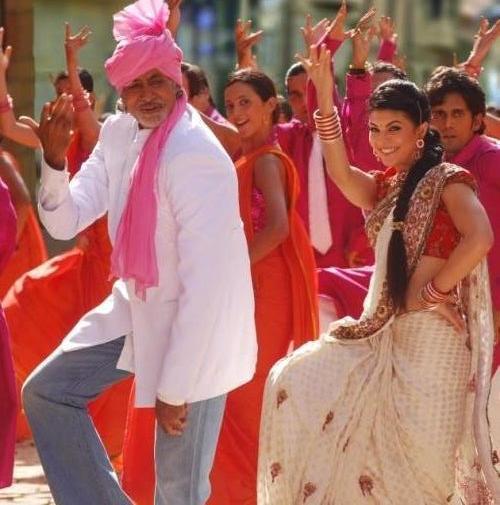
Hrithik’s aping of the “dance” stylings of Amitabh Bachchan in the “Pardesia” number was spot-on, and the medley shamelessly called back to the defining songs of each of the star couple’s breakout films: Kaho Na…Pyaar Hai (Hrithik) and Kuch Kuch Hota Hai (Rani). It was so good that I returned to it after the film to re-watch it–no kidding–four times.
I also thought it was a crazy inside joke the way they named the characters. Calling Rani, who played the Tina character in KKHH, Pooja and calling Kareena, who played the Pooja character in K3G, Tina, was bound to elicit either squeals of joy or, in my case, groans of disgust, from fans. And this song, which introduces the grown-up Raj character, starts out JUSTLIKE his entrance in KNPH:
Finally, here’s my rant on the email plot device. The film takes place in 2002, right? Which means, the first scene, when they’re kids, takes place 15 years prior, in 1987. Email in 1987 was very rudimentary and, unless you were a government professional or included in a business network, practically unavailable. Eudora, the first mass-market email program that made email easy to read and send over PCs regardless of what network they were on, was not introduced until 1988. So unless the families were extremely cutting-edge (Raj’s father seems to have been, because the reason for them moving away was to start a high-tech company in the West, but the others make fun of him for jumping on what is essentially unproven “fad” technology), they really would not be emailing to each other. But when does reality matter in these films?
Jenny K: Oh, dear…didn’t I warn you about slamming your head against continuity/reality issues in Bollywood films? You’ll just give yourself a headache and ranter’s cramp in your typing digits.
Julie M: Verdict: watch MDK if you like the actors, appreciate cute inside jokes and love dramatic true-love-with-obstacles film plots. It wasn’t a waste of my time (watching Hrithik never is!) but it wasn’t necessarily a prime use of it either. The film is available for $2.99 on-demand on YouTube.
[and to wind us up, the next week…back to a sweet surrender, sorta…]
 Julie M: Sorry, Bhai! (Sorry, Brother! 2008) is a pretty and low-key family drama with an unexpected ending. Boman Irani and Shabana Azmi play the modern parents of a small, close-knit family that includes two sons, stockbroker Harsh (Sanjay Suri) and scientist Siddharth (Sharman Joshi). As the story begins it is Siddharth’s wedding day, which occasions a flashback to 11 years previous when the family has traveled to attend the imminent marriage of Harsh to Aaliyah (Chitrangada Singh) on the island of Mauritius, where they both live.
As preparations are being made Harsh is involved in a work crisis, which throws Aaliyah together with his family, particularly Siddharth. As Mom struggles to learn to like her future daughter-in-law, Siddharth and Aaliyah fall in love. Once the triangle is out in the open, how the family deals with the revelation is the true heart of the film. The ending is warm and emotional without being maudlin (yes, I did mist up). This song from the film serves as a good teaser.
While I am not generally a fan of this type of story, I found myself gradually falling under its spell. It’s slow to start (I was nearly comatose during the first 45 minutes), but the depth of feeling between the characters builds to just the right amount, and the gorgeous Mauritius scenery was perfect for the winter blahs. The best part of the film, however, is the charming marital jodi of Boman and Shabani. They are completely adorable together and make the perfect couple. I couldn’t decide if I wanted Irani’s character more as my life partner or my dad.
If you like not-very-dramatic, realistic stories about sweet, romantic love, you’ll enjoy this film. I liked it well enough—2/5 for me.


 Five point someone: what not to do at IIT was Bhagat’s first book, published in 2004 when he was just 30 and after years of writing on the sly. Bhagat had attended IIT Delhi from 1991 to 1995 and majored in mechanical engineering, just like the three protagonists of FPS, Hari, Ryan and Alok. They meet on their first day at IIT and instantly bond. IIT (Indian Institutes of Technology—a national series of independent institutions, each specializing in specific curricula) is a pressure-cooker where grades are everything–they literally determine your future. The closer your grade point average is to a full 10 points, the more success you will find in life. Or so goes the common wisdom. Our anti-heroes find, to their horror, that after topping all their high school curricula and mugging (grinding) as much as is palatable, at IIT they can manage no better than a five-point-something. So they decide to roll with it, and proceed to have as good a time as possible in their college years without flunking out. Although there are some amusing incidents, overall things go from bad to worse as they cut classes, drink on the roof, pick up a girlfriend (Hari), ignore their homework in favor of a personal research project (Ryan) and prioritize their family’s happiness over their studies (Alok). They fight with each other and have repeated run-ins with their department head. Will the guys pull things out by graduation with their friendship intact? Or will their eagerness to have a good time ruin their lives forever?
 which had the same basic premise—three slackers at IIT—but went far beyond it, turning it from a college-antics novel into a strong bromance with a rom-com thread and megawatt star power. Aamir Khan played the Ryan-analogue character, called Rancho, an unconventional thinker with surprising technical gifts. Kareena Kapoor played his out-of-reach love interest. Sharman Joshi and R. Madhavan also starred, with Boman Irani playing the nemesis-professor and a fun cameo by Javed Jaffrey. The book was not followed closely although certain key events in the novel did reach the screen more or less intact, and each 3 Idiots character seemed to have attributes of all three of the FPS protagonists as well as quite a few original aspects. Suffice it to say that one can safely read the book without spoiling the movie, and vice versa. For a point-by-point comparison, check out
  At this point I moved on to Bhagat’s second book, One Night @ the Call Center (2005). As can be expected from the title, the novel’s entire action takes place in the course of one night shift, and all the characters work in the same group at a call center in Gurgaon. All are in their early-to-mid 20s and each has unhappy aspects to his or her life, which they all feel they are powerless to change. Numerous flashbacks illuminate the backstory of the romantic relationship between two of the characters, and pop-culture references abound in the exposition during the first two-thirds of the novel. Amid all of this young-person rhona-dhona a “defining incident” happens, and the Voice of God (!!) comes to the characters, inspiring them to believe in themselves in order to change their fates. The last third of the book has them doing just that.
 the film Hello* was released–before 3 Idiots, it should be noted–and Bhagat wrote the screenplay. Not surprisingly, the film follows the book almost exactly and even has the same 3 Idiots actor, Sharman Joshi, as the narrator/main character. I found Hello equally as boring as I found the novel, with low production values, comatose acting (with the exception of Sohail Khan as the volatile Vroom; Joshi’s valiant attempts at main character Shyam were obviously hampered by the inadequate script) and cheesy pseudo-philosophy. Obviously lots of people agreed with me, because it did terrible box office and was uniformly panned by critics who called attention to its weak script. Everyone learned something, particularly that writing a novel and writing a screenplay are two very different things. Maybe that’s why 3 Idiots was the bigger hit—Bhagat’s role was limited to script approval, which he gave wholeheartedly, and I think having that emotional remove allowed the professionals to do their job.







 Jenny Ketcham
 julialmoore
 Filmi-Goris