
Jenny K: When I read Julie’s reactions to her latest DVD, Kai Po Che! (2013), I was flooded with waves of déjà vu…I know that sounded familiar to me, that plot…and it was! I went to see Kai Po Che! at the theaters with my friend Pat back last February. Julie was kind enough to dig up my original reactions so we can compare them…as follows.
Jenny K: Sometimes I wish I research films more before I plunk down my hard-earned-paisa at the movie theater! The trailers are right out there, but did I watch them? No. Check it out.
Not saying that I didn’t like parts of it, but I had skimmed the positive review in Rediff (planning to review it myself, so didn’t want to prejudice myself) and had seen the director’s name, Abhishek Kapoor (Rock On!) and the Chetan Bhagat tie-in…well, I went in expecting a Dil Chahta Hai/ZNMD buddy-comedy-drama about cricket, and didn’t get the sentimental feel-good film I expected.

What we expected
Julie M: I must say that I was expecting the same thing, based on that trailer which did seem to focus on the bromance aspect and the joyful title (a shout of triumph in Gujarati, from kite flying), and was a bit disappointed as well, but I still liked it for what it was…mostly.
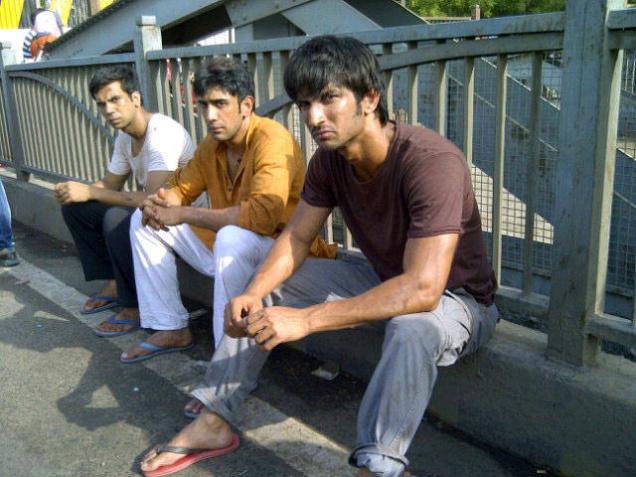
What it’s really like
Plot summary: Omi (Amit Sadh), Ishaan (Sushant Singh Rajput) and Govi (Raj Kumar Yadav) are best friends from childhood, now all grown up and out of college but going nowhere. Their dream is to open a cricket supply store/coaching school, but they have no money. Omi ends up borrowing what they need–twice–from his rich uncle Bittoo (Manav Kaul). The boys open the shop and it goes very well, but ironically, they start to drift apart just as they have made their dream a reality. Omi is guilted into assisting Bittoo in his political ambitions, and finds that he likes the work and believes in Bittoo’s ultra-conservative Hindu party beliefs. Ishaan discovers Ali (Digvijay Deshmukh), a young Muslim cricket prodigy and the son of Bittoo’s political rival, and he spends more and more time coaching him on the field and befriending him and his family. Govi secretly takes up with Ishaan’s sister and in order to feel less bad about deceiving him (and to avoid Ishaan’s wrath: he is very protective about his sister), spends less time around his friend. Things come to a head when political feuds turn personal, and a final confrontation turns their mutual lives into a tragedy.
Jenny K: I was very off-put with Ishaan’s short-fuse, touchy character, at least until he started teaching Ali. He kept acting as if everything was owed to him, the shop, the money to start the shop, success, everything, when all he had going for him was playing talent (so he says) and the arrogance of the young. When he snaps at outsiders, and also his partners, I found it very hard to sympathize with his problems, at least in the first half…and in the second, the change in him comes almost too late for me.
Julie M: That didn’t bother me so much. I felt it rang fairly true that this washed-up (at age, what, 22? 23?) cricketer would have intense amounts of anger and feel the world owed him. It’s not made explicit what derailed his career, but it makes sense that once he finds a protégé he would mellow out and feel that his life had purpose again. He’s even willing to risk his friendships to keep that relationship going: witness this scene where Ishaan steals money from the business in order to help Ali’s family rebuild after a devastating earthquake:
Jenny K: When the film went very political about two thirds of the way through I, not knowing enough of the local political subtleties, was rather lost about who was affiliated with whom, and why things escalated so quickly. I got the Hindu versus Muslim part, but I wasn’t sure if any of the three guys was, in fact, Muslim. Didn’t think so, but it might have made things clearer for me.
Julie M: None of the guys was Muslim, but Ishaan was protecting Ali and had come to love Ali’s family. He was acting in the family’s interests and that’s how he ended up where he did. I had the same problem you did: I felt that this final premise tearing our trio irrevocably apart seemed overly contrived and almost TV-movie-ish: set up for the purposes of this narrative. Yes, I know it was an actual historical event but the narrative seemed squeezed in around it.
 Jenny K: The actors, all relative newcomers, gave very realistic, affecting performances (Raj Kumar Yadav had done a nice bit in Talaash) but I felt the plot of the three life-long friends pooling their talents to start their business had been done better for me in Shuttlecock Boys, even though this film is more polished. It seemed to me that in stretching his scope as a director, Mr. Kapoor may have left the clarity and focus that he had achieved so well in Rock On! a film that I have watched several times, each time liking it more. Too much diversity of theme and intention is not always the best thing, especially in the shorter two hour format. Everything felt a bit thin and unsatisfying for me. I’d be interested to know how desi audiences took to it, or fans of the book.
Julie M: Yeah, I thought that the fact it was taken from a wildly popular (but critically panned) Chetan Bhagat book would speak well to it. Not as bad as that horror Hello that Bhagat wrote the screenplay for. At least he surrounded himself with a team this time.
Jenny K: Have you read The 3 Mistakes of My Life, the book this film is based on?
Julie M: No: I couldn’t stand attempting another CB book. Not my style. But his books tend to be humorous on at least one level, and this film had zero humor at all. Only one brief scene where they all smiled simultaneously, and that’s it.
Jenny K: Though I haven’t read any of Bhagat’s books, I’d tend to agree, having seen 3 Idiots, that this interpretation was abnormally solemn. The songs brought some lift to the spirits, but not enough. I liked this song, but it felt like one from DCH and sounded like a Shankar-Eshaan-Loy one from ZNMD
Julie M: It’s almost becoming a trope, three guys “coming of age” and facing tragedy, to the strains of singer-songwriter music. I liked Shuttlecock Boys better—it just felt less self-conscious about being a Message Movie.
Overall I felt that KPC had a lot of potential but in the end just left me cold. Because the action of the film was a giant flashback you know the ending–most of it, anyway–and once the political situation comes to a head you’ve figured it all out, and the denouement is almost boring. Except for the final scene, which I felt was tender and perfect and brought me almost to tears.
I agree with you that the cast was excellent and it is worth watching for their performances, and to me, for Sushant Singh Rajput alone. And it seems that he comes by the cricket knowledge honestly: his sister is a state-level cricketer! He’s definitely one to watch.
Jenny K: He sure is the flavor of the month, these days. Did you see…he has a new movie out, Shuddh Desi Romance, that has been getting pretty good reviews. I’m planning to go see it, soon.
Julie M: I noticed that one too—made a mental note to follow it up in a couple of months, because by the time I get the time to go out to the theater it is likely to have left.

 Five point someone: what not to do at IIT was Bhagat’s first book, published in 2004 when he was just 30 and after years of writing on the sly. Bhagat had attended IIT Delhi from 1991 to 1995 and majored in mechanical engineering, just like the three protagonists of FPS, Hari, Ryan and Alok. They meet on their first day at IIT and instantly bond. IIT (Indian Institutes of Technology—a national series of independent institutions, each specializing in specific curricula) is a pressure-cooker where grades are everything–they literally determine your future. The closer your grade point average is to a full 10 points, the more success you will find in life. Or so goes the common wisdom. Our anti-heroes find, to their horror, that after topping all their high school curricula and mugging (grinding) as much as is palatable, at IIT they can manage no better than a five-point-something. So they decide to roll with it, and proceed to have as good a time as possible in their college years without flunking out. Although there are some amusing incidents, overall things go from bad to worse as they cut classes, drink on the roof, pick up a girlfriend (Hari), ignore their homework in favor of a personal research project (Ryan) and prioritize their family’s happiness over their studies (Alok). They fight with each other and have repeated run-ins with their department head. Will the guys pull things out by graduation with their friendship intact? Or will their eagerness to have a good time ruin their lives forever?
 which had the same basic premise—three slackers at IIT—but went far beyond it, turning it from a college-antics novel into a strong bromance with a rom-com thread and megawatt star power. Aamir Khan played the Ryan-analogue character, called Rancho, an unconventional thinker with surprising technical gifts. Kareena Kapoor played his out-of-reach love interest. Sharman Joshi and R. Madhavan also starred, with Boman Irani playing the nemesis-professor and a fun cameo by Javed Jaffrey. The book was not followed closely although certain key events in the novel did reach the screen more or less intact, and each 3 Idiots character seemed to have attributes of all three of the FPS protagonists as well as quite a few original aspects. Suffice it to say that one can safely read the book without spoiling the movie, and vice versa. For a point-by-point comparison, check out
  At this point I moved on to Bhagat’s second book, One Night @ the Call Center (2005). As can be expected from the title, the novel’s entire action takes place in the course of one night shift, and all the characters work in the same group at a call center in Gurgaon. All are in their early-to-mid 20s and each has unhappy aspects to his or her life, which they all feel they are powerless to change. Numerous flashbacks illuminate the backstory of the romantic relationship between two of the characters, and pop-culture references abound in the exposition during the first two-thirds of the novel. Amid all of this young-person rhona-dhona a “defining incident” happens, and the Voice of God (!!) comes to the characters, inspiring them to believe in themselves in order to change their fates. The last third of the book has them doing just that.
 the film Hello* was released–before 3 Idiots, it should be noted–and Bhagat wrote the screenplay. Not surprisingly, the film follows the book almost exactly and even has the same 3 Idiots actor, Sharman Joshi, as the narrator/main character. I found Hello equally as boring as I found the novel, with low production values, comatose acting (with the exception of Sohail Khan as the volatile Vroom; Joshi’s valiant attempts at main character Shyam were obviously hampered by the inadequate script) and cheesy pseudo-philosophy. Obviously lots of people agreed with me, because it did terrible box office and was uniformly panned by critics who called attention to its weak script. Everyone learned something, particularly that writing a novel and writing a screenplay are two very different things. Maybe that’s why 3 Idiots was the bigger hit—Bhagat’s role was limited to script approval, which he gave wholeheartedly, and I think having that emotional remove allowed the professionals to do their job.
 Jenny Ketcham
 julialmoore
 Filmi-Goris