November 1, 2011: An Aamir To Remember

Julie M:  Can’t get enough of Aamir!  Got Hum Hain Rahi Pyaar Ke (We are Traveling on the Path of Love, 1993) from the library.  A very young Aamir takes on three orphans and falls in love with Juhi Chawla. I’ve never seen Juhi in a film before and I’m looking forward to this one.

Jenny K:  Aamir and Juhi are fun together, but that one doesn’t stick in the mind much.  All I recall are the plethora of kids, him having problems trying to control them, and also, a really goofy, though fun number with him as the boss at a factory. He looks a bit like a deer in the headlights (character choice, not actual fear) with all those love-crazed employees.

Also I think I remember a scene where she jumps out of her daddy’s yacht and swims to shore to escape his marriage plans for her. Three scenes, that’s it. I hope you can hang onto more of it.

IMDb tells me it’s a remake of Houseboat with Sophia Loren and Cary Grant, which I liked much more. I remember the film reminding me of another one, but Houseboat wasn’t it. Maybe I should watch it again with you and then I can clarify things for myself a bit.  Hmmm….they had songs and everything in Houseboat…maybe it is more of a remake than I thought.  Here’s a clip with Spanish subtitles, no less.

[a couple of days later]

Julie M:  HHRPK was something of a disappointment. I kept thinking I had seen it as a Disney film in the early 1960s: young uncle suddenly in charge of three wild kids, falls in love with the bubbly nanny, has business problems that the nanny helps solve… it’s the kind of thing that would star Brian Keith and Doris Day.  I found HHRPK similar to Houseboat but not an exact remake. Lots of running around and overly enthusiastic facial gestures, boing-boing sound effects and comically widened eyes. Just too much “comedy” for me.

Aamir as usual was great, so young, handsome and a stand-up guy, and we got to see his hobbit feet (which I always suspected he had). Lookin’ good in a long kurta. (hmm, wonder if I can get B to buy one of those?) Juhi Chawla was alternately adorable and annoying, as were the kids. The music was not very interesting to me–the background music was tinny and the female voice (sorry, Alka) was screechy.

I’ll give Qayamat Se Qayamat Tak a try as the last of the early Aamir films, and then I’ll give up. Love Aamir but sitting through the milieu of these early films is torturous.

Jenny K:  Before you give up on early Aamir completely…yes, QSQT is the one that put him on the map, but the one he did right afterwards, Raakh, is more up your alley, I think. He’s an anti-hero in it, a young man who watches a female friend of his get molested (he tries to help, at the time, but can’t) and wants the authorities to get her justice, but he finds out they are being paid off and won’t do anything. So he goes on his own search for justice.

Really roughly made, but very stark and intense (sort of like Aamir!). I can put them both in the next package, if you like. Dil with Madhuri has its charms, too, but I’m not sure enough of them to have you love it…they are rather spunky and look pretty good for being dressed ’90s, and all. One of my favorite scenes in it is a little silly/a little sexy bit at 7:03 on this clip when they’ve defied their parents, run away and set up a tiny shack for their first home. He’s cooking.

[about a week later…]

Julie M:  Qayamat Se Qayamat Tak (From Disaster to Disaster, 1988)…well. Yes. It grabbed me from the start–who can resist witnessing the beginning of a bitter family feud?–and I was hooked until the end. There were a couple of groan-worthy moments but overall just the right amount of drama, romance and humor.  I found it a highly faithful adaptation of Romeo and Juliet, with saris and item numbers. 

Plot summary: In the village of Dhanakpur there are two neighboring families, one the wealthy Singhs and the other the less-wealthy but still pretty well-off Singhs (gotta say, they throw a lot of men at you in the opening sequences and it’s difficult to understand, given the intense amount of emotion, who’s who).  Over the opening credits we see the start of a feud between the two families involving the pregnant daughter of one committing suicide and her lover from the other family being shot by her brother.

Cut to fourteen years later, when the brother is released from prison and comes home to his grown son Raj (Aamir Khan). Through a series of circumstances Raj meets Rashmi (Juhi Chawla), the daughter of the shot man’s brother, they get to know each other through the standard plot device of being stranded alone together, and they fall in love. He knows who she is but she doesn’t find out until much later who he is, but it doesn’t matter: they are irrevocably meant for each other. Of course the families find out and clash.

The two run away on the eve of her marriage to another man and very sweetly set up housekeeping in an abandoned shrine that looks curiously like the one in Sholay, rocky cactus landscape and all.

Her father hires thugs to track them down and do away with Raj while he takes Rashmi back to the city to marry this other dude. [Spoilers from here on] Raj fights the thugs and manages to subdue them, but not before Rashmi is fatally shot. He kneels by her side, takes out a knife that she had given him as a present earlier in the film and stabs himself in the stomach. They die in each others’ arms as the sun sets and their families look on in shock. [end]

Lots of opportunities for high drama in this film. Saving the honor of the family, children of bitter enemies falling in love, semi-secret identities, the visual theme of sunset throughout. I thought it was done very effectively with a minimum of cheesiness considering it was 1988. Aamir was so young and beautiful and romantic with his blow-dried hair and slim, muscular physique, and contrary to SRK, he can make fight scenes work. In other words, the man of anyone’s dreams.

Juhi was cute and sweet, so charming and lovable. Adorable together. I did not really enjoy the music very much, particularly the cheesy college-auditorium guitar number in the beginning, but the number seems to have been very influential in the soundtracks of later movies so I guess I’m forced to show it.  The song really reminded me of the end of Grease.
Jenny K:  Why?  I saw no spandex pants anywhere!  And no Fun Fair or carnival rides…

I haven’t watched this for a while but I do remember liking it quite a lot. One of the gang on Bollywhat mentioned that Aamir’s first wife Reena Dutta made a cameo in that “Papa Kahte Hain” number in the red dress at about the 5:00 mark. Very early on in their marriage, and they had a similar cross-religion marriage, if I recall correctly. He used to see her across the apartment complex on another balcony, and they fell in love, in spite of their differences in faith.  Sooo Sweet! I’m sorry it didn’t work out in the end.

Julie M:  I had predicted that this film would go another way: she would come up pregnant, but he would marry her, thereby reversing a generation’s worth of bitterness. But I guess this was still influenced by the days of noble tragedies rather than happy endings. Still, I liked this one much better than the Aamir/Juhi pairing in HHRPK five years later, when in retrospect she was getting a little old for cutesy-poo. And any day that I get to see Aamir bare-chested and in denim short-shorts (not at the same time, because that would surely kill me) is a good one.

Just for fun I did a “parallels” chart between QSQT and R&J. Amazing when I thought about it how exactly alike they are, from how they first see each other (party at her house) and the final death blow given by a dagger (although in R&J she stabs herself; in QSQT he stabs himself). And in both stories there is an unwanted arranged marriage for the girl: Paris in R&J and Roop Singh in QSQT. The difference is mainly time: the Indian version detailed the beginning of the feud between the families, gave the lovers time to get to know each other and time together once they ran away. And in R&J the tragedy inspires the families to set aside their feud, whereas in QSQT we don’t know what happens after the tragedy because the film ends too quickly.

But there is no good line in QSQT like this one of Juliet’s: “My only love, sprung from my only hate/Too early seen unknown, and known too late.” Or maybe there is, but it’s in Hindi.

Another one of the “25 best” crossed off the list!

[the next day]

Julie M:  Rushed to see Raakh (Ashes to Ashes, 1989) while I was still in an Aamir mood.  I could only see the first half because your disk had lots of schmutz on it and I couldn’t get past Scene 9. Maybe I’ll try to clean it well and attempt again later this week.  But from what I saw, I liked it a lot.
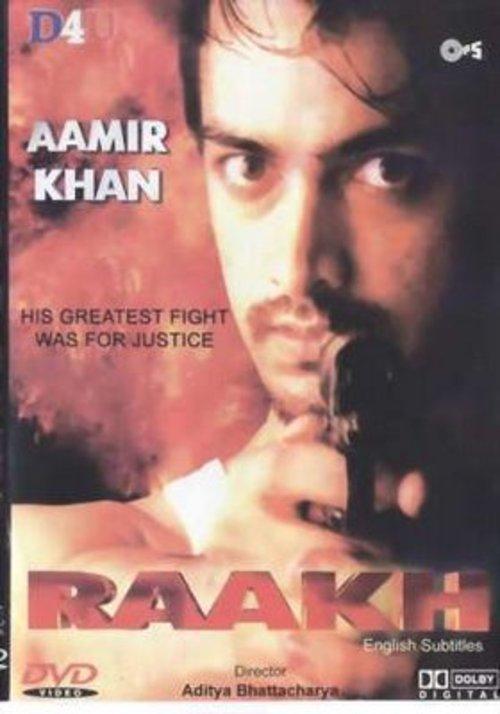
You already gave a plot summary but let me elaborate:  Amir Hussain is a somewhat wealthy but disaffected 21-year-old, done with college but with no idea what to do next.  He is also still somewhat obsessed with his ex-girlfriend, Neeta.  After a party, where he tried to get her back, they are intercepted by members of a local gang.  Amir tries to fight his way out of the confrontation, but they beat him up and he can only watch while they rape Neeta. 

Amir blames himself and slips into a depression, convincing himself that he owes it to Neeta to retaliate and takes steps in that direction by stealing money from his parents, buying a gun and trying to track down the gang members.  He approaches a local policeman, who (unknown to Amir) is familiar with the gang from a previous run-in and has in fact witnessed Neeta’s rape.  With the officer’s help he tracks down the gang, but the officer is suspended for assisting Amir in his vigilante vendetta.  The two of them then spiral into near-madness in their mutual obsession.

This is probably the film that showed Aamir as someone capable of more than the typical chocolate hero stuff. Only his 2nd film, and WOW.  First, he spends most of the movie unshaven, sweaty and brooding. Second, he does very non-hero things, like buy a gun and go out for revenge. Finally, there are no dance numbers or love scenes, both of which he had done well in QSQT.  Still, my eyes were riveted on Aamir (and wandered when he wasn’t in frame).

Warning to all: this movie is slow. Lots of time goes by with nobody saying anything. Most of the scenes take place in the dark. Everyone sweats. It’s very, very serious. If you are new to Aamir, my advice is to watch Lagaan and a couple of his later non-funny, non-romantic films before coming back to this, or you may be turned off.

Jenny K:  Gosh, I’m sorry there were some problems with Raakh…I don’t remember there being problems the last time I watched it, but you never know…the cheaper the video, the more likely the disc rot. The director, Aditya Bhattacharya, actually re-packaged and hopefully cleaned up the film for a re-release last year on the filmfest circut. Raakh Redux. Here’s the promo.

I had meant to order it…if it’s out on DVD yet.  I should look out for it, else my Aamir collection will be incomplete.

I remember really liking Pankaj Kapur in this…Shahid’s dad. He was the renagade cop that was advising Aamir’s character. Also, I thought it was interesting that he used a version of his own name in this film. Aamir’s father’s last name is Hussain, and the character name was Amir Hussain. I always thought that it was an indicator as to how strongly AK felt about the issue of police corruption and the protection of women.


Julie M:  Great point!! That makes this so much more personal and really indicates that Aamir, even back then, was more than just another actor in the great Bollywood machine. I also love that he can do these serious films and also the popular ones, with equal skill and acclaim.  But back then it was a huge gamble:  I read online that they only made six prints and released it in three cities.  And—can’t believe you didn’t point this out, you who know the inside scoop—his sister Nuzhat (Imraan’s mother) wrote the dialogues.
October 26, 2011: The Classics and the Kapoors

Julie’s been going into the back catalogue lately and catching up with some old (OLD!) films, just to understand where the young-‘uns are coming from.  Here’s the conversation, condensed from about 2 weeks of back and forth.

Julie M:  So last night, had the house to myself and watched Awaara (The Tramp, 1951). GREAT movie, thank you so much for sending it!

For those who haven’t seen it: Raj Kapoor plays Raj (I know, right?), a poor kid in Bombay’s slums. He lives with his mum, doesn’t know who his father is, but mum makes sure he goes to school and has high ambitions for him. Unbeknownst to him he’s being watched by Jaaga, a well-known dacoit, and it is Jaaga who gets him kicked out of school so he has to make his way on the streets with Jaaga’s own “help.” Nevertheless, he is as honest and upright as he can be under the circumstances and still keep himself and his mom fed.

One day, as he is casing a bank prior to a planned heist for Jaaga, he meets Rita (Nargis), and is attracted to her, and through a series of interactions (and mixups) they become close. The rest of the film is the gradual uncovering of the truth of Raj’s parents, Rita’s identity, and a couple of interesting courtroom scenes, all of which are too spoiler-filled for me to relate in detail. The ending is a bit weird for a Bollywood film in that it’s neither happy nor melodramatically tragic. Have to point out, also, that the part of the young Raj is played by his real-life baby brother, Shashi Kapoor.

The story is told backwards: we find out a mind-blowing secret/spoiler in the first 5 or 10 minutes before we can really absorb its impact, and then it’s a giant flashback from there starting at Raj’s pre-birth and building up to the extremely high drama that the revelation of this secret requires. There is of course romance and song, and one dream-sequence number that is as mesmerizing as it is howl-inducing (check out the heavenly slide!).

This was my first viewing of a Nargis film and she is absolutely incandescent. Maybe it was the old-movie-ness of it but she totally RULED the screen when she was in frame. This was also my first full-length experience with the Rajster and he’s awesomely talented.  Raj did lots of films with Nargis and their chemistry is undeniable, but in this particular one he often paled in her presence.  But here is a number where they are equally matched, and SO cute together.

So, two thumbs WAY up for this one.

Jenny K:  You have to love Rita’s first entrance in the courtroom…she is just riveting.  I couldn’t take my eyes off her.  For some reason the whole film reminded me of Citizen Kane, maybe because of the flashback style and the lush black and white cinematography, though it was filmed ten years later. Nargis is just lovely…Sanjay has her eyes, doesn’t he?

Also, the man playing Raj’s dad, the judge, is his real dad, Prithviraj Kapoor, who is pretty darned handsome and charismatic. PK is the Emperor, nine years later, in Mughal-e-Azam, but isn’t as much of a looker in this one. Still a wonderful actor, though.  Here’s a number from the film…one of the first big (partly) color historical extravaganzas starring Prithviraj, Dilip Kumar (eternally mopey), and Madhubala as the dancing girl Dilip loves and can’t have. The big numbers were hand colored, that’s why the color is a bit jumpy in some places. Never been my favorite film, but had some nice moments.

Julie M:  I thought Prithviraj Kapoor looked like a 1920s star–he has the hair and the mouth that heroes of that era seemed to have. Nargis…is not strictly beautiful (not like Meena Kumari), but so very, very talented that she seems to glow. Her slightly crooked teeth, I think, make her so appealing.


Jenny K:  Part of it must be to do with the lighting.  Black and white has an eternal quality all its own, doesn’t it? Raj is unique, but to me, his appeal is equal parts Charlie Chaplin, Ronald Coleman and even, occasionally, a bit of Clark Gable. Next I’ve got to try you out on Guru Dutt, another classic actor and see how you like him.


Julie M:  While you’re at it, I need a good Dilip Kumar starter movie…


Jenny K:  Can’t be a judge…I don’t get him at all…Mughal-e-Azam is one of his most famous and it is online with subtitles, but for $1.99. 

I don’t get Dev Anand, either, except in Guide, maybe.  


Julie M:  What about Shashi Kapoor? I’ve gotten to know Shammi, so I need to hit the Kapoor brothers trifecta!


Jenny K:  Shashi I liked in The Householder, in Shakespeare Wallah, in Bombay Talkie.

He also did a lot of films with BigB like Deewaar and Silsila which I haven’t seen yet, but probably should, as it’s with Jaya and Rekha, too and was really talked about because it was supposed to be rather art-imitating-life.


Julie M:  Oh, I guess that was Shashi as BigB’s policeman brother in Deewaar, so I HAVE seen him in something!


Jenny K:  Yeah, but I think he only comes into his own when he’s out from under BigB’s shadow;  he’s a bit muted in close quarters.


Julie M:  Silsila was on my list to try and see for BigB anyway, so I’ll get to that. I’ve also decided to work my way through the rest of the India Times “25 Best Bollywood Films” list that I haven’t seen…thanks to your advice I was pleased that I have seen quite a few of them already.


Jenny K:  I’ve seen all but four of the list. You’ll like Arth…Shabana and Smita Patil, both very good. Mr. India is a superhero thing with Anil blessed/cursed with invisibility, I think. I didn’t like Mother India as I said before. But, you may like it. Numbers 18 & 20 are Guru Dutt, both good, but I’m surprised they don’t put Kaagaz Ke Phool in it, too.   Waheeda Rehman, who you saw in Delhi 6, is so beautiful in that.  And you should skip Satya, it is Ram Gopal Varma and very gangstery, if I recall.  QSQT is Aamir, same era as JJWS and more emotional romantic stuff, but very famous, nonetheless. I’ll send it to you. Pakeezah is another Umrao Jaan kinda film.


Julie M:  I’m looking forward to Bobby, with Rishi Kapoor.


Jenny K:  I keep meaning to see that, too…Dimple at 16 years old and a budding sex symbol. Oh, wait a minute…you should see the Devdas from 1955 that is on that list…it’s Dilip Kumar! And you never did finish SRK’s version. Some people like the DK version much better, and not so overblown.  Padosan looks very slapsticky, but IMDB has it online for free through Hulu.


Julie M:  Yeah, I do have to finish Devdas one of these days. Maybe I should see the DK one first and then I can get through the SRK one. Or maybe now that I’ve seen more SRK I’ll have patience with Devdas.

[a few days later]

I watched the 1955 Bimal Roy version of Devdas last night. I didn’t like the story any better, although this time I hung on until the end.

Here’s a clip of the beginning.
http://www.veoh.com/watch/v17345903aG9AwYMh?h1=Devdas+1955

 
The most obvious difference is that the 1955 version spends significant time on the childhood relationship between Devdas and Parvati (Paro), and shows older backstory between the families. I think it makes the story a little richer. But the 2002 version is visually more lush, which I liked more (I found the 1955 version dull to look at). And has better music. I really liked Dilip Kumar as an actor (I want to see more!) and his portrayal of Devdas seemed more tortured but with less obvious effort doing so than SRK’s portrayal 47 years later. I guess that makes him better. Again, I need to finish the 2002 version to make sure.


Jenny K:  Ismail Darbar’s music from the 2002 Devdas is some of the best of his work that I’ve heard.  Doesn’t quite do as much for me as Rahman or Vishal Bhardwaj, but he still does some nice soundtracks.


Julie M: But in neither version (even less in the 1955 version) can I understand the attraction Parvati has for Devdas, as he is shown from minute one to be weak and selfish and downright abusive to her. Even after reading this scholarly analysis [by Corey K. Creekmur] and comparison of the 3 main versions I still don’t understand the fascination with the story.

Although did learn a lot from the article about the different filmmakers’ visions of the tale, particularly the 1955 version, which I felt upon my viewing to be the more artistic one despite the oodles of cash spent on the latest version.

So even though now I will go back and finish the 2002 version, I guess I am just never going to “get” Devdas. And if Devdas-the-story is an important part of the Indian psyche, I am probably never going to get that either.


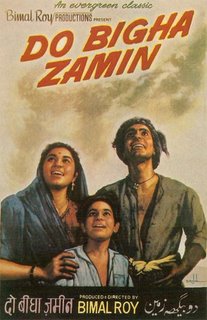
Jenny K:  Okay, you liked Devdas, sorta-kinda, or maybe just Dilip. Not to my taste, but I grant, I haven’t seen him in that many films, so maybe I should look deeper. He was just too weak a character in Mughal-e-Azam for me to get his appeal. I like Bimal Roy as a director…did you end up seeing Do Bigha Zamin (Two Acres of Land, 1953), online?


Julie M:  I did indeed… and I’m thoroughly bummed out now. At least Disha had something of a happy ending.

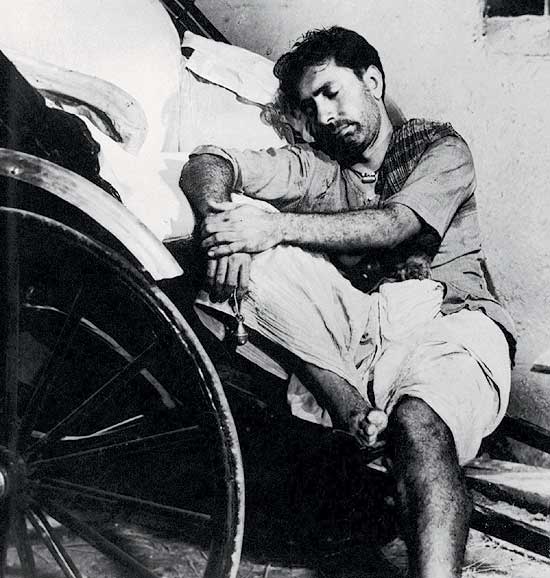
Brief plot summary: Shambu (Balraj Sahni) is a poor farmer with a beautiful, pregnant wife Paro (Nirupa Roy) and only two bighas of land to his name (about 2/3 of an acre). The local landlord has convinced the neighboring farmers to sell their land to him so he can build a mill, but Shambu won’t sell, and the landlord concocts a scam with his accountant to inflate Shambu’s debts to the staggering sum of 235 rupees.

With no way to pay the money, Shambu temporarily shifts to the big city of Calcutta where he has heard the money is just floating in the air ready to scoop up. His son tags along.  Of course reality is nothing like that and Shambu has to live in a slum and work as a rickshaw driver for pennies a ride. The boy also works, as a shoe shiner. The rest of the film shows the ups and downs suffered by the family both in the city and the village, although everyone survives ultimately (spoiler alert) they lose their money, their land and their home.

But I have to say, I was completely glued to the screen for the entire two hours. It was like a soap opera of the poor. I was a bit dubious in the beginning as it seemed to me like it was the type of highly moralizing and deadly boring “noble peasant” film that pretty much every country has to produce at least once between 1945 and 1965. And it sort of was, but I was pleasantly surprised at its watchability. Balraj Sahni, under the rags and grime, was very handsome and I really became attached to the good-guy character of Shambu. And there is a cute scene where the shoeshine boys talk about seeing the film Awaara and sing the title song.


Jenny K:  Do you get the feeling that all the best depressing films are Bengali???  They do seem to know how to nuance the pathos, don’t they?


Julie M: Compared to Disha it’s clear that this was the grandaddy of the genre and a landmark in Indian film. And I couldn’t help but notice the physical resemblance of Nana Patekar in Disha to the character in DBZ that opens the film, and the inspiration of this number to a similar moment in Disha, where the poor people are trying to lighten their lives in song.

Although similarly melodramatic [Spoiler: Paro comes to the city and is almost instantly kidnapped, nearly raped and run down by a motorcar as she makes her escape–and the only rickshaw driver around to take her to the hospital is none other than Shambu!] DBZ is far from the escapist fantasy of Awaara, which has another poor but honest man as the lead character.

Even though you had already put the idea in my head that Aamir Khan had gotten inspiration from DBZ for the look of the countryside in Lagaan, I was even more tickled by the very closely related picturization and music of the “it’s finally raining” songs in the two movies. Here’s the one from DBZ, which occurs moments after the film starts:

And here’s the one from Lagaan.

Anyway, I thought DBZ was a great film, definitely worthy of the “25 Must-See” list and best of all, it’s online free with subtitles on YouTube. Here’s Part I.   


Jenny K: Though DBZ isn’t a film that I watch over and over again, it has been one whose memory sticks in my mind and lingers there.  Bimal Roy was certainly a master of his craft.


Julie M:  And finally, I got a good dose of Shashi Kapoor by watching Shakespeare Wallah (1965), not technically a Bollywood film since it’s British-made and in English.

Like most Merchant-Ivory films it developed too slowly for my impatient tastes, and I hated the Shakespeare bits for being bad and overblown, but I guess the troupe was not supposed to be a very good one. Shashi was excellent and GORGEOUS, but his character was not manly in the grand tradition of Bollywood manliness. I guess since it was an English film he didn’t need to be, but instead of the tragic hero (yes, Devdas was weak but he had a certain consistent sense of misguided but manly self-sacrifice) we got to see a pseudo-manly but ultimately scared and weak person too afraid to figure out what he wants.  So, good actor, bad character.


Jenny K:  Actually, I found myself being impressed by Shashi’s lack of vanity in doing this role.  His character is, as you say, not a likeable one, if lovely to look at.  He had to know that he wasn’t playing the hero when he chose it.

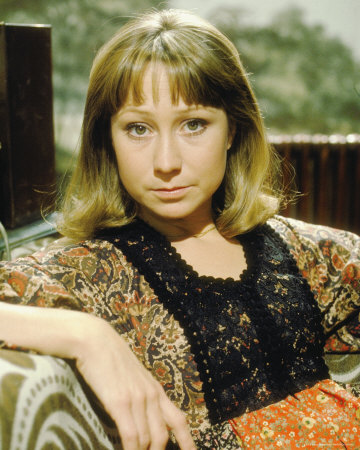
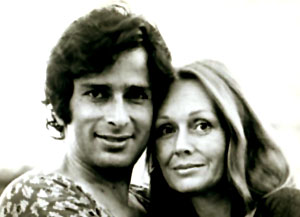
On the superficial side…the only thing I remember fixating on was that he was romancing his sister-in-law, Felicity Kendal, in that misty walk they took together. His real wife, Jennifer, Felicity’s sister, played someone else in the film altogether. Odd…perhaps they wanted someone younger against him, or someone more of a known quantity in England, which Felicity is. I really enjoyed Felicity’s autobiography White Cargo which told about the times in India with her family. 


Julie M:  She was REALLY young in SW.  I think she was supposed to be around 17 or 18 at the most.  A real ingénue, both on stage in the troupe and in moviemaking since this was her debut film.


Jenny K:  Very true.  I’d forgotten that.  However, you should see Jennifer Kendal (Kapoor) in her prime in Bombay Talkie with her hubby, or in an award-winning turn in 36 Chowringee Lane….an Aparna Sen-directed mood piece.  So, lots of worthwhile treasures to find in Classic Bollywood, if you are willing to dig back a bit in time!

Oct. 20, 2011: On The Table ~ The Middle Age Spread

Jenny K:  Since we had been talking literature adaptations recently, I ran across and decided to watch Such a Long Journey (1998) on Netflix the other day, an adaptation of Rohinton Mistry’s (author of A Delicate Balance) 1991 novel. Frankly, I picked it out for the cast; Naseeruddin Shah, Om Puri and Roshan Seth. Even a young Ranjeet Chawdhry (The Last Holiday, Bollywood/Hollywood) has a great cameo as a talented street artist. Yet with all that talent, the actors seemed to have been encouraged not to shine, to be as ordinary as possible.  Here’s a typical scene, with Roshan Seth and his family not really relating.   

If they wanted to show the dark and dismal everyday side of contemporary Indian life…this movie has it in spades. Poor Gustad (Roshan Seth). His life is one long frustration. He works at a drab bank, with drab people, they have ordinary drab conversations. He and most of his friends have everyday hopes and dreams for their families and lives, but none of them seem to come true. His wife, Dilnavaz (yes, the Ice Candy Man’s name in Earth…which kept throwing me off… I thought it was a man’s name), played by Soni Razdan is faded and almost drab, too.  She’s worn out by how hard they have to work for so little…and her husband’s optimism just irks her when it shows up, as in the episode where he brings home a live chicken, so she can cook it “fresh” like his grandmother used to do. His son, Sohrab (Vrajesh Hirjee) hates his life and how his family is pushing him to be an engineer…and that’s the upbeat part of the film. Really, here’s another typical clip…at least he’s getting out a bit with a co-worker.

Julie M:  From what I know about Mistry as a writer, he idles at dark and dismal.  There are particular political backdrops in his books that are important to know about, and the whole point of his books seems to be the extra chaos politics causes on regular people who are just trying to live their lives amid all the other non-politics-related stuff that happens.  Such a Long Journey is from the time period of the big India-Pakistan war—same war as in Border—and although I’ve not read it (I’m going to have to now, though) I can bet it’s a similar “you are there” total-immersion experience like A Fine Balance was for the Emergency period.  The clips at least show it to be highly realistic.

Jenny K:  Yeah, he’s a one-man antidote to the Bollywood feel-good film glut.  But the way films are going these days, there’s a shortage of those films now.  Pessimism is the new Peppy in film USPs. 

But back to the film, to put a cherry on the top of my disappointment, Naseerji’s character (my main reason for watching) is just there peripherally.  He’s an almost mythical character who rescued Gustad from a car accident (that we see in flashbacks) and involves him with Om and some probably fictional espionage dealing with the Bengali Resistance, Indira Ghandi and the Pakistani problems of the 1970’s.  So, the big guns are there for so few scenes (except Mr. Seth, of course) that it scarcely merits their being in the credits. The plot twists about this resistance movement are really convoluted, too and neither Pat (my co-pilot in tedium) nor I really understood all the nuances of it in the first place. So, in spite of the cast, and the atmospheric cinematography, I can’t really recommend it…even if Roger Ebert really liked it.

Julie M:  Actually, from your description and the clips this seems like something I might like.  It’s a Canadian production, so it seems designed for Western audiences.  The big question is:  book or movie first? I probably shouldn’t have looked at the clips…now I’ll imagine Roshan Seth instead of whoever my brain chooses to put there…

Weird that while you were watching Such a Long Journey, I also watched a film about a drab man, but mine was much more uplifting than yours seems to have been.  Khosla ka Ghosla (“Khosla’s Nest”, 2006) is a low-key, low-budget dramedy about working together as a family to achieve your dreams.

K.K. Khosla (Anupam Kher) is a fairly milquetoast, middle-classDelhi salaryman, close to retirement, who has just spent his life savings to buy a plot of land on which to build a dream house for his family. His family is a tad dysfunctional—I would say more disconnected than an actively bad family—the film opens with K.K.’s dream sequence that he has died and his family barely notices, being tied up in their own concerns literally over his white-wrapped and flower-bedecked corpse.  But they grudgingly humor him in his obsession with the plot and the dream house.  His family is his wife, older son Bunty (Ranvir Shorey), younger son Cherry (Parvin Dabas), and an unmarried adult daughter. Bunty is of an entrepreneurial temperament but hasn’t seemed to actually start a business yet, while Cherry is a gainfully employed software engineer who, unbeknownst to his family, has arranged a new job in New York and is about to emigrate.

Jenny K:  This is a complete non-sequitur, and I don’t expect an answer, but…was Anupam Kher ever young?  I’ve been watching for almost ten years now, and have gone a ‘fer piece back in my viewing, and he’s always looked the same.  Villain or nice guy, lawyer or teacher…always with the balding head and the lovely warm, weary eyes.  The portrait of perennial middle-age.  I wonder if he regrets never being thought of as a bankable romantic lead in a film?  I mean, without it being a comedy riff, like in KKHH.  He’s such a good actor; he could probably pull it off creditably.

Julie M:  On the day the plot is to be consecrated, the family discovers that a squatter has walled it off and claimed it as his own. Here is that scene, which beautifully shows the characters of K.K. and his sons (no subtitles, sorry):

[The writing on the wall means “Don’t pee on the wall!”]

The squatter is Kishan Khurana (Boman Irani), a wealthy and powerful developer. K.K. returns to the property agent, who encourages them to visit Khurana to clear up the “misunderstanding.” Khurana offers to vacate the land upon payment of half the Khoslas’ purchase price, which the Khoslas cannot afford. They complain to the police, who are in Khurana’s pocket and merely laugh off the complaint. Trying to resolve the situation through the legal system only leads to more frustration. 

Having exhausted standard methods to resolve the situation, the family turns to more creative ideas. Bunty’s brute-force plan ultimately lands K.K. in jail, so Cherry (on very short time due to the impending emigration) reluctantly gets involved. He comes up with an idea featuring his friend Meghna (Tara Sharma) and her theater troupe: con Khurana with a fake land deal and use the mobster’s own money to pay him off. There are of course complications, mainly resulting from the nervousness of the con’s star character who must play a wealthy and sophisticated NRI. Here’s a clip of one of many moments where the con almost falls apart:

I’m not going to spoil the ending but, since it’s billed as a comedy, you can generally assume that things don’t end up worse than they started out.

The acting in Khosla Ka Ghosla is wonderfully underplayed. The comedy aspect is gentle and subtle where it could have been played for huge laughs, and is the result of the viewer’s knowing people in their own lives exactly like the characters in the film. Relationships are developed in such a way that the viewer ends up loving all the characters equally, making it a true ensemble piece although the Cherry character is pretty much the focus. The family drama aspect derives from typical intergenerational conflicts: Cherry is embarrassed of his given name and his father’s traditional values, hence his desire to emigrate to a more “modern” culture (it is telling that he cuts his face out of a family portrait to use it for his US visa application), and K.K. is reluctant to rock the boat or do anything shady despite the insistence of his family that he shouldn’t stand by and be taken advantage of. Watching this family eventually pull together in the face of corruption on every level to make the patriarch’s dream come true is exceedingly charming.

Jenny K:  That last bit with Cherry’s situation reminds me a bit of the father/son dynamic in The Namesake, down to the name issue.  A universal theme, I guess.

Julie M: If I had any complaint, it is a typical one: the female characters are heartbreakingly undeveloped. We never even learn the names of K.K.’s wife and daughter, they are used so little. Meghna fares better as a character, probably due to the need for a love interest (it IS an Indian film, after all!) but given that she is supposedly an accomplished actress, it is strange that they do not think to use her at all in the con, falling back on her nervous director-boss as the ruse’s central figure.

Jenny K:  It was the same with the female characters in Such a Long Journey!  Dilnavaz was a one-emotion portrait, almost, and the only other female characters, the sweet little daughter, the sexy co-worker, the cranky upstairs neighbor, all were drawn with a very hasty brush, there only to convey their points through visual shorthand.  And don’t get me started on the little girl’s missing doll…there’s a symbol that I can’t even begin to translate, or even think about. Shudder.

Julie M:  Anupam Kher and Boman Irani turn in typically excellent performances, with Irani’s tendency to go overboard nicely held in check by the director. Parvin Dabas’ performance as Cherry was beautifully nuanced–you could tell the moment when he decided to throw his lot in with the family he thought he hated. It took me a while to place him, but eventually I recalled that loved him as the handsome NRI groom in Monsoon Wedding.

Verdict: if you love small indie American and British movies you will love this.  I sure did.

Khosla Ka Ghosla is available on YouTube with English subtitles:

Jenny K:  And Such a Long Journey will be much harder to find, unless you have Netflix, it’s only on VHS, I think…but, now that I think about it, maybe some Journeys are better left untraveled.

October 12, 2011: Books for Bollywood Lovers

As you may have realized by now, I am a geek and therefore a reader.  In fact, following Indian films for the past six or seven months has seriously cut into my reading time.  But as a literary fiction addict and a new inductee into the world of Indian film, I was particularly thrilled to notice that three Man Booker Prize*-associated novels are perfectly compatible with film enjoyment and over the past couple of months I have eagerly devoured them.

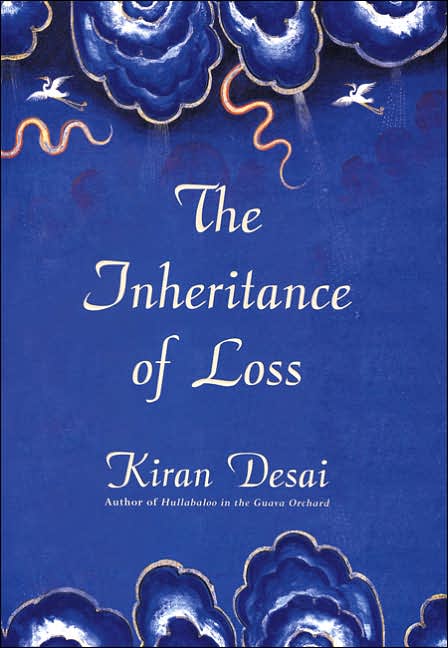
If you are in love with the beautiful Himalayan setting of films we’ve discussed in this blog like Professor, Barsaat Ki Ek Raat, The Blue Umbrella, Jab We Met and Jo Jeeta Wohi Sikander, as well as in the hundreds of other Bollywood productions and item numbers filmed there, try reading The Inheritance of Loss by Indian-born, US-based novelist Kiran Desai (Man Booker Prize winner, 2006).  Set on the India/Nepal/Sikkim border during a Ghurka uprising in the mid-1980s, Loss is simultaneously a girl’s coming-of-age story, a meditation on the changes time has wrought to a particular Anglicized lifestyle, the plight of the not-well-educated NRI in America and the horrors of political turmoil, all with loving descriptions of the gorgeous local landscape and buildings.

Sai Mistry is 16, a British-educated Indian girl living with her retired grandfather in a crumbling yet still elegant house outside of Kalimpong. She is in the flush of first love with her tutor, a local Nepalese youth sympathetic to the Ghurka cause. Her grandfather is very bitter, raised to expect certain things as a Cambridge-educated man in pre-Partition Delhi but having had to settle for the life of a rural judge in the Himalayas. Lack of funds has led them to dismiss all but one servant, their cook, whose life savings has just been given to his son Biju so he can emigrate to a better life in New York.  Unfortunately Biju, with little education and virtually no English, can only find hard labor in the city’s ethnic kitchens for minimal wages as he moves about evading the INS and learning that America is not the land of opportunity it’s cracked up to be. As the novel progresses, its chapters alternating in perspective between Sai and Biju, we learn about the grandfather’s upbringing and early adult life, the circumstances under which Sai came to live with him, and the lives of other village denizens, all of whom have in common a reduced quality of life, shattered dreams and uncomfortable reactions to the swift changes Indian culture is undergoing.

I found Loss beautiful and touching, not a little sad, the language at times a thicket of imagery requiring some time to penetrate, but ultimately a testament to the human spirit.  To my (admittedly little) knowledge there are no plans to turn the novel into a film, but if there were, I can easily see Sanjay Leela Bhansali, with his love of rich fantasy-like detail as is evident in films like Devdas, as the perfect director.

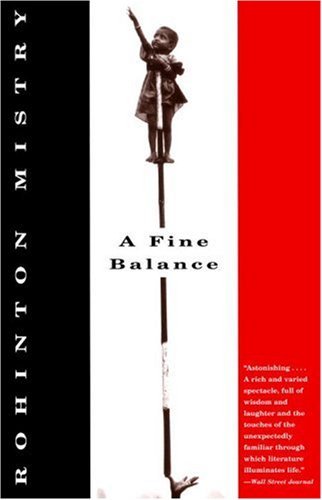
If you enjoy the reality-based, epic-feeling films of Deepa Mehta or the intimate characterizations directed by Aparna Sen, you might enjoy Rohinton Mistry’s A Fine Balance (Man Booker Prize shortlist, 1996).  Between the main characters’ detailed backstories (often including those of their parents as well!) and the epilogue, the novel encompasses episodes, often horrific, of both village and city life from the 1920s to the 1980s.  However, the main action takes place in the course of about a year starting in 1975, at the beginning of the Emergency declared by Prime Minister Indira Gandhi that had the unintended consequences of terrible human rights atrocities.  Mistry himself was born and raised in Bombay, and emigrated to Canada as a young man in 1975 during the Emergency.

Dina Shroff Dalal is a middle-aged, middle-class Parsi woman, tragically widowed in her youth, who takes in a college-student boarder and runs a small (two-worker) garment factory in her house in order to make ends meet and stay independent of her controlling older brother.  Her boarder, Maneck, is the son of a fellow Parsi school friend, the friend having moved to the mountains upon her marriage and reluctantly sent her son to the “city by the sea” (never named, assumed to be Bombay) to get a certificate in the up-and-coming field of refrigeration and air conditioning. (remember: 1975!)  Her workers are Ishvar and Om, a Hindu uncle-and-nephew pair, who have been ostracized from their village for having dared to independently upgrade their caste from cobbler to tailor.  They are also suspect among their fellow Hindus for their utter lack of hatred towards Muslims.  All of the main characters are emotionally damaged but they have inner strength; the tale of how they live (the Ishvar-Om sections are heartbreaking), learn to trust and even love each other, and rely on each other to survive a politically, economically and socially difficult historical time, is ultimately uplifting and the stuff of the serious end of Indian films.

AFB is very easy to read, with clear language that is nevertheless evocative, a tight plot and familiar dialogue.  Since this is literature, astute readers will notice certain minor characters and devices that form circles and arcs, teach lessons and support the main story in exceedingly artistic ways.  A warning:  if upon reading this book you internalized the characters and the time period, and understood (if maybe not liked—I guarantee that you will experience some anger) the incidents which came upon them at the close of the main action, you might want to skip the epilogue, which looks in on the characters in the year 1984.  It is very difficult to read.  I admit that I cried a little.  The novel has been adapted into a play, but I think it would work extremely well as a film.  If I were casting it, I would tap Shabana Azmi to play Dina, Imraan Khan as Maneck, Naseeruddin Shah as Ishvar and for Om…well, find me a scowly teenager, nothing remotely chocolate about him, with a flaring anger and resentment of the world.

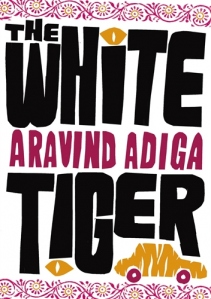
If you like smart-mouthed and cynical modern heroes (and anti-heroes) such as those played by Shah Rukh Khan, check out The White Tiger by Anglo-Indian novelist Aravind Adiga (Man Booker Prize winner, 2008).  A present-day, first-person narrative written as a series of letters to the Chinese president by a snarky youth, Tiger details the pervasive corruption, casteism, and just plain lack of funds that combine to block a young man’s entrepreneurial dreams.  The ways he uses his wits and a willingness to break longstanding cultural taboos in order to get ahead are as entertaining as they are shocking.

Balram Halwai, who we learn on the first page is an admitted murderer, begins his autobiography as a clever boy living in a village in rural Bihar, nicknamed “White Tiger” by his schoolmaster for the way he stands out from the other children yet unable to camouflage himself and his gifts within the prevailing culture.  Poverty forces him to quit school, and he uses his imagination (and not a little fakery) to upgrade himself to the job of driver in the household of a wealthy landlord.  The landlord soon asks him to drive for his son, who is moving to New Delhi, and this wider view of the world both intrigues and disgusts Balram.  The resourceful Balram becomes even more aware than he was of the extremes of Indian society and the causal relationship of corruption to wealth and power.  Ultimately, he realizes that the only person looking out for him is himself and if he wants a piece of the “new India,” he has to let go all of his previous assumptions about morals and do whatever is necessary to achieve his desires.

Those whose tastes run to the appreciation of traditional Indian family values as promoted in Bollywood films might find Tiger’s narrative arc and irreverent tone fundamentally distasteful.  However, I found Balram’s voice funny, satirical and refreshingly real in a world that still has illusions about what modern India is like.  Smuggler Films’ John Hart (The Revolutionary Road) has acquired the film rights to The White Tiger, Mukul Deora (Bheja Fry 2) is one of the producers, and Haneif Kureishi (My Beautiful Laundrette) is set as the screenwriter.  The Chennai-born Adiga has jokingly said that he has in mind the perfect actor to play Balram…Rajinikanth.  (he goes on to say that there is “only one” actor in Hindi cinema who could play Balram, and we can probably guess who he’s thinking about.  Another “dream cast” can be found here)

And there you are.  Three literary novels that may deepen your appreciation of Indian films–or that your love of Indian films might excite you more about.  In a way I hope none of them make it to the screen—I much prefer the scenery in my head as I read than to subject my vision to that of someone else, no matter how excellent it might be.  I have several other works in a similar vein scheduled to read and comment on, so consider this the first of a (mercifully short) series.  Jenny and I have also vowed to read (or in my case re-read) Salman Rushdie’s Midnight’s Children and comment on it before it comes out as a film towards the end of 2012.

*The Man Booker Prize is a 43-year-old, annual and very prestigious award for contemporary fiction written by citizens of British Commonwealth countries plus Ireland.  The selections are known for their high literary quality as well as their accessibility to general audiences.  The 2011 award should be announced soon.

Oct. 4 2011:Ranbir, Ajay & More Bhagat Singh…Deol With It!

Julie M: Finished Shaheed: 23rd March 1931, the Bobby Deol version of the Bhagat Singh story.   I saw it mostly for the story, which I fell in love with in The Legend of Bhagat Singh, and I hate to leave similar films uncompared, so here goes.

It was way bloodier and more violent than the Ajay Devgan version, but Bobby did not play Bhagat as intensely as Ajay did. The production value was significantly lower and cheesier, and the early part of the story seemed rushed. The Ajay version spent a lot of time on the early years, while the Bobby version spent more time stressing the family-drama aspect of the story. Aishwarya had a cameo as the girl Bhagat refused to marry, which seemed jarring. The songs weren’t translated, and the subtitles generally were pretty bad (sometimes no subtitles at all!). The English were portrayed as complete idiots as well as evil in this version, whereas in the Ajay version they were just clueless and a bit scared. I was actually more impressed with Sunny Deol’s performance as Azad than I was with Bobby’s as Bhagat.

Comparison: here is the “Sarfaroshi Ki Tamaana” song as sung in the Bobby Deol version:

And in the Ajay version
Here is the “Mere Rang de Basanti Chola” number in the Bobby version:

And in the Ajay version.

 
So, Bobby Deol may have looked more like the real Bhagat Singh, but I liked the Ajay version better. In a nutshell: the Bobby-version of the story was hit-you-over-the-head whereas the Ajay-version was more subtle and actually more stirring for it.


Jenny K:  It may all come down to AR Rahman vs. Anand Raj Anand/ Surendra Singh Sodhi. Nobody beats the Rahm! And though I liked the Bhagat Singh version, I still think I like the Rang De Basanti version, just a tad better, as I said before… Aamir’s voice-over just gets me all shivery…what a guy!

Sunny Deol will always, sorry to say, beat out Bobby on acting talent whether or not he tries. He actually is very supportive of baby brother, but has, at least until recently, been the most visible star. His movie Gadar, holds the record for highest gross made for 2000-2009. He can really pull them in. Is that the first one you’ve seen him in? Have you watched Border yet?  Here’s one scene, the odds are against Sunny’s boys, 150 Hindustanis to 2000 Pakistanis but he’s going to give it all he’s got, attitude-wise.

And here’s a backround piece on the filming.

Border gives you the emotional side of “the women left behind” and also tells a real story about the 1971 Indo-Pakistani War where the Pakistani Air Force came in and surprise bombed 11 Indian air bases with no warning. Indira Ghandi sent her troops on all fronts, and beat them back so badly that the whole thing was over in 11 days with Pakistan ceding Bangladesh to independency. It’s the best of its kind in all ways, except, perhaps, for the “happy to go to war, dancing with my tank” song, which is catchy, if incongruous.

[next day]

Julie M:  Saw the first half of Border. I get that there’s some personal stuff there, but it’s still a war movie and I’m not a fan of war movies. Still, I’m enjoying Sunny Deol’s performance and Akshaye Khanna had one great scene where he blew the cr*p out of one guy, after having failed to do so at his first opportunity.  Tell me if it gets significantly better in the 2nd half, because I’m just about ready to quit.


Jenny K:  All I can say is that I liked Border…I found the performances good and I liked the personal back-stories. I think Sunny’s best scenes are in the second half, when things get toughest, but if you’re not liking it, you shouldn’t watch it.

Sonny doesn’t tend to do many comedies, so if you like him, you’d have to take him in some earnest, heroic drama, and this is one of the easiest to take, military-wise. Maybe you should see Gadar: Ek Prem Katha. Not my taste, but it was a Really Big Hit. Set during partition, about a Sikh guy falling for the Muslim girl he rescues and how they fight to stay together, despite religious differences. Sunny has played a lot of soldiers and sardars in his time.

He did one comedy recently, Yamla Pagla Deewana, with Bobby and their dad, Dharmendra, but it looked so PriyaDhawanish (my new term for unrelentingly slapstick) that I just couldn’t do it. Here’s the trailer, see what you think.

Julie M:  I’ll finish Border, then. So far the war aspect is overshadowing everything else, in my mind. B was very surprised when he saw me watching it, because he knows I don’t watch war movies.

 [the next day] 

 So I finished Border, finally, and you were right, it did get better. (I should always, always finish Indian films before I pass judgment on them!!)  The dyad of the characters played by Sunny and Akshaye was brilliantly done, and although a minor role, I enjoyed Jackie Shroff’s air force commander, as well. It was a treat to see Suniel Shetty portraying a young, idealistic soldier, given that previously I’ve only seen him in villain or criminal roles with a hard-etched face. Each of the characters who died (no spoilers here — given that it’s a war movie) performed acts of supreme heroism in defense of Mother India, and the scene where the Sunny Deol character got misty over the death of an enemy soldier was heart-wrenching.

However, I was unprepared for the absolute bloodiness and sheer length (probably close to 45 very intense minutes) of the final battle scene. War sure is hell, and the realism of it in Full Technicolor was probably quite shocking to audiences because it completely unhinged me–yet I had to keep watching. Here’s one of those scenes.

I have to credit the filmmakers for resisting the temptation to do the battle in slow motion, and if I have one criticism it is the maudlin nature of the very final scenes where they intercut images of the battle aftermath with tear-jerking impressions of the families at home — including one character’s cancer-stricken wife, who was previously only alluded to but never seen in flashback. Oh, and the truly annoying cry/chant of “Hindustan, Hindustan, Hindustan” at the peak of the action disturbed the mood — obvious pandering patriotism is never my thing.

Here is the stirring scene at daybreak where the Air Force can finally come to rescue our boys.

[Bringing the political theme to the present day, we both watched Raajneeti (Politics, 2010).]

Julie M:  Raajneeti is one of those films where a plot summary reveals too many spoilers, so I’ll make it brief:  This is the story of the ins and outs of one Indian election as we follow a political family and their associates.  After a bit of backstory on the mother of the political family and how she married into it, we are introduced to the younger-generation Pratap brothers and their families as well as to Indu, a young woman from outside the family with some political ambitions.  One brother, Prithvi (Arjun Rampal) is handsome and politically ambitious, while his younger brother, Samar (Ranbir Kapoor) has just come back from his PhD studies in the U.S.  A family tragedy catapults Prithvi into electoral (and familial) competition with his cousin Veeru (Manoj Bajpai), and Samar reluctantly takes a role after a second tragedy.  Here’s the trailer:

Jenny K:  Raajneeti doles out its own style of gunfighter justice which seems to be the predominant way to run a government in India, if Bollywood filmmakers are to be believed. Yuva, RDB, and other similar films of the past decade paint the picture of ultimate corruption by a group of morally bankrupt would-be contenders for office who are willing to do anything and everything to get their man (or woman) in power.  If that’s true, all I can say, is run out of the polling places, and straight for the airport… Just don’t stop and roll down your taxi window on the way there. You may get blown away. I certainly was. 

Julie M:  Although I felt the film had crazy, over-the-top dramatic tension–I kept thinking the level and volume was more appropriate to a TV miniseries rather than a feature film–I really enjoyed Ranbir ‘s performance as the reluctant-cum-ruthless political strategist. Ajay Devgan–love him–was a little disappointing as the outsider behind the opposing campaign, as it seemed to be a role he could do with his eyes closed rather than a creative challenge. Katrina Kaif was OK as Indu, Nana Patekar was perfect as the older political mentor, and what is it about Indian movies, where they choose American actors to be the least convincing possible to avoid upstaging the Indian actors?  The Ranbir character’s girlfriend was horrible, just horrible.

Jenny K: While you’re right about the lack of effective white actors in Indian films, this girl isn’t at all the weakest…trust me.  Her character was meant to be a quiet reproach to Samar, and not someone to steal focus…and she did that reasonably well.  She reminded me of Jennifer Garner, favorably, more than once.

Otherwise, the performances were uniformly pretty darned good. Nana Patekar was, as usual, a true artist, layering his portrayal with so many degrees of gray that he could have hidden among the newspaper clippings of his great reviews.

Ajay Devgan looked fetching with his dark, simple wardrobe, gold earrings and now patented scowl, but on the whole I wish he had more to do. He had only two really good scenes, the one at the very end with his mentor Veeru on the roadside, where he showed some grace even when losing, and then the scene on the hillside with his mother. Wonderful expressive looks flew across his face as he reacted to her admissions. Frankly, as much as I love Ajay, I didn’t know he had that much subtlety in him. Bravo!  Here’s the director Prakash Jha and Ajay talking about their history together. 

This Making of Raajneeti video is interesting, too.

Arjun Rampal is shaping up as a rather tasty villain/psychopath these days. Always elegant, a killer with style. Much more interesting than his sweet, sensitive victim roles like his banker-turned-robber in Don or his edge-of-slacker musician in Rock On! And Manoj Bajpai turns in another slick moustache twirling version of the ultimate single-focus campaigner, Veeru. He showed us all the layers of Veeru’s insecurities, that drove him and tripped him, simultaneously…very nice. And Ranbir Kapoor, did his turn as the youngest Corleone brother…oh, I meant Pratap brother…easy mistake with all that ruthless mayhem and the schmaltzy pseudo-Sicilian soundtrack going on…with a degree of underplaying that I wasn’t expecting from the Saawariya Song and Dance Man.

 Only the women in the film seemed a bit muted in Raajneeti…Mom, Indu and Sarah, the gori girlfriend were scarcely there.  I wondered whether some of the girls scenes got left on the cutting room floor, but if this example is anything to go by, probably not…window-dressing.

Here’s the full movie with subtitles on YouTube.  But it’s in pieces.

Julie M:   Not only was it a political thriller, it was the tense story of a political family where there are secrets, jealousies, alliances and emotions equal to the best soap opera. This was a film that could have gone either way for me, but I actually liked it. Critics seemed to hate it, it was highly popular, but I thought it was a pretty good catharsis. I found myself cheering people and then in the next breath booing them, rolling my eyes at one thing and holding my breath at the next. A bit bloody for my taste but it fit the action. The only problem was that I ended up not really liking any of the characters, and waiting for each of them to get what they deserved. And each one of them did, except for Nana Patekar, who got off scot-free.

Jenny K:  Cheering and booing…becoming a real typical filmi-girl audience member, aren’t you? 
But while Nana got off without having to get his come-uppance, but the real crime to me was [spoilers] letting Samar off on his flight back to the US with only a weak token of a mea culpa “Gosh, Indu, I never wanted to be a politician…I knew I wouldn’t like who I’d become”…Understatement of the Year! What about a scene where he tried to take his mother back to NYC, and she turns her back on him and leaves? Or Indu finally donning a backbone with her robes of office and arresting him as her first official act? [end of spoilers] Would have been appropriate…What was his doctoral thesis again? “Sublimated Violence in Victorian Literature”? A natural!


Julie M:  Nice analysis. The only thing I’ll take issue with is your characterization of Prithvi as a villain. I’d call him obsessed and ruthless — and pretty dumb — but I think he genuinely wanted (!) to get into politics for more than just personal power or family pressure, and eventually he came to realize that the cost was starting to mount up but by then it was too late, he had to push on.

I agree that Veeru was the most interesting character to watch, outside of Samar, who actually got a bit boring towards the end with his sheer villainy. You could almost see Veeru’s head splitting with all the conflicting emotions.  And Indu was just a cipher from the start.


Jenny K:  Manoj Bajpai is always a great character actor…you love to hate him. Though, in this film, that’s so full of questionable ethics and downright villainy…you can’t throw a stone without hitting a baddie. It’s harder to decide who you should identify with…even mom is a liar.


Julie M:  That’s why I said earlier that I came away not liking anyone. But I think Prithvi was the closest to sympathetic, except Indu, who ended up being used by everyone. Even though Prithvi was not clean, he did realize that it had all gotten out of control. And then [spoiler alert] he was blown up, so… Veeru was more psychotic than Prithvi—he had the crazy eyes from minute one!


Jenny K: I was looking for a clip of Manoj Bajpai with subtitles and found one that looks as if it belongs in this article…another historical uprising film called Chittagong.  Not out yet, though it was made last year.  There’s always a new one coming out…hope it’s as good as it looks!

October 2, 2011: Always a Bridesmaid, Never the “Bride”

Love stories come and go;  some become classics and sometimes they just get an E for Effort… Who knows what makes one stick in your mind and heart? As an example, let’s compare the new romance, Mausam with the classic Dilwale Dulhania Le Jayenge and see how it stacks up.

Jenny K:  I went out last weekend to see the latest Shahid Kapoor film, Mausam (Seasons) with my friend Sultana.   Well…though it is by no means awful, I’m not sure it merits the bother of a full review. Pankaj Kapur, the freshman director and Shahid’s father, attempts a large, lush, multi-year love saga in the recent past that seems to be aiming for an old time “missed connections” romance with many things reminiscent of Gone With the Wind. It boasts military attacks, burning cities, a rioting populace, the birthing of babies, toddlers in peril, scores of the dead and injured, helpless females who wait endlessly for their men and/or get threatened with rape…Why Mr. Butler…eh, I mean Mr. Kapur…all I can say is Fiddle-dee-dee! You can’t do Gone With the Wind without a Scarlett and Rhett to keep you interested!

As cute as they are…and Shahid has proven more than once that he can do that, especially in his dance numbers…Shahid and Sonam are just not seasoned enough, or gifted enough or their characters aren’t well written enough to sustain the audience’s attention throughout an almost three hour film. Aayat (Sonam), who has lost way too much weight since Saawariya, IMO, ambles about the place like a pretty, young giraffe giggling and retreating throughout the film. She does it so often that she could easily assay the part of a cuckoo in any cinematic clock big enough to hold her. Lovely, but gawky and too tentative, I was left wondering why Hari (Shahid) was so struck by Aayat’s charms. Especially when her rival is the live-wire, Aditi Sharma, the sweet, friendly daughter of the local baker, who steals focus in every scene she’s in. 

And the same goes for Shahid’s Hari. While he’s portrayed as a callow youth, he’s charming and funny, especially when covered with flour, mud, leaves or whatever gets dumped on him in his pursuit of Aayat.

But when he misses his first chance to secure her love (her father spirits her away to Mumbai) he just metaphorically shrugs his shoulders and consoles himself with his love of jet airplanes, and joins the air force. Now, would Rhett do that? For that matter would SRK’s Raj let things stand like that in DDLJ? nahi…Nahi!!…NAHI!!!  I think NOT! Hari is too ready to let things go with the status quo for my taste, not even using his more modern resources effectively to find her during the next SEVEN YEARS! Phones, phone books, relatives, and to some extent, computers (it is only the early 1990s, I realize) could have cleared up this star-crossed mess, with at least one or two reels to spare.

And I will just touch briefly on his Top Gun wardrobe of flight suits and ubiquitous aviator sunglasses! Yes, he looks fetching in this ensemble, but, really, if they’re laying the fly-boy stuff on us, couldn’t they afford to have him do more than one flight sequence instead of just endlessly striding to or from the jets on the tarmac with flight helmet tucked neatly under his arm to allow his locks to waft photogenically in the breeze! And I coulda done without the pencil-thin moustache in this middle section, but I kinda liked the stubble into beard that he sported toward the end. It aged his baby-facedness a bit.

And again, Shahid had an almost inconvenient bit of standby eye-candy to distract me, I mean Aayat, in the form of one Vaibhav Talwar…Note to self: I must go back and watch Teen Patti again. Yowza!   Sorry for the lapse, but with “costars” like these, any reviewer would be tempted to bury the leads!

Summing up, I thought Mausam was a noble effort that fell sort of flat, and definately LONG. Worth seeing only for the great shots of Edinburgh, Scotland (I want to go back!!! Calton Hill!!! Sigh) and Shahid’s wonderful dancing.   2.5 out of 5 stars.   Here’s my favorite example from Mausam, “Saj Dhaj Ke”

And somebody please tell me what happened to Anupam Kher’s character…he just disappeared! 


Julie M:  Oh, well.  Sorry for your waste of time.  I had already made up my mind not to see it, and to catch Shahid’s dance numbers via clips. Too bad this was disappointing—I actually liked him in Jab We Met although I know you are not overly a fan of his. 

But to cheer you up, I have good news for you.  I had a half-day today and it was cold and windy out, so I decided to spend the afternoon warm and cozy on the couch watching a DVD, and it had to be something feel-good and not too thinky. In short–the perfect day for DDLJ. Yes, I took the plunge, and totally fell in love with it. 

For the twelve people on the planet who have not seen it, since it’s been constantly running [in Mumbai] since its release 15+ years ago, the full title is Dilwale Dulhania Le Jayenge (The Brave Heart Will Take The Bride, 1995).  Here’s the trailer (English subs): 

And here’s a quick plot summary.  Simran (Kajol) is the London-born daughter of a Punjabi convenience-store owner (Amrish Puri), and is reluctantly engaged since infancy to Kuljit, the son of her father’s friend, back in India.  As a last fling before marriage she begs her father to let her travel with her girlfriends for a month in Europe.  As it happens, wealthy, fun-loving and insouciant London-born Raj (Shah Rukh Khan) is also on the same European rail tour with his buddies. They meet incredibly cute, she hates him, they end up missing their tour train in Switzerland and then travel together for a while with adorable consequences. 

After they part they realize they are each in love with the other (not knowing that the other feels the same way).  Here’s that scene, shown with him flashing back to their Switzerland time and scenes where she imagines seeing him everywhere: 

Simi’s dad learns that she met a boy in Europe and instantly whisks her off to India for the wedding.  Raj tries to reconnect with Simi, learns that she has left, and trots off to try and intercept her.  The rest of the film is the unfolding of Raj’s very original plan, and its unintended consequences, to stop the wedding and convince Simi’s dad (who already hates him due to an incident in the first half) that only he can make Simi as happy as she deserves to be.

This all sounds very rom-com formulaic, but really, it comes across as very fresh and engaging.  Maybe I’m just used to how it all works now (the goofy first half and melodramatic second half), but I suspect it’s because the SRK/Kajol pairing is absolutely impossible to beat. Sure, there are massive plot holes (if all her luggage was taken away on the train, how could she make all those costume changes when she and SRK were on the road? How the heck did he find her knowing just that she was “Somewhere in the Punjab”?), but who doesn’t love love when it’s presented so charmingly?

This is my new favorite love song, when he just shows up in her field inIndia: 

And who could fail to adore this classic Amrish Puri look?

So, I get it now, I really do. I promise not to rag on SRK too much from now on. And I know I will watch DDLJ every time I need to be assured that even though life really s*cks sometimes, it all works out in the end (and if it’s not working out, it’s not the end).  And I know you like “girls vs boys” dance numbers, so here’s  the one in this film: 


Jenny K:  It took me a while to “get” SRK, too, unlike my buddies Pat and Kathy who fell into Kamp Khan almost from the start. And weirdly enough, the reason I didn’t like him at first (beside the goofy slapstick) was that I kept seeing stills from Devdas and thought he was just “too pretty” for my taste with the big doe-like eyes and long eyelashes, etc. I told that to one of the store managers (the pretty part, not the eyelash details) and he looked at me like I was crazy. Well, after a few of Shah Rukh’s offerings, over the course of time, he began to sneak in to my psyche and, as you know, I quite like him, on most occasions, and always find him charming. I like to think I have a more evenly dispersed love of Bollywood Male Amazing-ness, but it may be that I can’t choose just one!

As to the charming…this is one of my favorite interviews with SRK on CNN. In three parts, here’s a link to the first one.  


Julie M:  Great interview!  Mostly I like him, too, but there are a few facial expressions that really turn me off (that “lip trembling about to cry” one, for example).   But I never really got the absolute adoration of an entire country and the diaspora for him, until DDLJ.  Raj’s speech at the end about loving her so much that he was willing to give her up to another man if it’s truly what her father thinks is best for her…yeah, that was kind of a ruse on his part but he said it so convincingly, and it rang all the cultural chimes so loudly, that no wonder the actor and character became conflated in the public imagination.

DDLJ is available for rent through YouTube.   As usual with YRF rentals the aspect ratio is likely going to be goofy, and I don’t know if the rental comes with English subtitles. [the page says you can turn them on]


Jenny K: I guess it’s safe to say that though you can put the boy in the village and the girl in the field of yellow flowers, it may not be enough to call up the same responses that Aditya Chopra gave us with his Dilwale Dulhania Le Jayenge.  Lightning doesn’t often strike twice…but please, directors, don’t stop trying to find it, because when the jodi has jadoo, it’s unforgettable!

September 28, 2011: Amitabh ~ Changes and The Guard

Julie M:  Eklavya:  The Royal Guard…the only thing I can say is thankfully it was short (only 108 minutes), otherwise I don’t think I could have taken the high emotional level–unbroken by levity of any kind–much longer. This film plumbed just about every dramatic trick in the canon: death and mourning, secrets, loyalty and duty, father- and mother-love, admiration, jealousy, romantic love, intrigue, suspense, conspiracy, and, oddly, marksmanship. And beautiful countryside, stunning traditional costumes and jewelry (in a film set in contemporary times), and the coolest old fort ever.  Here’s the 60-second (non-subtitled, but you get the emotion) trailer:  Exciting, yeah?

Jenny K:  I liked Eklavya when I saw it in the theaters… a period visual treat.  Not that I remember that much, except for the “surprise” reveal toward the end. BigB was good, and as you said, and the cast is great, with Saif and his mother playing royalty (such a stretch!) but they did it well.  Vidya was good, as per usual, and you got to love a cast that has Boman, Sanjay, Jackie Shroff and Jimmy Shergill, who I usually like, even though he WAS in Mohabbatein. The producer/director Vidhu Vinod Chopra is often associated with quality productions, 3 Idiots among them.


Julie M:  I’d do a plot summary but there would be too many spoilers, so I’ll skip it.   The fact that the film started with a Shakespeare sonnet should have been the tip-off that the action would be very Shakespearean in its layers of plot and emotion. And it was, in spades. Amitabh Bachchan’s performance as Eklavya, the man torn between love and duty to his royal employers, was mesmerizing–I literally could not take my eyes off him. Saif Ali Khan as the young Prince was likewise excellent and mostly kept his shirt on. Vidya Balan as Saif’s almost offhand love interest did not have much to do except moon after Saif and lip-synch a pretty song, and her most dramatic speech was given as a voice-over, which I thought was a waste of a perfectly good actress.

Here’s Vidya’s song, “Chanda Re”: 

Even if you don’t understand Hindi, you can tell how dramatic and loaded the film is.  Lots packed into a short running time.

Sanjay Dutt had an all-too-brief role as the police chief who admired Eklavya at the same time he was resentful of how his family had been historically mistreated by the royal family. I think more could have been wrung out of that situation. Boman Irani was a little over-the-top, but still excellent, as the vengeful king, and Jimmy Shergill could have amped up the acting a little more as his jealous nephew–I know he’s up to it.

Normally I am not a fan of EFD, but that’s mostly because it usually takes a tiny bit of normal and perfectly understandable emotion and spins it out endlessly to no real point–we get it already. This was crazy-unusual emotion–the kind that nobody ever has to contend with in real life because, come on, who is ever in the position of having [spoiler alert]your son whom you can never acknowledge murder your beloved royal employer, and have it be your sworn duty to kill him in return? This is what movies are for, actually.

And I have to put this in even though there are no subtitles, because Saif is shirtless and for once it’s not gratuitous: 


Jenny K:  Not sure about that…Never seen the main celebrant shirtless in a Rajasthani funeral.  Only in the South.  Maybe it’s a Brahmin thing. 

Well, I’m glad to see you can handle Eklavya‘s EFD if given the right encouragement!   It’s occasionally worth the effort.

Julie M:  This one definitely was.  If Shakespeare would have decided to set a tragedy in India, he would have come up with something very similar to this, except in Shakespeare Eklavya would have killed himself in confusion, Saif would have been driven insane with remorse and Vidya’s character would have wailed over the end credits.

As it was, the ending was almost uplifting: [spoiler alert again] Eklavya declares his duty to be wrong (!!!), Vidya’s character forgives Saif’s character for killing his own father (!!!!!!) and Saif, throwing custom, tradition and royal protocol to the winds, publicly acknowledges Eklavya, a commoner, as his father (!!!!!). I mean, sure, it was set up that Saif felt stifled by all the tradition and custom of his homeland and position and had escaped to London to avoid it, but in that situation doesn’t the typical Indian film end with the son coming back, assuming his royal duty and realizing with pride that the old ways are there for a reason?  And the ending also seemed wrong for Sanjay’s police chief character. If he was so resentful, why would he be so happy to [spoilerscover up the misdeeds of the family who did his family bad? [end]

But despite all that, my verdict: Excellent–one of my faves.  It’s available on YouTube with English subtitles.

I couldn’t find any clips with English subtitles, and the dialogue is so important to this film—you’ll just have to watch the whole thing!

And to balance it out…as an older BigB movie, I really liked Abhimaan (Arrogance, 1973). It was weird (as always) to see Amitabh in a romantic role, but then as the film went on it all made more sense why he was cast. And he and Jaya have huge chemistry together.


Jenny K:  I saw this film in 2005 when Amitabh picked it as one of his twelve favorite films when Lincoln Center wanted to do a retrospective of his work. As I couldn’t go, I chose a few of them to watch and liked this one best. IMDb says that Jaya and Amitabh liked this film so much that they helped bankroll it…which must have been quite a stretch, as they had only been working in film for about five years, at most, and Zanjeer was the most famous film he’d done to date. Sholay and Deewaar hadn’t happened yet. Here’s the whole movie with subtitles for those who haven’t seen it.


Julie M:  Plot summary: Subir Kumar (Amitabh Bachchan) is a well-known pop singer with tons of fans, nice house, doting manager/companion, and a hip wardrobe (for 1973). One day he decides to visit the aunt who raised him in the small village she lives in, and meets Uma Devi (Jaya [Bhaduri] Bachchan), the neighbor’s daughter, who also sings, albeit shyly. They fall in love, marry in the village and he takes her back to Mumbai. At their wedding celebration they sing a duet, and although Subir’s manager is excited to have them start singing together, a well-known musician warns against it. Then, of course, they are blissfully happy for a while afterwards. 

Jenny K:  I especially like the scenes with them together in the bedroom. Very sexy, without actually seeing anything. Wah, wah!  What chemistry! Lovely to see them young and in love.

Julie M:  They record a song, and it is an instant hit. They are hired together for concerts and playback, but slowly she becomes more popular than he is. Subir starts resenting her, drinking heavily and spending increasing amounts of time with his friend Chitra (Bindu), who adores him. He also quits singing in a fit of pique, but doesn’t tell her. Uma eventually realizes what’s going on and can’t watch him throw his talent away; she quits singing too and returns to her village, where she finds out she is pregnant. Ultimately she suffers a miscarriage and sinks into a deep depression, which finally rouses Subir to go and bring her home, where she doesn’t get any better.

Subir finally understands that she blames herself for his unhappiness, and realizes that the only thing that will make her happy is if he starts singing again. He hires a hall and schedules a concert–she perks up while he is on stage alone but when he starts singing their duet she bursts into tears. He brings her on stage, they finish it together, Chitra (sitting in the front row) realizes that he and Uma are made for each other, and the film ends with the audience’s applause. Here’s that final scene:

 Jenny K:  This film always reminded me of an Indian version of A Star is Born…the young wife gradually surpassing the older established husband… but with more of the religious aspect to it…and, of course, a happier ending, which actually, seemed more realistic than ASIB‘s. Beaucoup melodramatic, with James Mason walking into the waves and Judy Garland singing her solo to him onstage…”I am Mrs. Norman Maine!” Applause…Tears…Applause… I can’t believe that Karan Johar hasn’t remade this one with the genders flipped and SRK quavering that teary statement at the end of the film. Can’t you see it?


Julie M:  Oh, I can TOTALLY see KJ remaking ASIB. There was a whiff of that in Taal, perhaps, but to go whole hog…yes. SRK plus…who? Madhuri? Rekha?


Jenny K:  Would have to be someone like Rekha, who is older than SRK, if we were to do the whole gender flip thing…but I really think Dimple would be better for him…more sympathetic and believable. Madhuri is actually younger than SRK.


Julie M:  Anyway, I really liked this portrait of a man with a gigantic ego getting knocked down and finally learning to put that ego aside for the sake of his marriage.  Very moving—and unconventional for a man of that era—yet he is utterly convincing in all the emotions he is called upon to portray. And, as I’ve said before, ’70s fashions were made for his body type: even the most hideous shirt patterns look good on him. At one point he wears a beautiful rust-colored silk kurta over white pants that almost made me swoon.  

Have to say that this is quite the negative role for him. He is a spoiled brat, his manager is an enabler, and even though it’s part of Indian culture for men to assume women will keep the males’ needs as primary in the family, his character really fell apart when she started winning all the awards and getting the attention. One could read this as a frustrated diatribe against women’s liberation by the male establishment, but the ending is a realistic portrait of the compromises that everyone has to make in a marriage and how personal pride has to be put aside sometimes.

Also, this is only the 2nd film I’ve seen “young” Jaya in, and I don’t know if it’s a coincidence that both times she played very shy and subdued characters, or if it’s the kind of role she is drawn to. Just once I would like to see her doing a character who is happy. When she wasn’t in the frame with BigB she was very flat; again, can’t tell if that’s the character she was playing (a woman who only comes alive in the presence of her husband, in which case, ick) or if it’s her normal mien.


Jenny K:  I haven’t seen that many of her films, but she always seems to find roles with gravitas. I don’t think I’ve ever seen her in a light role, unlike Shabana, who takes time out from angst to do a comedy every so often. And Jaya took a good amount of time off to raise the kids. As I’ve said before, she’s always the one who can make me cry, no matter how many times I’ve seen the scene…”He just made a mistake, Naina…he was a good man!” Sniff, sniff…just thinking about the church scene in KHNH…I get all teary.


Julie M:  Gravitas is one thing–Shabana and Manisha do gravitas–but making a name for oneself out of absolute stoicism and blank expression, particularly in one’s youth, is completely different and kind of a risky career choice.   I read that it was doing this film that tipped Jaya towards taking that many-years-long acting break when she started having kids–to avoid the breakdown of the marriage.


Jenny K:  I see what you’re saying about Jaya, but only seeing five of her films, I don’t want to make that assumption that she let herself be pigeon-holed. She was the top actor in her graduating class, over the men, even… Hey, found this article on Amitabh’s appeal by the fabulous David Chute who says if we want to see Jaya as a “diminutive firecracker” and a “headstrong teenager” we should look for Guddi and Mili, both by Hrishikesh Mukherjee. 


Julie M:  I have to say, for a story that has music at its core, I really wasn’t all that moved by the songs. They all sounded very similar and were quite slow, and although I know she’s a national treasure, something about the quality of Lata Mangeshkar’s voice in these songs really grated on me.

All in all, both Eklavya and Abhimaan amply show what star power BigB has, and has always been.


Jenny K:  Just goes to show that whether you swathe him in lurid polyesther or bury his magnetic mug in birds-nest-crazy facial hair, Amitabh Bachchan will always emerge the quintessential star…some things about him will never change.

September 23, 2011: Chocolate Heroes a la Mode: 90’s Style

Summer’s over now, but there’s still a bit of heat in the old Bollywood favorites, especially in the World of the Chocolate Heroes.  What?  You haven’t been there?  Haven’t met a few of them?  Yet, if you’ve wandered through the emotional rollercoaster of the gloriously overdone 1990’s, you’ve met them.  I’d like to quote fellow Bollyfan, Filmigirl (who has a wonderful site at filmigirl.blogspot.com), who gives quite a helpful definition:

A young, fresh-faced hero who specializes in romantic roles is called a chocolate hero (or sometimes chocolate boy).  The term comes from a time when handsome pictures of men used to decorate boxes of chocolate and there is a bit of a negative implication to it.  A chocolate hero may be popular with the ladies but he is usually seen as nothing more than a pretty face and any film starring a chocolate hero is going to have a heavy romance focus.

Earlier this month Filmigoris had fun critiquing some of the current crop of Chocolate Boys, but this week we jumped into the Bollywood Dessert Cart of Days Gone By with a pair of delicious (mmm) CB’s more of our own age;  one who became HUGE and the other, well, has not been as fortunate.  Julie watched Aamir Khan in Jo Jeeta Wohi Sikander, and Jenny continued her Kumar Gaurav film festival with Phool.


Julie M: Watching Jo Jeeta Wohi Sikander (He Who Wins Will Be the Conquerer, 1992).  It’s so juvenile but I’m irresistibly drawn to Aamir and the cute Farah Khan choreography.

The setting is beautiful Dehradun in the Himalayas, where there are 12 colleges and scads of pretty young people who go there, and hang out at Mall Road, a filmi-strip-mall on the street that ties the colleges together. (I swear it is the same set used for the village in Koi…Mil Gaya) No malt shoppe, but there might as well be…the kids love ‘50s pop music, which tells you the general tone of the film.  All of the colleges are rivals and at the end of the year have a multi-sports competition including a bicycle race, with the honor of their college and personal accolades to the winner at stake. (Figured out the ending yet?)


Jenny K:  It’s about the race, not about the ending, Jule…who cares how it ends as long as  you look stylin’ gettin’ there!  They do look stylish, right?


Julie M:  Our yummy heroes:  Ratan (Mamik Singh, in his debut film…of five) and Sanjay (Aamir) are brothers, students at the lowest-class college and the sons of a cafe owner on the Mall Road. Ratan is an athlete, and at the beginning of the film just barely misses winning the big sports competition to Shekhar (Deepak Tijori—a chocolate villain, if you will), a very rich and popular, but not very nice, Rajput College boy.

Sanjay, on the other hand, is a slacker, interested only in fun and pranks and is the bane of his father’s life.  His best friend is tomboy Anjali (Ayesha Jhulka), the daughter of the owner of the mechanic shop across the road. She is awesome and fixes cars and bikes like nobody’s business. (Why are cute, fun, bubbly, tomboy girls always named Anjali in these movies?)  She is also in love with Sanjay (did I really need to say that?) and trying to find a way to tell him.  This number, which comes during the village Diwali celebration, sums up their relationship, where her friend is coaching her to play hard-to-get: [Sorry no subtitles available on this song.]

What happens next is 100% something out of John Hughes.  The new hot girl from Queens College, Devika (Pooja Bedi), meets both Shekhar and Sanjay. Shakar chats her up and she is interested, but it is Sanjay who, by pretending to be wealthy and applying a combination of lies, humor and pranks, wins her heart. However, to keep it, he steals money from his father to upgrade his wardrobe and buy her expensive gifts. Check out this pretty number, “Pehla Nasha”, where he is silly in love with Devika, and Anjali is silly in love with Sanjay: [full video starts twenty-some seconds in]

Then comes the big inter-school dance competition featuring about the most boring dance numbers ever with oh-so-subtle subtext (NOT) –check them all out starting at 5:19  here,  and continuing here, where Devika finds out the truth about Sanjay, dumps his a** and takes up with Shekhar. (At this point Jenny’s disk quit working and I had to finish the movie via YouTube with no subtitles…so I’m fuzzy on the nuances of any dialogue)  To top it off, Sanjay’s father figures out the stolen money situation and banishes him from the house.  Things are not looking good for our boy.

Meanwhile, Ratan is training for the next competition. One day he is ambushed by Shekhar’s crew, beaten senseless and accidentally slips down a cliff; he is rushed to the hospital in a coma. Sanjay (in admittedly the best acting job by Aamir in the film) realizes that he has been a bad brother and bad son, and vows to clean up his act and get revenge on Rajput by winning the bike race.

OMG, this is supposed to be a remake of Breaking Away?! Well, I guess I can see it in the “snobby college boys vs. townies” plus a bicycle race.  But nothing else.  I just wish they’d stop calling it a “remake” if so much is different. It’s “borrowing.”


Jenny K:  In the classical world they call it “Variations on a Theme” and it’s perfectly acceptable.  Go figure.  But you realize that this was well before Aamir had enough clout to demand and get original plots…nowadays he does…yet still he did Ghajini.


Julie M:  Cue typical ’80s training montage to kicky music (amazingly Sanjay does not wear an ’80s sweatband, but he does wear very short and tight white shorts, mmm), where Anjali helps him and he finally realizes that she is the right girl for him.  Then comes the big bicycle race and you can pretty much figure out what happens from there—winning, redemption, accolades, proud dad, blah blah blah.

My review:  The first half of the movie was completely, idiotically derivative, besides being a hair and fashion disaster.

Hey, JJWS!  1985 called you in 1992 and wanted their decade back!

And was there a ‘50s-filtered-through-the-’80s trope that was NOT used in this film? Poor Aamir, he did his best but couldn’t overcome a bad script and rip-off storyline. NOT Breaking Away, not even close. Phoo on you, Internet, for spreading that vicious untruth. Here’s what was common: bicycles, rich college jerks vs. townies, a couple of fistfights, and a guy pretending to be what he isn’t in order to impress a girl. But that covers, oh, EVERY ’80s MOVIE EVER MADE.

In the last third–pretty much the part I didn’t have the subtitles for–things seemed to improve significantly. Aamir, Mamik, and the dad did some real acting and there were some good moments (I can’t speak for the script, but emotionally and plot-wise it seemed original). There was a very touching song where Aamir remembered his and his brother’s growing up years—with the young Sanjay played by none other than Imraan Khan.

Jenny K:  The nephew’s screen debut!  So Shweet!  Destined for Dessert Status.


Julie M:  And then, just when I got to thinking, hey, this could really turn into something, came the obligatory training montage, the discovery of true love for the tomboy best friend, the chance-for-revenge-and-redemption bicycle race, and the inevitable ending. Yawn. I also noticed that nobody seemed to have a Ma in this, which seemed weird for an Indian movie, but then again, thinking about 1980s American movies it’s like parents didn’t exist in those either.


Jenny K: I’m sorry you didn’t like it more.  I always thought it was better than most of his early romance films…heck, there wasn’t even a snake goddess in this one [Tum Mere Ho (1990)] which was somewhat hard to swallow…er, follow.


Julie M:  I liked Aamir (as always), looking young and very cute, dancing and moving like a dream (less elfin, and so good looking in tight jeans, but he rolled up his jacket sleeves, urgh).  I can see how this was a superhit back in the day, especially since from what I understand the 90s were a filmi wasteland. But it didn’t do much for me.


Jenny K: Well, cycling on…I’m two movies into my Kumar Gaurav film festival. While Kaante was…ummm, eventful…it wasn’t a good enough showcase for my hero of choice.  Phool (The Flower –1993) was a much better vehicle to display him. Costarring Madhuri Dixit in her scintillating youth, Kumar couldn’t have asked for a better “flower.” These two were destined for one another, pledged by doting parents, and were practically living in each other’s pockets. Young Raju (Kumar) was all but raised by Guddi’s (Madhuri’s) folks when his mother died early on. They all lived happily enough in scenic Ramnagar, in the hills of Southern India, until Raju’s dad, Dharamraaj (Rajendra Kumar) got a taste for City Gold that took him, and his little boy away to the metropolis.

Our story begins with the kids grown up, not really remembering each other well, but Guddi’s parents still believing that the betrothal will take place when Raju comes back from his schooling in America. Well, wedding banns are announced, but Dharamraaj surprises the recently returned Raju with a shaadi-accompli…Whooops! “Welcome home, beta, but before you unpack, here’s your fiancée, Kitty, my business partner’s only daughter and heir!” And what does Raju say? Like any good Indian boy…”If you’re okay with it, Dad, and Dadima’s okay with it, and Kitty’s okay with it, than all I can say is ‘Okay-Okay’ by me!”

Not Okay by me, except for the dancing…Kumar and the girls mambo very well, or perhaps I should say “mambo-twist hybridize,” given it’s a rather dated multi-style number.

Dadima (the ever feisty Dina Pathak), isn’t okay with it, either. She’s just biding her time, before she spills the beans to Raju about his pre-pubescent promises, about how Guddi’s dad, Balram (Sunil Dutt), came a few weeks back to set the date for the long-awaited wedding and Dharamraaj made excuses and broke everything off…and into the bargain, broke the hearts of Balram’s womenfolk back home. Unbeknownst to Raju’s family, Guddi’s mom, when she heard the news, keeled over, dying with her daughter’s wedding bangles piteously poised in her palsied hands. Guddi and her father vow vengeance on Raju’s family, and when Raju writes to try to suss out the situation, she verbally rips into him. Raju determines he will go to Ramnagar and win her back (blithely forgetting Kitty)…come hell or high water!

And this is all within the first twenty minutes of the almost three hour drama. Yes, Julie, a very Emotional Family Drama, indeed, dressed up with gor-ge-ous scenery, lovely ladies dancing in waterfalls and in temples (almost worthy of a Raj Kapoor seal of sexiness…though Madhuri is more chastely clothed than Raj K would have considered strictly necessary),

[Sorry, no subtitles available.] and then there’s identity switching (worthy of the Bard himself), lots of local baddies (headed by a youngish Shakti Kapoor, channeling BigB’s ‘tude and wardrobe) who Eve-tease at the drop of a fetching eyelid, and even a damsel-in-distress-runaway-jeep scene! What more could you ask? Mads to pop out of a giant lotus flower? Well she does that in this title track:  [Sorry, no subtitles.]  

As for my verdict on Kumar Gaurav…as the typical Chocolate Hero of the era, I’d say he was Godiva. He had the looks, the delicious rich speaking voice, a great head of hair (if a bit too long) and he has height, too, no typical thing! Add to that, for three quarters of the film he seemed rational, reasonable and romantic, too. Maybe that’s what doomed him with the Indian public. Mature, stable, a catch, in fact…but perhaps, he just wasn’t a wild card enough for the masses; no hair-trigger hotshot, He!


Julie M:  What is it about that era of Indian film that attracts you so? I mean, here I’ve just watched Jo Jeeta Wohi Sikander, of the same vintage, and if I have to see any more fluffy mullets (yes, even the girls) through a highly Vaselined camera lens I think I will vomit. But I will admit that Kumar Gaurav is quite good looking, although I like his looks better in Kaante where I can see them better. And Madhuri is clearly the 90s queen of pastel garments and sparkly skin.


Jenny K:  Oh heavens…don’t make out like all I watch is nineties love stories! I have watched them, because I liked Aamir’s work so much that I wanted to see where he came from, film-wise. I also thought they were kinda sweet, if definitely cheesy. I like them nostalgically, in small doses, just like I can still turn on occasional Annette and Frankie beach movies and enjoy them, especially if Erich Von Zipper is involved. I love me some Harvey Lembeck. “When Erich Von Zipper likes you…you STAY LIKED!”


Julie M:  Well, for Aamir anyway, this seems to be the best of his early films, although unaccountably people seem to like Andaz Apna Apna, which just from the clips I’ve seen I plan to see only when there is literally nothing else available.  LITERALLY.


Jenny K:  I will make my final assessment on Kumar Gaurav with GANG, to see if he can bring any Chocolate Hero-dom with him into a multi-starrer comic crime caper (man, I’m alliterating all over the place here, aren’t I?).  But if anyone is up to it, KG may be the man. He seems to be an actor who is aging well, charm intact, but, unfortunately now that his age has caught up with his maturity, he might not be of the first appeal to the younger audiences.  Too bad, if so, because so far, I think he’s worth the wait.

September 17, 2011: I Remember Nana…Patekar


Julie M:  Finally finished Khamoshi: The Musical. Took me three sessions, and I’m still not sure whether I liked it. It was very rhona-dhona, which I don’t like, but Nana Patekar and Manisha Koirala were amazing in their roles. The songs were not translated, and since easily half the movie was sung (and the rest completely backgrounded–it felt like an opera), I think that I missed a lot.

But the real surprise was that I liked, actually liked, a young Salman Khan, and I realize this is the earliest movie I’ve seen him in. Pre-bulbous-muscles and with good hair, and a wonderfully refreshing youthful sweetness, I now see why he’s so beloved. People must see him and keep remembering him in his prime. Even in this film, though, he displays that weird sartorial sense. His costumers must ask him what he wants to wear, because some of the ensembles looked very odd and similar to his “civilian” clothes.

See what I mean in this number: 

Jenny K:  You’re so funny…”remembering Salman in his prime”…he’s a bigger money maker now than he ever was back then. But I agree, he’s too muscular now.  That musclebound walk in Bodyguard, with biceps so big the arms wouldn’t go down was a joke, but I can’t deny that he looked sweeter and more vulnerable back in Khamoshi.


Julie M:  Prime LOOKS. I don’t doubt that he’s big box office now, but his rep had to come from somewhere. ICK on his muscles, though. Also, I recalled seeing Nana Patekar in something and liking him, not an Indian film though, but his filmography isn’t helping me figure that out.

I also liked this song from Khamoshi, since Manisha is usually so serious:

But man, overall this movie was such a bummer. Just when you thought things were OK, someone dies or disappoints someone else and cue the sighing and gnashing of teeth.

So: liked a couple of the performances, hated the bulk of the storyline, missed the point of most of the songs, and as usual I liked the look of a SLB-directed film whereas most everything else did not live up for me.


Jenny K:  Well, I am sorry that your 100th movie wasn’t more of a thumbs up. Congratulations, by the way!


Julie M:  Thanks for the congrats! 100, wow. Glad you’re keeping count because I’m not.


Jenny K:  Khamoshi is a very unusual film for what was going on at the time, not very many films made at all about the deaf, and then making it a full-out musical! The casting was very non-traditional, too with Nana and Seema in the leads. It was very early in both of their careers, and they always give wonderful performances.

Seema always plays tough women, either mentally or physically. She was the best part of Water, the only one who made me cry, and you can’t have a tougher debut than playing Phoolan Devi in Shekhar Kapur’s Bandit Queen! It’s based on a true story about a woman who was abducted by bandits and ended up becoming one, herself, lived a violent life, went to prison and after she got out, became a politician! I haven’t seen the film, but have heard it was very controversial when it came out. Phoolan Devi, herself, said that it wasn’t accurate, but it made her very famous. It’s on Youtube, but only in pieces.

Nana Patekar, too, doesn’t tend to do nice guys. I remember finding his role in Salaam Bombay by Mira Nair as very animal, very sensual, and rather sick. Always gives a very layered performance, even in films like Shakti (bad movie, good performance) and Bluffmaster!

Salaam Bombay is online, too.

Not sure which “not Indian” films Nana would have been in. I saw Salaam Bombay years before I started watching Indian films as an alternative vocation…Mira Nair’s first big film. I saw it in a standard theater. Much later I realized that Nana was “that same guy, but much younger.” I saw a clip from it on YouTube and Irfaan Khan had a tiny role in it too, as a sidewalk letter-writer-for-hire.

Nana also did a film called The Pool, which had an American director, Chris Smith, but I still think I saw it at a film festival, because it didn’t release wide. It made inroads at Sundance, too. Nice quiet little film.   Oh, and I remember you did say something about his performance in Bluffmaster! That’s the only one I remember you commenting on.


Julie M:  Maybe that was it. But I could have sworn it was a non-Indian film…Irfaan Khan, I definitely remembered from The Namesake, also Tabu. And the actors from Bend It Like Beckham were all NRI except for the dad, Anupam Kher, right?


Jenny K:  I think all the actors from BILB have careers in American television serials… Parminder Nagra in ER, Archie Panjabi winning Emmys for The Good Wife, Jonathan Rhys Myers on The Tudors, and one could argue for Keira Knightley’s Pirates of the Caribbean films as being serialistic.  End of non-sequitur.

As far as I can tell Nana has never been in an English language film, though occasionally I hear him speak English, but as far as I remember, he seems to get the majority of his roles in Hindi or another dialect. And he does a lot of “country” roles like Disha that I sent you. It’s a bleak but interesting story about a family (husband-Om Puri, wife-Shabana Azmi, his brother-Raghuvir Yadav) who run out of work in the country, and send their younger family members to work in the city…Nana is another local who follows Raghuvir to work in a city factory…and then they find that the urban promised land is no better than the poverty they left…just more crowded. Very good cast and performances.

[a few days later]

Julie M:  OK, so I watched Disha (The Uprooted, 1990) tonight. I liked Raghuvir Yadav’s performance better than Nana Patekar’s, actually, although Nana’s was pretty good too. Shabana Azmi (yes! who I remembered from 15 Park Avenue—I’m not totally  hopeless) had maybe one good scene and otherwise spent the whole film in the kitchen, alternately cooking and sniping at Om Puri.  Overall I felt the film could have been better. It was a hyper-realistic look at a certain and largely invisible segment of Mumbai’s masses and how they came to be there (immigration into the big city because of lack of work in the countryside), and so was worth seeing from a cultural perspective, but it seemed to me to have been rendered in a monotone. There were joyful moments but they seemed devoid of real joy, even the celebration near the end, and the potentially dramatic moments seemed flattened as well.

I kept waiting for something to really happen to these people, but it never did—it was mostly a collection of low-key interactions, many without any dialogue—and then it ended.  Suddenly.  Even the two songs were a bit on the pathetic side (as in, evoking pathos) even though they were supposed to be celebratory. I came away very depressed.  B watched the first half (or so) with me and said that it was more like a documentary than a fiction film.

And what happened at the end? The only thing I can figure out is that [spoiler alert] Phoolwanti had started sleeping with her boss from the beedi factory to keep her job, and that’s why Nana’s character suddenly came back. [end spoilers] Too bad: he was a bit of a romantic optimist through the whole movie, and you could tell that his life was shattered. And you said Nana didn’t play nice guys: he was definitely a nice guy in this.


Jenny K:  No, he just doesn’t specialize in nice guys. I bet he’d say the bad guys are more interesting. I’m not sure about the ending to this one. It has been a long time since I watched it. It was sad, I grant you. I don’t even remember songs being in there. It just had such a good cast, and good performances, and it’s an example of a type of Indian film that should be checked out from time to time. It balances out the overly filmi side of Bollywood. Do Bigha Zameen by Bimal Roy is I think the best of the genre of poor farmer being taken advantage of by fate/The Man/etc. films. It’s sort of cleansing in its aesthetic. Here’s the opening number of the film. From the look of it, I’d say that Aamir drew a lot of Lagaan‘s look from it.

And if you wanted it, this is the whole movie with subtitles.


Julie M:  I’ll have to watch that one, since it’s free online and all…

There were only two songs in Disha.  One was early on, at Nana’s character’s wedding, and it was kind of weird—the female singer had an outwardly happy face and the music was bright, but the lyrics were double-entendre about how awful life is.  The other one was in the men’s dorm where they used the click-clack of the machines to inspire a clapping/syncopated rhythm song/dance (a pretty long one). The latter song really seemed like a desperate attempt to inject levity into what is a horrible existence–not a life, existence is the correct word.   So basically—the songs made you feel worse instead of better.


Jenny K: Dear me, sounds even more dismal than I remembered.  But, I have some interesting news on the book to film front which looks rather exciting.  Don’t know why I haven’t heard of it so far.

I couldn’t believe I had only sent you two films with Shabana Azmi in it, as she’s sort of the Arts & Literature Queen of Indian cinema (in multiple dialects, of course) and she’s been in over one hundred of them.  So, I checked on IMDb to be certain and there it was!  She’s in the new Deepa Mehta film adaptation of Salman Rushdie’s Midnight’s Children!  Holy Caroley…the cast list looks good, with Shabana and Seema, wonderful character actors like Rahul Bose, Rajat Kapoor (the uncle in DCH and Monsoon Wedding) and Ronit Roy (Udaan) plus newcomers like Siddarth and Soha Ali Khan from Rang De Basanti, and even the little kid from Taare Zameen Par, Darsheel Safary.

Here’s a short clip of Salman Rushdie speaking of adapting the book.

And there’s also a longer, more film-scholarly interview with the director, Deepa Mehta, and later in it Mr. Rushdie, if you have a spare hour. 

You’ve probably read Midnight’s Children, with your love of Indian literature, but I was wondering if, with the film coming up, maybe I should finally read it and we do our first literature post.  What do you think?


Julie M:   I most certainly HAVE read Midnight’s Children and now have got to keep from piddling with excitement  for more than a year until the film releases.   I have a stack of other Indian books to read (sitting on my bedside table at this very moment is A Fine Balance by Rohinton Mistry and The White Tiger by Aravind Adiga, and I’m trying to clear some time so I can finally dive into Vikram Seth’s lengthy A Suitable Boy–I guess that’s what winter is for!), but will excavate my copy and re-read it so I can discuss it semi-intelligently with you.  Let’s do it!

September 15, 2011: Kaante, My Eyes Off of You!

Jenny K:  I know you’re over gangster films right now, but how do you feel about heist/caper films? I’m very intrigued by this one actor I had never heard about Kumar Gaurav that I found in this clip when I was looking for Jaaved Jaffrey films. The guy with the glasses. “Who is he? Why haven’t I seen him before?”

I ordered it on Amazon, and decided I’d watch one film of his earlier films, Phool, with Madhuri Dixit, then the multi-starrer Kaante which is a remake of Reservoir Dogs/Usual Suspects with BigB, Sanjay, Sunil Shetty, and Kumar Gaurav. Since Kaante is such a big starrer, thought you might like to give it a whirl, too.

Julie M:  I LOVE caper films. I’ll watch it. I’ve got the afternoon + evening free anyway.

The library is officially a filmi desert. Shelves were thin today–lots of Satyajit Ray and Bengali/Punjabi films, but not much else that I hadn’t already seen or had passed up as looking too much like yet another tale of thwarted love (please). I did find Eklavya: The Royal Guard on the shelf, and couldn’t resist it (Vidya + Saif + BigB = joy).

[later that evening]

Kaante is a complete testosterone-fest. Lots of shooting, lots of blood, lots of men standing up to each other and daring the other to blink. There is one scene where they all practically make love to their guns, in slow motion, yet. There is lots of slo-mo throughout, many scenes where time just stops and the screen goes monochrome, and at the end there is perhaps the longest freeze-frame I have ever seen. I thought my laptop had crashed! And an item number choreographed around, and using, stripper poles. Chee!

I have not seen Reservoir Dogs (I was warned away) but I did see The Usual Suspects and even though it was hard to follow, I liked it (mainly because of Kevin Spacey, whom I love in anything). I think Kaante is just another take on the same themes as RD and TUS, not strictly a remake. After you see it I will go into detail with you–don’t want to spoil it.

But I will say that this is definitely Sanjay Dutt’s film, even though it’s an excellent ensemble cast. Amitabh was good but he was one-dimensional. Sanjay was superior to him in all ways. Your boy Kumar Gaurav was pretty good too–as good as anyone–and I’d like to see more of him.

Did I like it, overall? Well, I don’t like super-violent films as a rule and this is definitely super-violent. From that angle plus the very over-male-ness of it all, I would say that I didn’t like it. But that doesn’t mean I can’t appreciate aspects of it, which I very much did.  I’ll say more after you’ve seen it.


Jenny K:  Glad you thought Kaante was worth watching…I have a vague recollection that it was panned a bit by the critics when it came out, but I wasn’t watching Bollywood then, and so I must have read that. I haven’t watched it yet, but I saw about the first 8 minutes or so before I had to leave, and I knew it was Sanjay’s film…any man who can wear that much jewelry and still look cool…well, he has to be the focus.


Kathy has always linked him with Salman as very similar guys in type, but I find Sanjay less, how do I say it…maybe self-conscious says it best. He seems more genuine and I find him more sexy than Salman almost every time. Salman can be more funny, though. Sanjay’s attempts at humor usually become more dorky, like laughing at his own jokes, so I’d say he’s more passively funny, like a good straight man, with things happening to him, rather than actively witty.

I have a very hard time explaining why I find Sanjay sexy, when he is sexy, in films. He isn’t always…and not as much lately. My favorite one for that quality is one I can’t even recommend, Khalnayak, though it has many things to recommend it. Primarily, it’s the best performance, or at least the most varied performance I have seen to date for Madhuri Dixit.

She plays the girlfriend of Jackie Shroff, a warden of a prison that Sanjay breaks out of. Jackie is mortified, and his girlfriend, also a warden of a woman’s prison, decided she’ll go under cover to find Sanjay for him. Under cover, she has disguised herself as a loose woman, a nautch girl, who tries to seduce him in her stage show. He’s trying to be unobtrusive…yeah right, the eyepatch and the old salt’s cap isn’t at all noticeable…and he’s caught by her and takes her along on an amazing ride, where she falls for him against her will…she keeps thinking of him instead of Jackie.

She’s very sexy in this one too.  Here’s the closest I’ve come to their chemistry in this song, but most of the chemistry is in the dialogue scenes, not the songs. Right before this he’s decided to clean up to impress her…I think she told him he was dirty, or something. Seems to have worked for him. I love the scenery, too.

Julie M:  Sanjay’s hairstyle does not leave one with the “sexy hero” impression, I must say. It’s more like “doofy outsider.” And Madhuri is definitely the best dancer in Bollywood.


Jenny K:  Well, the hair is very much “of the era” and it was either this or very fluffy mullet-land for most of the eighties and nineties.  I liked him better with the scruffy look in this earlier song, and I think Madhuri’s character did, too.  This is the famous “Choli Ke Peeche” where she’s trying to seduce him. The score was so good for this one, by Laxmikant/Pyarelal(lyrics quite scandalous and caused a ruckus), that Danny Elfman, no mean composer himself, went all the way to India to talk with BW music industry insiders and find out how they layered the percussion.  The article is here. Yet still, the weirdo costumes and the Jackie/Sanjay prison scenes where they all but chest butt each other in their competitiveness, make this a non-recommend film, in general. Another Subhash Ghai connundrum. [No subtitles available, sorry.]

Watching the number back over, I just got to say…back then he had the best bedroom eyes in the business…oh, I mean bedroom eye, singular. Stupid disguise. All I can say is, watch it if you felt in a silly-tolerant mood sometime.


Julie M:  I need to see more Sanjay before I can comment knowledgeably on his sexiness. My experience is just with the two Munnabhai movies (not sexy, but he has a cheerful teddy-bear-like attractiveness) and Kaante, where he is definitely sexy in a crazy-dangerous way despite the skull rings that scream “douchey poser.” There is one scene towards the end where…oh, let’s talk about it after you’ve seen it.

But Parineeta seems to be the film to see, since it has him plus performances by others that you think I might enjoy. And it looks as if he has another Munnabhai film coming up–Munnabhai Chale Amerika (Munnabhai Goes to America). I didn’t like the first one, liked the second one, and if they seem to be getting better I might check out the third one on DVD eventually. And he’s got a cameo in Ra.one, which is on my list to see, not for him though.


Jenny K:  You liked the Ghandi one better than MBBS? In my notes I had that you were “meh” on both of them. I would say that was my order of preference, too. Though Sanjay does fewer sexy performances as he gets older, he relaxes into his likeability (and/or fists) to sell a film now.


Julie M:  I was indeed “meh” on both, but the Gandhi one, I thought, was better. He couldn’t bribe his way into expertise, he had to acquire a certain amount himself, and I think the character truly earned Vidya’s character’s love by the end. I didn’t like the contrived old-folks-house plot element but I thought as a character Munna was more likable in the 2nd one.


Jenny K:  Parineeta, as I recall it, is much more centered on the Saif/Vidya jodi, not with Sanjay. He’s the nice guy outsider who Vidya’s slated to marry, if she hadn’t fallen madly in love with Saif’s character. EFD ensues, but in a rather period, atmospheric way that mutes it a bit. Feels to me in my memory more like a lower-budget, lower-angst Devdas…a tale of secret love. You know, I don’t even remember if they end up together or not. Let me know!

[the next day]

Jenny K:  I don’t know what to say about Kaante…I finally got through it. Wasn’t sure I would last night, around part 9/15… Man, were these guys the worst criminals, or what?

You can try to blame it on Tarantino, the Father/Creator of Style-Over-Substance crime dramas, but even he would hesitate before taking every visible guiding hand out of his story. In Reservoir Dogs, that Kaante is based on, the members of the gang are put into the plot and taught the ropes by an old hand, Joe Cabot who bankrolls everything and calls all the shots down to the silly aliases used to preserve gang anonymity.

The boys in Kaante, on the other hand, seem determined to have everyone know who they are. They meet in jail, supposedly as the Usual Suspects. Then they boil and fume with rage until they decide they’ll punish The Police for such a major piece of disrespect and so, within audible range of the coppers, the Major (BigB) concocts a plan. Let’s empty all their bank accounts! “Okay, Major, what a good idea! That’ll show ‘em. Teach them not to mess with us! Woo-Hoo!” Cue hysterical tough-guy laughter. Lots of that.

Geez, they should have renamed this pot-boiler BAKWAS, Hindi for nonsense, because it doesn’t make much more sense than that.  First, we should be laying low, and plotting…no, we’re doing target practice with semi-automatic weapons on our Downtown LA roof!   Secondly, we’ll go into the bank in nice, spiffy suits (well, they do look very good, I’ll agree) so we blend in with the customers…oh, then we’ll put on our ski masks after everyone’s already seen us! And, thirdly, didn’t anyone plan for an escape route better than just saying “Down on the floor!” and then walking out the FRONT DOOR! Well, it did make for another stunning shot of BigB, Sanjay and the boys in their lovely suits. There are an embarrassing number of those shots.  Literal overkill.

What’s so hot about Kaante?  So, it’s stylish. I got my fill of that very fast, especially the yellow filter shots. Sheesh. Has your cinematographer been hanging out with Sanjay Leela Bhansali lately? Red, Blue, Yellow…who’s got dibs on Green, I wonder? And the two item numbers seemed almost identical from the pole dance choreography to Malaika’s costumes. The other songs were all montage songs, often with Sanjay moaning his way through the lyrics.


Julie M:  I didn’t even think Kaante was so stylish–or if it was, I didn’t like the style. I thought it was terribly affected and trying too hard to be Hollywood. I liked none of the characters and only some of the performances.


Jenny K:  Don’t get me wrong, I looked at this cast list and was pleased to see some of my favorites listed here, but there really wasn’t much acting in it…just posing, like live ad campaigns for smoking and Ray-Bans. Everyone looked so cool, and laughed so cool, that my interest soon cooled, right down to sub-zero.

I did like Kumar Gaurav, but I’m going to have to watch him in something else, Kaante didn’t give him much to shine in.  The only real acting on display was, perhaps, in one scene between Amitabh and Sanjay when they were alone in the warehouse with that oversized Smurf in a Ricky Schroder wig, Mahesh Manjrekar, who played Baali. Boy, was he annoying. I almost cheered when Lucky Ali shot him. But, like that dangling cop, it was far too late to save my good opinion of this film.


Julie M:  That’s what I wanted to tell you: it was very easy to divorce performance from actor in this film. I could respect Sanjay’s acting ability while not liking the performance. I was so unimpressed with both Major as a character (bland) and BigB’s performance (phoning it in), and MM was awful, simply awful. And what was up with Sunil Shetty? For a guy who makes his living playing gangsters and terrorists very well, he was so very lame in this. And all the talking…so much talking.


Jenny K: Now that, you may be able to blame on Tarantino…they copied some scenes word for word.  So cool…yeah, right.   Or maybe we should go further back and see who QT stole it from.  You can learn so much from YouTube surfing.

But there were some interesting moments, if I’m being fair.  This song, “Chhod Na Re”, was the only song I really liked. It was funny, with everyone mugging like crazy.

Julie M:  I liked the song too, but in retrospect it seemed a bit random.  Like they had to remind everyone that it is, in fact, an Indian film and not a Hollywood production.  Kaante is SO not a masala film!

Jenny K:  I’m also depressed that Sanjay and a lot of the original cast is signed to do Kaante 2 next year! Oh dear, so much to look forward to.


Julie M:  Wait…a sequel?  [spoiler alertDidn’t they all shoot each other dead at the end of the first one?  [end spoilers]  So this one would either be a prequel (ay yi yi) or something from the Other Side.


Jenny K:  Yup…Night of the Living Goondas!


Julie M:  Can’t wait (NOT).

  • Categories

  • Blog Stats

    • 77,339 visits
  • December 2025
    S M T W T F S
     123456
    78910111213
    14151617181920
    21222324252627
    28293031  
  • Archives

  • Enter your email address to subscribe to this blog and receive notifications of new posts by email.

    Join 24 other subscribers